King Lear: A Dragon and His Wrath - An Essay
King Lear: A Dragon and His Wrath
Appropriately, Wrath is considered to be, in certain Christian circles, one of the ‘seven deadly sins’.
Essentially, wrath is the concept of revenge on a deserving recipient. From the perspective of Christianity or Judaism, wrathful vengeance is an act reserved as the sole responsibility of the Divine because a corruptible human is not capable of judgment without prejudice, or vengeance without benevolence. The question may arise, why would it be considered a “sin” for a human to wield wrath or vengeance?
Simply put, mere mortals walk in dangerous territory when they begin to sit in judgment of others and attempt to dole out justice or revenge. Without benevolence or the wisdom that can only come from the inner peace of compassion, the anger and pride that arises from wrath will eventually consumes a mere mortal.
Of the many tragic flaws in literature, I would argue that wrathful vengeance is a powerful one that leads to the fall of many characters. One example of the dangers facing a human bearing the burden of wrath can be found in the William Shakespeare play, King Lear.
Throughout the play, King Lear goes through a metamorphosis. First, there is King Lear: omnipotent ruler and lord, wielding great power and authority over a wide kingdom. Next, there is simply Lear, a father looking for peace and tranquility in a world gone mad.
The ego of King Lear is unmistakable when it first appears.
“Come not between the Dragon and his wrath” (1.1.123-24).
This sentence is one of the first powerful statements coming from King Lear which illuminates the degree to which he views himself as judge, jury, and executioner of justice. By using the ‘Dragon’ metaphon, King Lear paints himself as the possessor of an ageless, peerless wisdom, parallelled only by his ferocity. He all but dares those around him to challenge his power, so that he may display it in all of its terrible glory.
Unquestionably, this mindset would not have something thay appeared overnight. King Lear had been alive for roughly 80 years according to this play, which means that he has been sitting in a position of power for around 60 years. The ceaseless temptation of pride that comes along with that degree of authority has the tendency to develop the sort of egos that can make dragons of both men and women.
In regards to a tragic flaw, it is quite possible that King Lear’s enormous ego was the catalyst to a chain reaction leading to his eventual fall from grace.
In mythology, dragons are known to live in caves, often devoid of any natural light. During the opening act, King Lear is blinded by a brilliant display of wisdom and truth from his daughter, Cordelia. By refusing to tell King Lear what he desired to hear, she sent him into a fit of rage that would lead to dire consequences for him, and all of those around him. After sitting in judgment over his own daughter, King Lear takes his revenge by banishing Cordelia from his kingdom forever. Kent, the faithful and loyal servant of King Lear sees this folly for what it is and challenges the King’s response with an appeal to reason,
“What wouldst thou do, old man? / Think’st thou that duty shall have dread to speak / when power to flattery bows?” (1.1.147-150). Just as King Lear was too blinded by rage to see the light of truth in his daughter, the words of Kent fell on deaf ears. Truly, the heart of King Lear had hardened and his ego was well beyond the possibility of benevolence. “I have sworn. I am firm” (1.1.247).
As the saying goes, ‘One reaps what one sows.” So too would King Lear reap the seeds of wrath and vengeance that he had sown. Soon after settling into his new life of expected leisure and comfort, King Lear begins to feel the sharp pain and consequence of his blind wrath. His daughter Goneril begins to remove the mask of adoration she hid behind and revealed herself as the deceiver she truly was. Horrified, King Lear flees for the only remaining fragment of his former authority. Before leaving, he shows that the desire for vengeance is still strong:
(To Goneril) When she [Regan] shall hear this of thee, with her nails
She’ll flay thy wolvish visage. Thou shalt find
That I’ll resume the shape which thou dost think
I have cast off for ever. (1.4.314-17)
Despite his confidence in the retribution which will be doled out by Regan, it is obvious he is beginning to notice the shadow of fear and regret slipping into his inner-most thoughts.
King Lear is beginning to feel the consequence of his wrongs, and is slowly reverting back into Lear.
This process does not truly begin in earnest until his interaction with Regan. At this point, he finally realizes his folly and for the first time, he begins to see through his wrath and recognize the destruction he brought into his life.
As is the case in nearly all heartache or major anxiety, there is a noticeable physical toll which occurs in one form or another,
“O me, my heart, my rising heart! But down!” (2.4.119).
The physical pain is the final step in King Lear facing the consequence of his actions and shedding the burden of his judgment and wrath. Though painful, this transformation becomes the path towards peace for Lear. Even though he faces prison and execution, in realizing his folly he appreciates his only loyal daughter and her importance in his life,
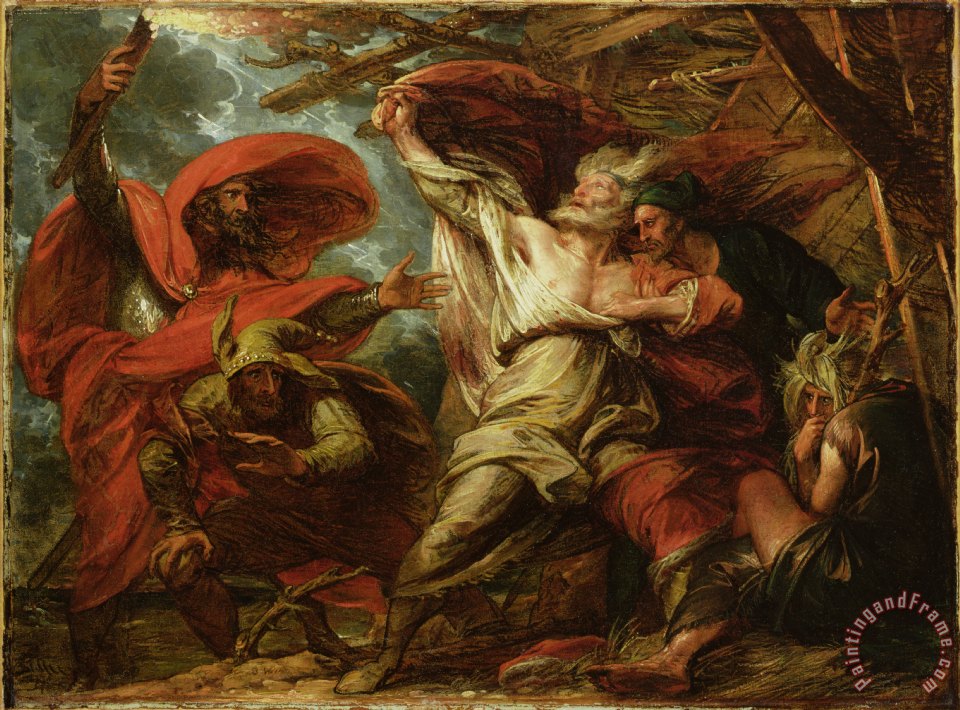
"When thou dost ask me blessing, I’ll kneel down / And ask of thee forgiveness” (5.3.10-11).
Throughout the entire play, this sentence marks the first moment that King Lear is no longer passing judgment, and Lear is seeing life with a clear mind and spirit.
Works Cited
Shakespeare, William. King Lear. The Pelican Shakespeare. Ed. Stephan Orgel and R.R. Braunmuller. Penguin Putnam. New York: 2000
nice story
you might like to read this story I have read yesterday
https://steemit.com/gedwriting/@awriter/the-lost