NASA APOD #99-108
#99 Tomorrow's picture: September 26, 1995
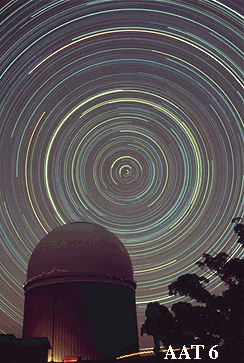
“As the Earth spins on its axis, the sky seems to rotate around us. This motion produces the beautiful concentric arcs traced out by the stars in this time exposure of the night sky. In the foreground of the picture is the dome of the Anglo-Australian Telescope in central New South Wales Australia. In the middle of the picture is the South Celestial Pole, easily identified as the point in the sky at the center of all the star trail arcs."
Copyright: Public domain
#100 Tomorrow's picture: September 27, 1995
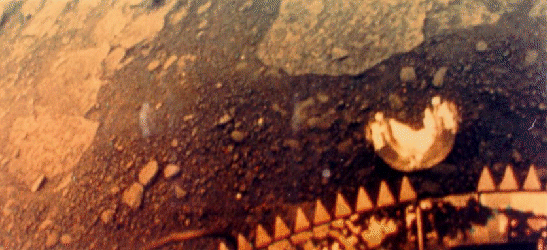
“This image is part of the first color panoramic view from Venus. It was transmitted by a TV camera on the Soviet Venera 13 lander which parachuted to the surface on March 1, 1982. Venus' clouds are composed of sulfuric acid droplets while its surface temperature is about 900 degrees Fahrenheit (482 degrees C) at an atmospheric pressure of 92 times that of sea-level on Earth. Despite these harsh conditions, the Venera 13 lander survived long enough to send back a series of images and perform an analysis of the Venusian soil. Part of the lander itself is visible in the lower right portion of the image. An earlier Soviet Venus lander, Venera 7 (1970), was the first spacecraft to return data from the surface of another planet."
Copyright: Public domain
#101 Tomorrow's picture: September 28, 1995
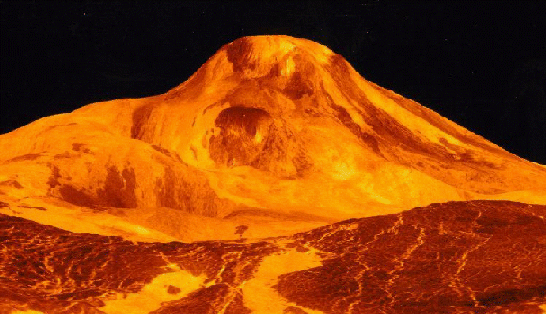
“This computer generated view of a Venusian volcano was created using data from NASA's Magellan spacecraft. Magellan used its onboard radar to map the surface of Venus which is hidden from telescopic observations by a perpetual cloud cover. Using this radar data to provide three dimensional information, a computer was then able to produce this view of Maat Mons, a 5 mile high volcano, from a dramatic perspective. The colors used to render the surface are based on earlier color images transmitted by TV cameras on the Soviet Venera 13 and 14 Venus landers."
Copyright: Public domain
#102 Tomorrow's picture: September 29, 1995

“The International Ultraviolet Explorer (IUE) was launched by a NASA Delta rocket in 1978 to provide a space telescope for ultraviolet astronomy. A collaborative project among NASA, ESA and the British SRC (now PPARC) agencies, IUE's estimated lifetime was 3 to 5 years. Amazingly, 17 years and 8 months later, it continues to operate, having made over 100,000 observations of comets, planets, stars, novae, supernovae, galaxies, and quasars. The IUE story is a truly remarkable but little known success story which will continue. To reduce costs, on September 30, 1995, the IUE team at GSFC will turn over its science operations to the ESA ground station in Villafranca, Spain where the ESA/PPARC teams will continue to make astronomical observations. Congratulations to the GSFC team for outstanding service to astronomy. Good luck to IUE and best wishes for continued success! Tomorrow's picture: An Energetic Radio Galaxy"
Copyright: Public domain
#103 Tomorrow's picture: September 30, 1995
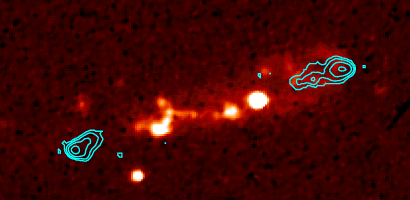
“The radio and optical emission seen in the above superposed images of the radio galaxy 3C368 indicate that energetic processes are at work. A radio galaxy is a galaxy that is visible to radio telescopes. A large radio signal usually indicates very powerful phenomena. The optical light is shown above in red and the radio emission in blue contours. Currently, one can only guess what causes the unusual radio and optical features. Scientists working with the Hubble Space Telescope speculate that the radio emission might have resulted from jets of high-velocity material thrown off from the center of the galaxy, while the optical light comes from gas and dust that are remnants of a burst of star formation triggered by the radio jet."
Copyright: Public domain
#104 Tomorrow's picture: October 01, 1995

“The pictured core of the galaxy NGC 253 shows an exceptionally high rate of star formation. In the center are some of the densest knots of stars ever found, surrounded by glowing gas and dust lanes. Galaxies where such high star formation rates are seen are called "starburst" galaxies. The unusual color is a combination of the light emitted from the young, hot, blue stars and their associated emission and reflection nebulae."
Copyright: Public domain
#105 Tomorrow's picture: October 02, 1995
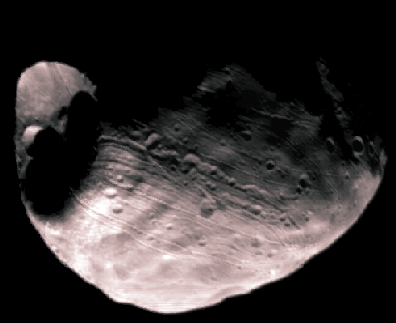
“Mars, the red planet named for the Roman god of war, has two tiny moons, Phobos and Deimos, whose names are derived from the Greek for Fear and Panic. These Martian moons may well be captured asteroids originating in the asteroid belt between Mars and Jupiter or perhaps from even more distant reaches of the Solar System. In this 1977 Viking orbiter image, the largest moon, Phobos, is seen to be a heavily cratered asteroid-like object. It is about 17 miles across and zips through the Martian sky completing an orbit in less than 8 hours. Phobos is doomed. It orbits so close to Mars, (about 3,600 miles above the surface compared to 250,000 miles for our Moon) that gravitational tidal forces are dragging it down. In 100 million years or so it could crash into the surface or be shattered by stress caused by the relentless tidal forces, the debris forming a ring around Mars."
Copyright: Public domain
#106 Tomorrow's picture: October 03, 1995
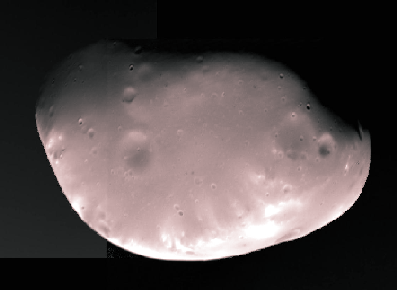
“Mars has two tiny moons, Phobos and Deimos. Pictured above is Deimos, the smallest moon of Mars. In fact, Deimos is the smallest known moon in the Solar System measuring only 9 miles across. The diminutive Martian moons were discovered in 1877 by Asaph Hall, an American astronomer working at the US Naval Observatory in Washington D.C. The existence of two Martian moons was predicted around 1610 by Johannes Kepler, the astronomer who derived the laws of planetary motion. In this case, Kepler's prediction was not based on scientific principles, but his writings and ideas were so influential that the two Martian moons are discussed in works of fiction such as Jonathan Swift's "Gulliver's Travels", written in 1726, over 150 years before their actual discovery."
Copyright: Public domain
#107 Tomorrow's picture: October 04, 1995
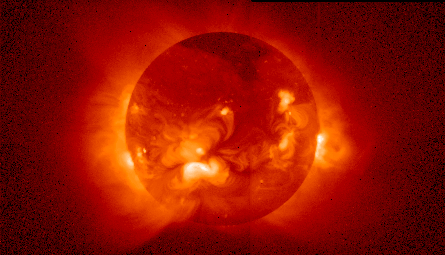
“Our Sun is really very hot. The Sun's outer atmosphere is so hot that it emits much light in the X-ray band, which was unexpected. X-rays are usually emitted from objects having a temperature in the millions of degrees, not the mere thousands of degrees of the Sun's surface. The above X-ray picture shows the Sun one particularly active day in August of 1992. Evident are hot spots on the solar surface, showing that areas above the Sun's surface really do reach millions of degrees. But possibly more puzzling is the broader X-ray glow visible surrounding the Sun. This glow is now attributed to the Sun's X-ray corona, the origin of which is currently a subject of much discussion and debate. The Sun is one of the most photographed objects, with frequently updated pictures available over the WWW. In fact, an X-ray picture from Yohkoh taken earlier today is usually available over the WWW. Compare it to the above picture!"
Copyright: Public domain
#108 Tomorrow's picture: October 05, 1995
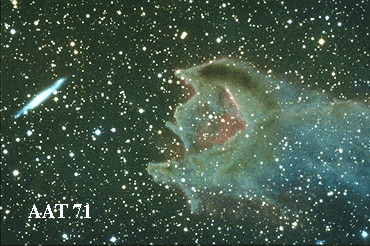
“The odd looking "creature" to the right of center in the above photo is a gas cloud known as a cometary globule. This globule, however, has ruptured. Cometary globules are typically characterized by dusty heads and elongated tails. These features cause cometary globules to have visual similarities to comets, but in reality they are very much different. Cometary globules are frequently the birthplaces of stars, and many show very young stars in their heads. The reason for the rupture in the head of this object is not completely known. The galaxy to the left of center is very far in the distance and is only placed near CG4 by chance superposition."
Copyright: Public domain
Upvote! Resteem! Comment! As you like it! Thank you for attention!