NASA APOD #92-98
#92 The Small Cloud of Magellan September 19, 1995
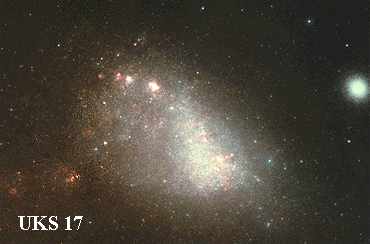
“Almost unknown to casual observers in the northern hemisphere, the southern sky contains two diffuse wonders known as the Magellanic Clouds. The Magellanic Clouds are small irregular galaxies orbiting our own larger Milky Way spiral galaxy. The Small Magellanic Cloud (SMC), pictured here, is about 250,000 light years away and contains a preponderance of young, hot, blue stars indicating it has undergone a recent period of star formation. There is evidence that the SMC is actually two galaxies superposed to appear as one. The bright blob near the right hand edge of the frame is a globular cluster near the outskirts of the Milky Way."
Copyright: Public domain
#93 GL 105C: The Coolest Star? September 20, 1995
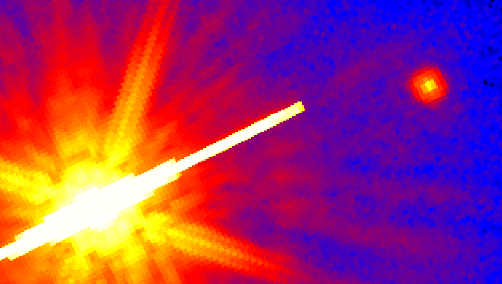
“Is the dim star to the upper right of this false-color picture the coolest possible normal star? From this recent picture by the Hubble Space Telescope, astronomers have estimated its mass is just high enough for it to fuse hydrogen into helium in its core. In general, the higher an object's mass, the higher it's core density and temperature. Above a certain point, the intense core conditions cause hydrogen atoms to move so fast that many stick or "fuse" after collision, releasing enormous amounts of energy. Were this object less massive, the object would shine by gravitational contraction and so be termed a "brown dwarf" rather than a normal main-sequence "star." The star on the left is so much brighter than the "coolest star" that it creates the white streak and dramatic pattern visible in the image. More information is given by the Space Telescope Scientific Institute's press release."
Copyright: Public domain
#94 One Small Step September 21, 1995
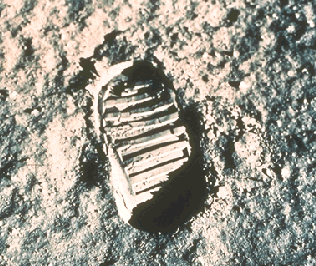
“On July 20th, 1969, a human first set foot on the Moon. Pictured above is the first lunar footprint. The footprint and distinction of the first person to walk on the Moon belong to Neil Armstrong. It has been estimated that one billion people world-wide watched Armstrong's first step - making the live transmission from a camera mounted on the lunar lander the highest rated television show ever. Upon setting foot on the moon, Armstrong said: "That's one small step for (a) man, one giant leap for mankind." The Apollo missions to the Moon have been described as the result of the greatest technological mobilization the world has known."
Copyright: Public domain
#95 Tomorrow's picture: September 22, 1995
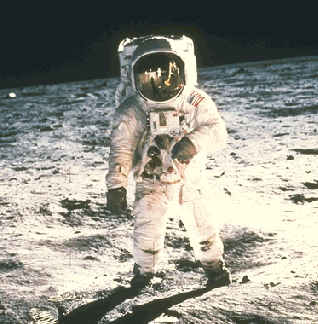
“Pictured, the second person to walk on the Moon: Edwin "Buzz" Aldrin. During this Apollo 11 mission, Neil Armstrong and Buzz Aldrin landed on the Moon while Michael Collins circled in the Command Module above. The lunar team erected a plaque on the surface that reads: HERE MEN FROM THE PLANET EARTH, FIRST SET FOOT UPON THE MOON JULY 1969 A.D., WE CAME IN PEACE FOR ALL MANKIND. The Apollo missions demonstrated that it is possible to land humans on the Moon and return them safely."
Copyright: Public domain
#96 Tomorrow's picture: September 23, 1995
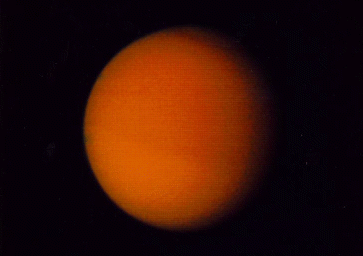
“The largest moon of Saturn is a rare wonder. Titan is the only one of Saturn's moons with an atmosphere, and one of only two moons in the Solar System with this distinction (Neptune's Triton is the other). Titan's thick cloudy atmosphere is mostly nitrogen, like Earth's, but contains much higher percentages of "smog-like" chemicals such as methane and ethane. The smog may be so thick that it actually rains "gasoline-like" liquids. The organic nature of some of the chemicals found in Titan's atmosphere cause some to speculate that Titan may harbor life! Because of its thick cloud cover, however, Titan's actual surface properties remain mysterious. Voyager 1 flew by in 1980 taking the above picture, and recently much has been learned from Hubble Space Telescope observations. The Cassini mission currently scheduled for launch in 1997 will map Titan's surface, helping to solve some of its mysteries."
Copyright: Public domain
#97 Tomorrow's picture: September 24, 1995
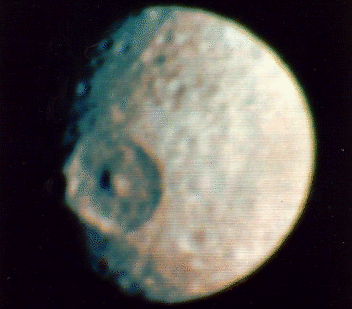
“Mimas is one of the smaller moons of Saturn but shows one of the largest impact craters! In fact, if the impact had been much greater, it would have disrupted the entire satellite. The large crater has been named Herschel after the 1789 discoverer of Mimas, Sir William Herschel. Mimas' low mass produces a surface gravity just strong enough to create a spherical body but weak enough to allow such relatively large surface features. Mimas is made of mostly water ice with a smattering of rock - so it is accurately described as a big dirty snowball. Voyager 1 flew by in 1980 and took the above picture."
Copyright: Public domain
#98 Tomorrow's picture: September 25, 1995
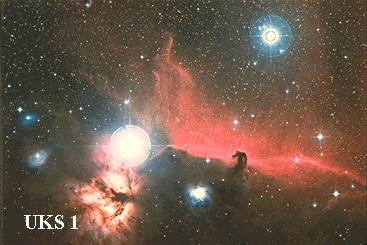
“The black indentation to the red emission nebula seen just to the right of center of the above photograph is one of the most famous features in any nebulae on the sky. Because of its shape, it is known as the Horsehead Nebula. The bright star near the center is located in the belt of the familiar constellation of Orion. The horse head feature is dark because it is really a dense dust cloud which lies in front of the bright nebula and blocks the light. Like clouds in our sky, this cosmic cloud has chanced to assume a recognizable shape. After thousands of years, the internal motions of the cloud will alter its appearance. The emission nebula's red color is caused by electrons recombining with protons to form hydrogen atoms. Also visible in the picture are blue reflection nebulae. This type of nebula contains dust which preferentially reflects the blue light of nearby stars."
Copyright: Public domain
Upvote! Resteem! Comment! As you like it! Thank you for attention!