NASA APOD #84-91
#84 Proplyds: Infant Solar Systems September 11, 1995
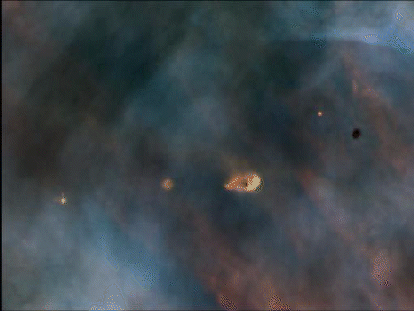
“The fuzzy blobs seen above may be some of the first ever images of entire solar systems forming right before our eyes. This close up of the Orion Nebulae taken by the Hubble Space Telescope shows only a few stars, but these stars are surrounded by proto-planetary disks known as "proplyds." As the stars have only just recently formed - in the past few million years - the disks around them are likely condensing to form planetary systems and may be similar to the disk that formed our own solar system 5 billion years ago. These HST results suggest that stars with planets may be relatively common place. Are there extra-terrestrial civilizations out there as well?"
Copyright: Public domain
#85 Spiral Galaxy M83 September 12, 1995
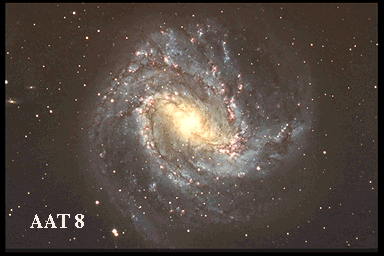
“Long winding spiral arms are clearly evident on this spectacular picture of the spiral galaxy M83. The blue color of the spiral arms is caused by the relatively large fraction of young blue stars there. Dark dust lanes are mixed in with the stars and trace the spiral structure of the galaxy. This galaxy contains many billions of stars, and its light took many millions of years to reach us. Our own Milky Way Galaxy would appear similar to this if viewed from M83! This picture is number eight on a publicly posted list of images from the Anglo-Australian Telescope (AAT)."
Copyright: Public domain
#86 Elliptical Galaxy M87 September 13, 1995
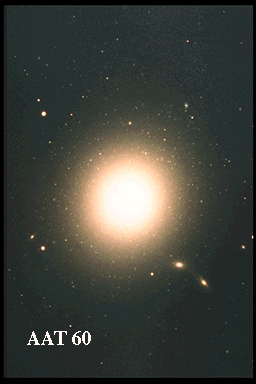
“cal galaxy M87 is a type of galaxy that looks much different than our own Milky Way Galaxy. But even for an elliptical galaxy M87 is peculiar. M87 is much bigger than an average galaxy, appears at the center of a whole cluster of galaxies known as the Virgo Cluster, and shows a very high number of globular clusters. These globular clusters are visible as faint spots surrounding the bright center of M87. In general, elliptical galaxies contain similar numbers of stars as spiral galaxies, but are ellipsoidal in shape (spirals are mostly flat), have no spiral structure, and little gas and dust. This picture is number sixty on a publicly posted list of images from the Anglo-Australian Telescope (AAT)."
Copyright: Public domain
#87 The Far Side September 14, 1995
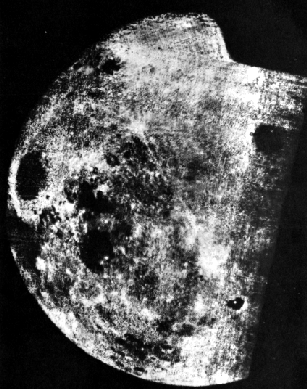
“This historic picture was humanity's first glimpse of the far side of the Moon. It was taken by the Soviet spacecraft Luna 3 in October of 1959. Luna 3 followed closely on the heels of another Soviet probe, Luna 2, which had become the first spacecraft to impact the Moon on September 13th of that same year. Why does the Moon have a far side? Gravitational tidal forces within the Earth-Moon system have synchronized the Moon's period of rotation around its axis with its orbital period at about 28 days. So, as the Moon moves around its orbit its rotation exactly compensates, keeping the same face toward the Earth."
Copyright: Public domain
#88 Space Station Mir Over Earth September 15, 1995
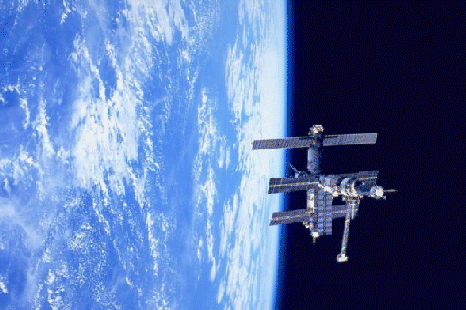
“This picture of the Russian space station Mir over the Pacific Ocean was recorded by the Space Shuttle Discovery in February 1995. During this mission Discovery performed a rendezvous and "fly around" with Mir in preparation for a future docking mission. Many scientific experiments and astronomical observations were completed jointly by the American astronauts and the Russian cosmonauts. An IMAX camera took many pictures of this historic encounter. Some cosmonauts have spent more than a year on board Mir, the longest anyone has ever lived in space. Work on an International Space Station is in progress."
Copyright: Public domain
#89 Rockets and Robert Goddard September 16, 1995
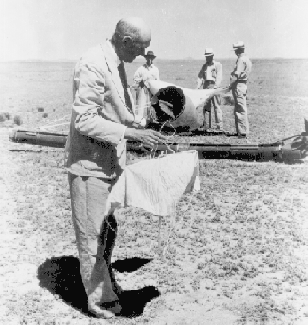
“Robert H. Goddard, one of the founding fathers of modern rocketry, was born in Worcester Massachusetts in 1882. As a 16 year old, Goddard read H.G. Wells' science fiction classic "War Of The Worlds" and dreamed of spaceflight. By 1926 he had designed, built, and launched the world's first liquid fuel rocket. During his career he was ridiculed by the press for suggesting that rockets could be flown to the Moon, but he kept up his experiments in rocketry supported in part by the Smithsonian Institution and championed by Charles Lindbergh. Pictured above in 1937 in the desert near Roswell New Mexico, Goddard examines a nose cone and parachute from one of his test rockets. Widely recognized as a gifted experimenter and engineering genius, his rockets were many years ahead of their time. He died in 1945 holding over 200 patents in rocket technology. A liquid fuel rocket constructed on principles developed by Goddard landed humans on the Moon in 1969."
Copyright: Public domain
#90 Thousands of Coma Cluster Galaxies September 17, 1995
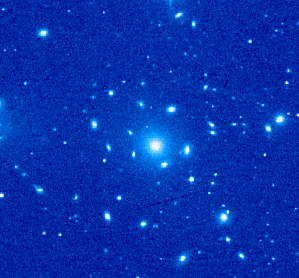
“Almost every object in the above photograph is a galaxy. The Coma Cluster of galaxies pictured is a dense cluster containing many thousands of galaxies. Many of these galaxies contain as many stars as our own Milky Way Galaxy. Although nearby when compared to most other clusters, light from the Coma Cluster still takes hundreds of millions of years to reach us. In fact, the Coma Cluster is so big it takes light millions of years just to go from one side to the other! This picture was created at the WWW site Skyview, a "virtual observatory" where it is possible to view any part of the sky in wavelengths from radio to gamma-ray."
Copyright: Public domain
#91 The Large Cloud of Magellan September 18, 1995
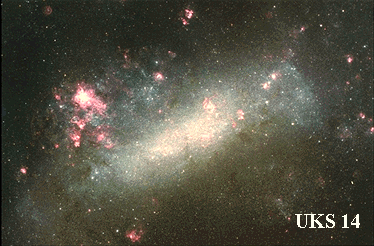
“Magellan and his crew had plenty of time to study the southern sky during their famous voyage around the world. As a result, two fuzzy cloud like objects, nestled among the southern constellations of Doradus and Tucana are now known as the Clouds of Magellan. The Magellanic Clouds are small irregular galaxies, satellites of our larger Milky Way spiral galaxy. The Large Magellanic Cloud (LMC) pictured above is the closest galaxy to our own Milky Way, at a distance of about 180,000 light years. The Magellanic Clouds are joined to the Milky Way by a stream of cold hydrogen gas whose origin is still controversial. An unusual effect called gravitational lensing has recently been detected in a few LMC stars, and there is hope this could tell us important information about the true composition of our universe."
Copyright: Public domain
Upvote! Resteem! Comment! As you like it! Thank you for attention!