NASA APOD #77-83
#77 Ganymede: Moonquake World September 04, 1995
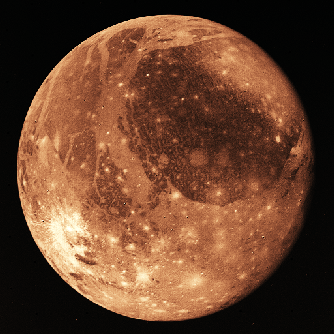
“Ganymede probably undergoes frequent ground shaking events not unlike terrestrial earthquakes. Ganymede, the largest moon of Jupiter and the Solar System, has a thick outer coating of water ice. Passing Voyager spacecraft found a large number of cracks and grooves in the ice so it is thought that Ganymede, like the Earth, has large shifting surface masses called tectonic plates. Ganymede was discovered by Galileo and Marius in 1610, and is larger than the planets Mercury and Pluto. The NASA spacecraft Galileo is scheduled to arrive at Jupiter is December of 1995."
Copyright: Public domain
#78 Europa: Ancient Water World September 05, 1995
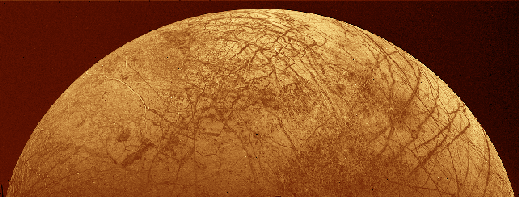
“Beneath the cold icy surface of Jupiter's moon Europa are probably the only oceans of water in our Solar System outside of Earth. These oceans, possibly 50 kilometers deep, might also be the most likely local place to find extra-terrestrial life. Europa's smooth surface is unlike any other known planet or moon, giving evidence for relatively few craters or mountains. Europa was discovered by Galileo and Marius in 1610. The NASA spacecraft Galileo is scheduled to arrive at Jupiter in December of 1995."
Copyright: Public domain
#79 Callisto: Dark Smashed Iceball September 06, 1995
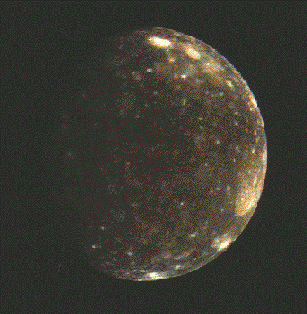
“Callisto is a dirty battered world, showing the most beaten surface of Jupiter's major moons. Made of a rocky core covered by fractured ice, Callisto's past collisions with large meteors are evident as large craters surrounded by concentric rings. The four largest moons of Jupiter: Io, Europa, Ganymede, and Callisto were all discovered by Galileo and Marius in 1610 with early telescopes and are now known as the Galilean satellites. The NASA spacecraft Galileo is scheduled to arrive at Jupiter is December of 1995."
Copyright: Public domain
#80 Distant Galaxies September 07, 1995
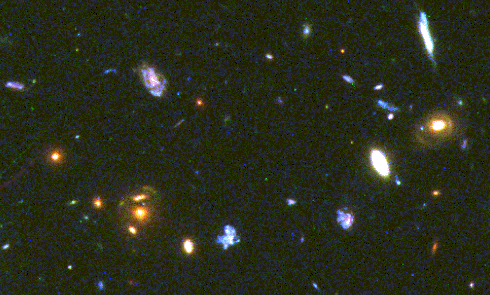
“This Hubble Space Telescope image of a group of faint galaxies "far, far away" is a snap shot of the Universe when it was young. The bluish, irregularly shaped galaxies revealed in the image are up to eight billion light years away and seem to have commonly undergone galaxy collisions and bursts of star formation. Studying these objects is difficult because they are so faint, however they may provide clues to how our own Milky Way Galaxy formed."
Copyright: Public domain
#81 The Milky Way's Center September 08, 1995
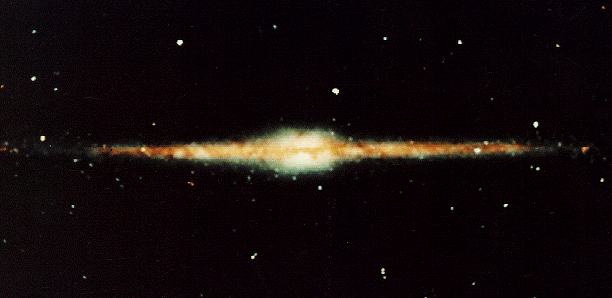
“September 8, 1995 The Milky Way's Center Credit: NASA, COsmic Background Explorer (COBE) Project Explanation: NASA's COBE satellite scanned the heavens at infrared wavelengths in 1990 and produced this premier view of the central region of our own Milky Way Galaxy. The Milky Way is a typical spiral galaxy with a central bulge and extended disk of stars. However, gas and dust within the disk obscure visible wavelengths of light effectively preventing clear observations of the center. Since infrared wavelengths, are less affected by the obscuring material, the Diffuse InfraRed Background Experiment (DIRBE) on board COBE was able to detected infrared light from stars surrounding the galactic center and produce this image. Of course, the edge on perspective represents the view from the vicinity of our Sun, a star located in the disk about 30,000 light years out from the center. The DIRBE experiment used equipment cooled by a tub of liquid helium to detect the infrared light which, composed of wavelengths longer than red light, is invisible to the human eye."
Copyright: Public domain
#82 The Last Moon Shot September 09, 1995
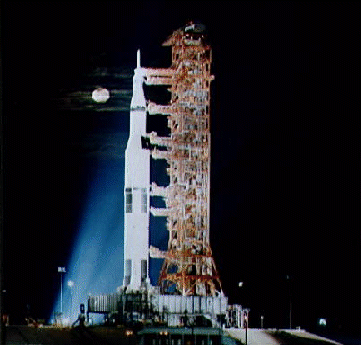
“September 9, 1995 The Last Moon Shot Credit: NASA, The Apollo Program Explanation: In 1865 Jules Verne predicted the invention of a space capsule that could carry people. In his science fiction story "From the Earth to the Moon", he outlined his vision of constructing a cannon in Florida so powerful that it could shoot a "Projectile-Vehicle" carrying three adventurers to the Moon. Over 100 years later, NASA, guided by Wernher Von Braun's vision, produced the Saturn V rocket. This rocket turned Verne's fiction into fact, launching 9 Apollo Lunar missions and allowing 12 astronauts to walk on the Moon. Pictured above is the last moon shot, Apollo 17, awaiting a night launch in December of 1972. Spot lights play on the rocket and launch pad while the full Moon looms in the background. Humans have not walked on the lunar surface since. Should we return to the Moon?"
Copyright: Public domain
#83 White Dwarfs Cool September 10, 1995
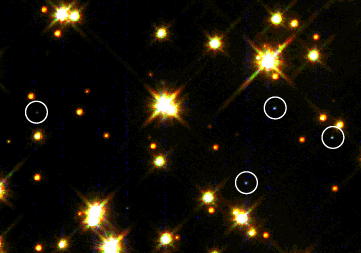
“The circled stars in the above picture are from a class that is hard to see in the cosmos: white dwarfs. The entire photo covers a small region near the center of a globular cluster known as M4. Researchers using the Hubble Space Telescope discovered a large concentration of white dwarfs in M4. This was expected - low mass stars, including the Sun, are known to evolved to the white dwarf stage. White dwarfs do not usually evolve further, they just gradually cool down from their high temperatures. It is hoped that studying how these stars cool could lead to a better understanding of their ages, of the age of their parent globular cluster, and hopefully even the age of our universe!"
Copyright: Public domain
Upvote! Resteem! Comment! As you like it! Thank you for attention!