NASA APOD #67-76
#67 A World Explorer August 25, 1995
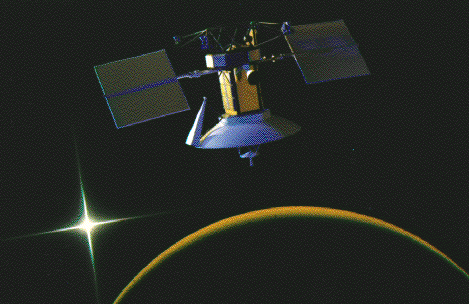
“August 25, 1995 A World Explorer Credit: NASA, JPL Magellan Project Explanation: Ferdinand Magellan was a world explorer. Many consider him the greatest navigator of Europe's 16th century age of sea going exploration and credit his expedition with the first circumnavigation of planet Earth. NASA's Venus probe, the aptly named Magellan spacecraft shown above in an artist's conception, provided a global view of the poorly known surface of Venus - just as Magellan's expedition provided the beginnings of a global perspective of the Earth. Ferdinand Magellan's expedition of 5 ships and 265 men left Spain in 1519 in search of a western route to the Spice Islands of Indonesia. In 1522 one ship and 17 men returned. NASA launched the Magellan probe on May 4, 1989. Placed in a polar orbit, Magellan's many circumnavigations resulted in a detailed radar mapping of 98% of the Venusian surface. As pictured, the radar mapper's antenna resembles a large inverted bowl. Power for the radar was produced by the wing like solar panels. In October of 1994, the Magellan probe entered the Venusian atmosphere and ground controllers lost contact with the spacecraft."
Copyright: Public domain
#68 Two Tails of Comet West August 26, 1995
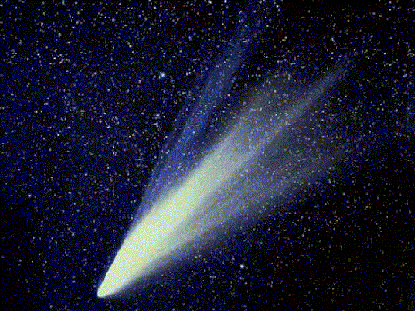
“August 26, 1995 Two Tails of Comet West Credit: Observatoire de Haute, Provence, France Explanation: Here Comet West is seen showing two enormous tails that wrap around the sky. The ion tale of a comet usually appears more blue and always points away from the Sun. The dust tail trailing the comet's nucleus is the most prominent. Comet West was a visually spectacular comet, reaching its most picturesque in March of 1976. A comet this bright occurs only about once a decade. Comets are really just large dirty snowballs that shed material when they reach the inner solar-system. Many astronomers are hopeful that Comet Hale-Bopp will look as spectacular as this in the spring of 1997."
Copyright: Public domain
#69 Gamma Ray Bursts from the Unknown August 27, 1995
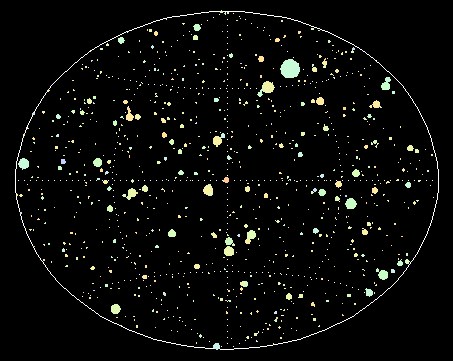
“August 27, 1995 Gamma Ray Bursts from the Unknown Credit: NASA, Compton Gamma Ray Observatory, BATSE Explanation: Gamma Ray Bursts (GRBs) pose one of the greatest mysteries of modern astronomy. About once a day, the gamma-ray sky lights up with a spectacular explosion. No one knows what causes these explosions or even how far away they are. The above map represents the entire sky in coordinates centered on our Galaxy, the Milky Way. It shows the positions of over 800 of these mysterious bursts of energy detected by the BATSE instrument on board NASA's Compton Gamma Ray Observatory. Before BATSE, most astronomers thought that most GRBs occurred in the disk of our Galaxy, but the above sky map shows little sign of this. The distance scale of GRBs was the topic of a historic debate in April 1995. The positions in the above map are currently being studied in great detail in an effort to uncover a clue about the nature of GRBs. In the above 3B map created by Robert Nemiroff, spot size is proportional to peak flux and spot color is indicative of hardness. Click here for a postscript version of BATSE's latest map of 1122 GRB locations (3B Catalog)."
Copyright: Public domain
#70 Dusty Galaxy Centaurus A August 28, 1995
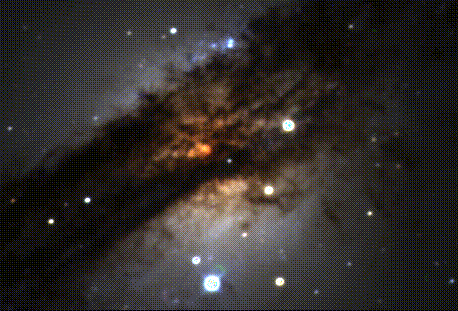
“August 28, 1995 Dusty Galaxy Centaurus A Credit: NOAO, Cerro Tololo Interamerican Observatory Explanation: One of the most unusual galaxies known, Centaurus A, is pictured above. Cen A is marked by dramatic dust lanes that run across the galaxy's center. These dust lanes are so thick they almost completely obscure the galaxy's center in visible light. Our Milky Way Galaxy contains dust, but not in the same proportion. Cen A is also unusual compared to a normal galaxy because it contains a higher proportion of young blue stars, is a very strong source of radio emission, and has a unique structure. Cen A is thought to be the result of the collision of two normal galaxies."
Copyright: Public domain
#71 Saturn V: NASA's Largest Rocket August 29, 1995
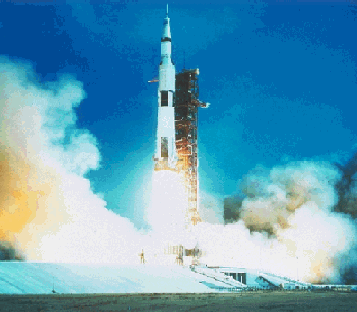
“August 29, 1995 Saturn V: NASA's Largest Rocket Credit: NASA, Kennedy Space Center, Explanation: Pictured, a NASA Saturn V rocket blasts off on July 16th, 1969 carrying the crew of Apollo 11 to the Moon. The Saturn V rocket was the largest rocket ever used by NASA, and the only one able to lift the large masses needed to land astronauts on the moon and returning them safely. Saturn V rockets launched all of the Apollo moon missions, and several to Earth orbit as well."
Copyright: Public domain
#72 Skylab Over Earth August 30, 1995
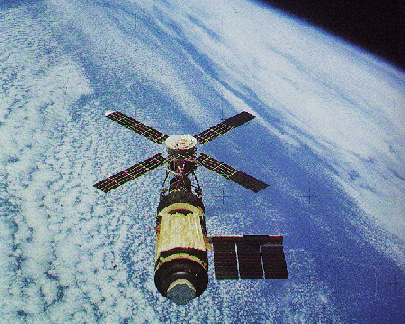
“August 30, 1995 Skylab Over Earth Credit: NASA, Skylab, HEASARC, Jesse Allen Explanation: Skylab was an orbiting laboratory launched by a Saturn V rocket in May 1973. Skylab was visited three times by NASA astronauts who sometimes stayed as long as two and a half months. Many scientific tests were preformed on Skylab, including astronomical observations in ultraviolet and X-ray light. Some of these observations yielded valuable information about Comet Kohoutek, our Sun and about the mysterious X-ray background - radiation that comes from all over the sky. Skylab fell back to earth on 11 July 1979."
Copyright: Public domain
#73 X-Raying the Moon August 31, 1995
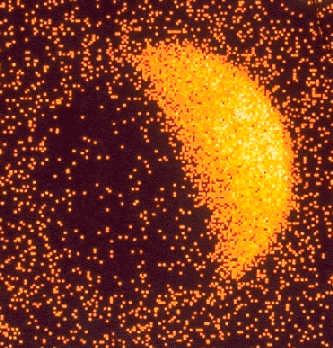
“August 31, 1995 X-Raying the Moon Credit: DARA, ESA, NASA, Max Planck Institut, J.H.M.M. Schmitt Explanation: Above is a picture of the Moon taken in X-rays by the Roentgen Observatory Satellite ROSAT in 1990. This famous picture shows three distinct regions: a bright X-ray sky, a bright part of the Moon, and a relatively dark part of the Moon. The bright X-ray region is exemplary of the mysterious X-ray background that is seen everywhere on the sky. The bright lunar crescent shines because it reflects X-rays emitted by the Sun. The dark lunar face is surprising because it is not completely dark, and its slight emission is thought to result from energetic particles from the solar wind striking the Moon."
Copyright: Public domain
#74 Subrahmanyan Chandrasekhar 1910-1995 September 01, 1995

“On August 21, 1995 one of the greatest astrophysicists of modern times passed away. Subrahmanyan Chandrasekhar was a creative, prolific genius whose ability to combine mathematical precision with physical insight changed humanity's view of stellar physics. His most famous discovery was that not all stars end up as white dwarf stars, but those retaining mass above a certain limit - today known as "Chandrasekhar's limit," undergo further collapse. His detailed mathematical papers and books on a wide variety of astrophysical subjects, including, for example, black holes, are classic references for research at every level. Obituaries are available from the University of Chicago Press and Reuters News Service, and a WWW page has been set-up to record personal memories."
Copyright: Public domain
#75 Hot Gas and Dark Matter September 02, 1995
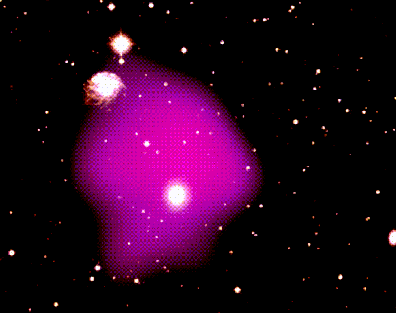
“Is the gravity of the above galaxies high enough to contain the glowing hot gas? Superposed on an optical picture of a group of galaxies is an image taken in X-ray light. The X-ray picture, taken by ROSAT, shows confined hot gas highlighted in false red color, and provides clear evidence that the gravity exerted in groups and clusters of galaxies exceeds all the individual component galaxies combined. The extra gravity is attributed to dark matter, the nature and abundance of which is the biggest mystery in astronomy today."
Copyright: Public domain
#76 Earth's Moon, A Familiar Face September 03, 1995
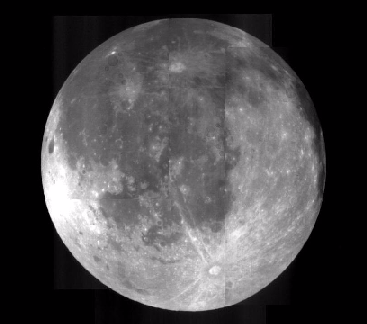
“The above mosaic of the Earth's Moon was compiled from photos taken by the spacecraft Clementine in 1994. This image represents the side of the Moon familiar to Earth dwellers. The Moon revolves around the Earth about once every 28 days. Since its rate of rotation about its axis is also once in 28 days, it always keeps the same face toward the Earth. As the Moon travels around its orbit, the Earth based view of the half of the Moon that faces the Sun changes causing the regular monthly progression of Lunar phases. Humans first crashed a spacecraft into the Moon in 1959, but the first humans to reach the Moon landed in 1969. There are now golf balls on the Moon."
Copyright: Public domain
Upvote! Resteem! Comment! As you like it! Thank you for attention!
Dear readers of my blog!!!! We done only 0.0097% of whole trip! Let's take a patience! Let's enjoy a trip! Actually we are going throug time and space!!!
Congratulations @george-zagraid! You have completed some achievement on Steemit and have been rewarded with new badge(s) :
Click on any badge to view your own Board of Honor on SteemitBoard.
For more information about SteemitBoard, click here
If you no longer want to receive notifications, reply to this comment with the word
STOP