Weighing a Kilogram—the Hard Way
The definition of a kilogram has changed. It is no longer defined by a physical object. So how do you weigh a kilogram?
The Planck constant
In a piece posted yesterday, The Kilogram has Changed!, I wrote about how the definition of a kilogram had changed from the mass of a single lump of metal in Paris to a universal constant derived from Planck's constant. I won't pretend I understand anything about this since it forms the foundation of quantum mechanics.
I won't quibble with Nobel prize winner Richard Feynman when he said, “If you think you understand quantum mechanics, you don't understand quantum mechanics.” He also said, “I think I can safely say that nobody understands quantum mechanics."
Planck's constant values are expressed in terms of the basic energy particles which make up the universe.
Global research over the last number of years has produced the now standard value of h, Planck's constant:
6.626070150 × 10⁻³⁴ kg⋅m2/s
The only thing that gives me heart about all this is the there's a kg in the equation.

Scales and balances
We're all familiar with using a scale to measure things. You put some stuff on the one side of the scale and some known weight on the other, and et voilà !, you know how much your stuff weighs. But how do you put the Planck constant on one side of the scale?
Interestingly, a “scale” is used to make this measurement, except that instead of two weights on either side, one side has an electromagnetic force. It's an instrument called the Kibble balance, formerly the watt balance—after the inventor Dr Bryan Kibble's death in 2016.
The Kibble balance
At its simplest, the Kibble balance can be thought of like an electromagnet such as found in scrapyards.
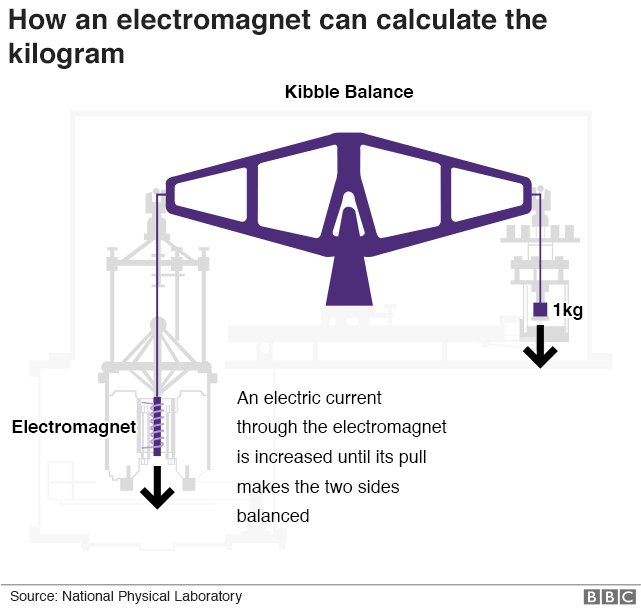
The pull of the electromagnet, the force it exerts, is directly related to the amount of electrical current going through its coils. There is, therefore, a direct relationship between electricity and weight.
So, in principle, scientists can define a kilogram, or any other weight, in terms of the amount of electricity needed to counteract the weight (gravitational force acting on a mass).
The problem is that extremely fine measurements—at the quantum level—have to be taken. The strength of the magnetic force and the strength of the current flowing have to be precisely determined. To make matters more difficult, there is a level of uncertainty at the quantum level that has to be taken into account. This is where the measurement of the Planck constant comes into it; the equation of h given above has an uncertainty of only 9.1 parts per billion.
Kibble balances were in fact used to measure the Planck constant. Another method to measure Planck's constant was obtained from measurements of the Avogadro constant.

The NIST-4 Kibble balance, which began full operation in early 2015, measured Planck's constant to within 13 parts per billion in 2017
“For all times, for all people”
The new standard has effectively democratised weights and measures. Until now governments have been the custodians of the standard measures. The current requirement for weights and scales to be calibrated at the national standards institutes will fall away.
Although Kibble balances are large, complex devices, anyone with the means could build one. Any mass could be measured on the balance—the absolute mass based on the Planck constant. And in future, like everything else, they will be miniaturised and become less expensive.
This short video has explanatory animations of how a Kibble balance works:
References:
NPL: The Kibble balance
NIST: Kilogram: Mass and Planck's Constant
SCIENCING: How to Use Planck's Constant
Vox: The world just redefined the kilogram
Also posted on Weku, @tim-beck, 2018-11-27