The Kilogram has Changed!
The kilogram as we know it, has been around for more than 130 years. What's happened to it?

The one true kilogram in the world
A lump of metal
One of the best scientific quotes ever, from Stephan Schlamminger, a physicist at the US National Institute of Standards and Technology:
If aliens ever visit Earth what else would we talk about other than physics? If we want to talk about physics we have to agree on a set of units, but if we say our unit of mass is based on a lump of metal we keep in Paris, we’ll be the laughing stock of the universe.
Yes, folks, the kilogram is currently defined by the weight of a platinum-based ingot called “Le Grand K” which is locked away in a safe in Paris.
International trade was ramping up in the mid-18th century. A measure of something in one country had to pretty-much match it to an equivalent measure in another. So it no longer made sense to use localised units, such as the local duke's shoe size as a unit of measure.
So in the late 1700s, King Louis XVI of France commissioned scientists to find a more sensible approach.
The group looked to the natural world to find global units, “for all times, for all people”. A metre was defined as one 10-millionth of the distance from the north pole to the equator. The kilogram was the mass of a litre of water. Each was enshrined in a physical object, a metal bar for the metre, and a metal cylinder for the kilogram.
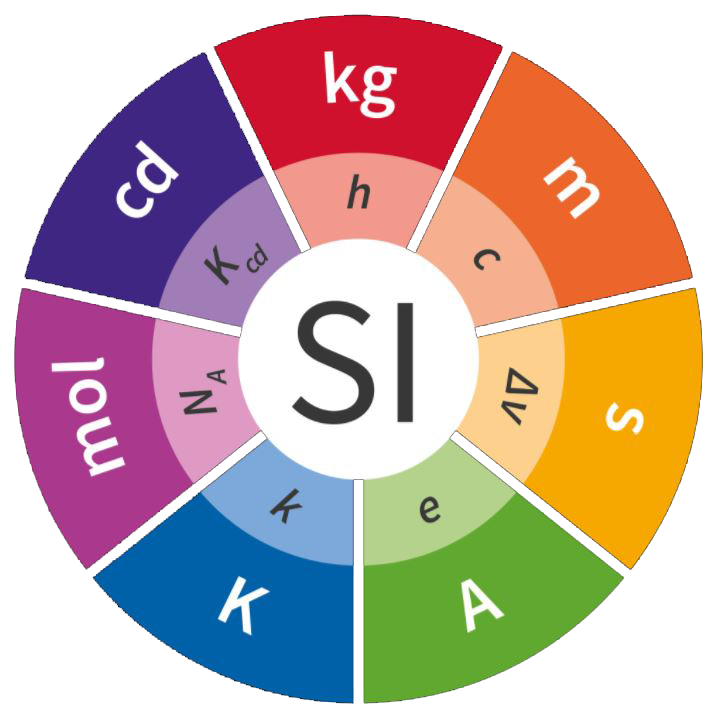
Over the years, this was expanded into the International System of Units with its seven base units: the metre for distance, the second for time, the kilogram for mass, the mole for amount of substance, the ampere for electrical current, the Kelvin for temperature, and the candela for luminosity.
For the past 129 years, the world’s official unit of mass has been the IPK, the international prototype kilogram, a cylinder of platinum-iridium stored under three sealed bell jars at the International Bureau of Weights and Measures (BIPM) in Sèvres, near Paris. National metrology labs hold copies of the IPK. Every 40 years or so, they are returned to Paris for checks against the IPK, nicknamed Le Grand K.
The system has a built-in check. There is a single standard that is always 100% accurate—the lump of metal in Paris. Its weight might go up and down as it picks up pollutants and is cleaned, but it nevertheless is, by definition a mass of 1 kilogram. The copies are adjusted to exactly match the IPK.
Time for change
The modern scientific age has required a revision of these standards. The properties of physical objects change depending on the environment. For instance, an increase in temperature would increase the length of the metre bar. It should be possible to measure a metre anywhere in the universe without reference to some physical object on Earth.
In 1983, the metre was defined as the length of the path travelled by light in a vacuum in 1/299 792 458 seconds.
During the Middle Ages the second was defined as 1⁄86400 of a day, or the unit of time division of the day first into 24 hours, then to 60 minutes and finally to 60 seconds each. With the obvious shortcomings of that method, by the late 1940s, it was being measured vastly more accurately by quartz crystal oscillator clocks. Since 1967 1 second is defined to be exactly “the duration of 9,192,631,770 periods of the radiation corresponding to the transition between the two hyperfine levels of the ground state of the caesium-133 atom”—at a temperature of 0 K. Without that definition, GPS would be impossible.
image
New definitions
On Friday, 16 November 2018, 60 countries voted to redefine the International System of Units (SI) for weight, current, temperature and amount of chemical substance. The definition of a kilogram will be replaced by the Planck constant—the fundamental constant of quantum physics. It effectively defines the kilogram in terms of the second and metre.
The new definitions impact four of the seven base units of the SI: the kilogram, ampere, kelvin and mole; and all units derived from them, such as the volt, ohm and joule.
They come into effect on 20 May 2019.
Saving face
This will redeem mankind. No longer will we have to, red-faced, explain to a visiting alien what a kilogram is. Now we'll confidently be able to say, “Ah, you know the Planck constant: exactly 6.62607015×10⁻³⁴ kg⋅m2⋅s−1”.
References:
Wired: Kilogram Redefined. The Metric System Overhaul Is Complete
Economic Times: Definition of kilogram changed after 130 years
BBC: Kilogram gets a new definition
Wikipedia.org: Kilogram, Metre, Second
Also posted on Weku, @tim-beck, 2018-11-25