🔬 Is stinginess hereditary?
Hello Steemians,
Today I will talk about the COMT gene, a gene that has been linked with the lack of generosity, or stinginess if you like, and has been dubbed the "mean gene" (1).
The inspiration came from a magazine I was reading the other day; it intrigued me so much, that I decided to look it up on the internet. Perhaps you'll find the subject interesting too.
As we all know, genes are something like our genetic identity; we were handed them down from our parents, and we will pass them on to our lucky (or not so lucky) offsprings.

One such gene, the COMT gene, provides instructions for (makes) an enzyme with a rather long name, i.e. catechol-O-methyltransferase. This enzyme inactivates (breaks down) catecholamines (such as neurotransmitters dopamine, epinephrine, and norepinephrine), catechol estrogens, and other substances having a similar (catechol) structure (2).
These neurotransmitters are vital for an area of the brain called the prefrontal cortex; a part of the human brain that organizes and coordinates information from other parts of the brain. The prefrontal cortex has also been long associated with various personality traits, inhibition of behaviors and emotions (3).

It follows then that since catechol-O-methyltransferase regulates the levels of the neurotransmitters dopamine, epinephrine, and norepinephrine, and these very same neurotransmitters are so important for the proper function of the prefrontal cortex, that any mutation in the COMT gene, affecting its enzyme production, will have an impact on the function of the prefrontal cortex. Something like a chain reaction, if you like.
Apparently, there are two variants of the gene; the "G" and "A" variants. German scientists recruited 101 volunteers (young men and women), and tested them for the COMT gene. Then they told them to play a gambling game on the computer; and finally, they asked the volunteers to donate their winnings to a poor child named Lina.
There was no correlation found between winnings and the two variants; there was, however, a correlation found between donations and the two variants; more than 20% of the people with the "G" variant gave all their winnings to Lina, whereas the percentage of those with the "A" variant giving all their winnings to the poor girl was less than 2%.
To put it another way, it seemed that the "G" variant was the "generous gene", whereas the "A" variant was the "mean gene", the stingy one.
It is my personal belief therefore, that stinginess as a personality trait resides somewhere in the prefrontal cortex, and that mutations in the COMT gene have a strong effect on that area of the cortex.
Could we blame stinginess on our genes then? Or does environment play a role too?
I believe that environment plays the most significant role on generocity/stinginess (judging from my own personal experience). I live in Greece now, a country that for the last 5 years or so has been facing austerity. People are very cautious about spending money, because they don't know what the future holds for them. You can't be too generous today, if you don't know whether you'll still have a job tomorrow, or if you do have a job tomorrow, whether your employer will reduce your salary, or your bills will go up.
I have also spoken to people that work as waiters, or in other roles that normally get a tip; and they have confirmed to me that Greek people have become less generous over the last years, to put it nicely. Sounds logical, doesn't it?
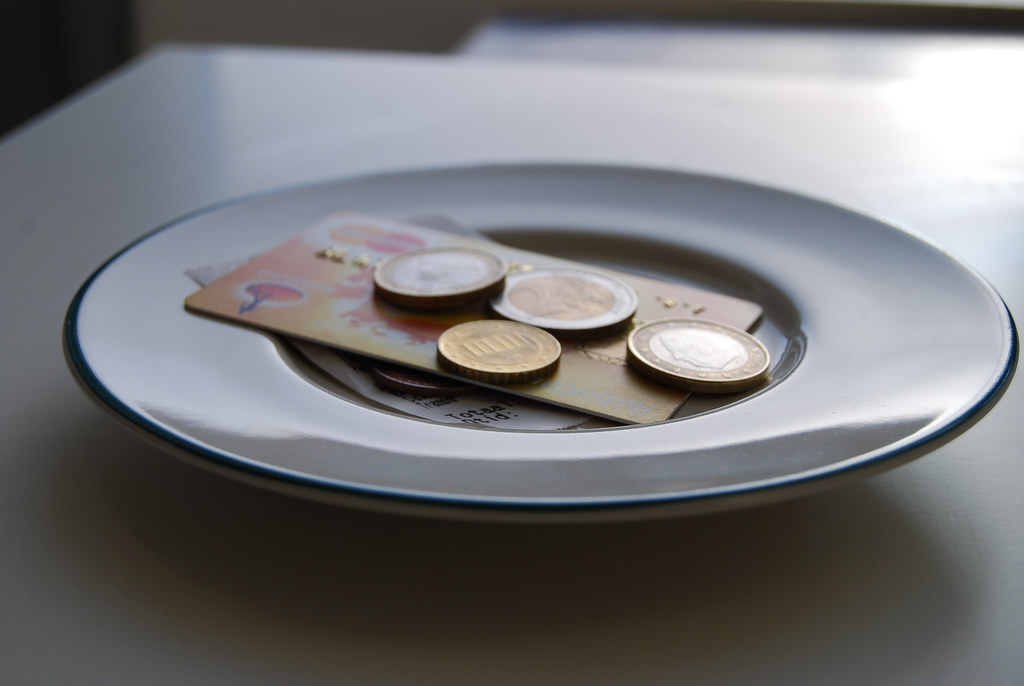
There may be a genetic predisposition, but environment probably carries more weight; the way one was brought up, the life he had, and what's happening around him now.
Personally, I think I am somewhere in the middle of the human range of generocity; I will tip reasonably, and I will also give money to the poor that absolutely need it. Do I have the "A" variant, the "G" variant, or am I a victim of my environment? Who knows.
What do you think? Is it the genes, the environment, both of them, or something else, that makes us Scrooge-like?
Text references:
1.http://www.dailymail.co.uk/sciencetech/article-1326463/The-mean-gene-The-DNA-strand-makes-people-stingy-cash.html
2.https://en.wikipedia.org/wiki/Catechol-O-methyl_transferase
3.https://ghr.nlm.nih.gov/gene/COMT
Image sources:
1.Image of a gene: https://cdn.pixabay.com
2.Image of the prefrontal cortex (in red): https://upload.wikimedia.org
3.Tipping: https://c1.staticflickr.com
All images labeled for reuse.
wraio arthraki anevases koskl...upvoted....an kai de pisteyw oti h tsiggounia einia klhronomikh exw sovares endeikseis apo to perivallon mou oti telika ..'' paei soi to vasileio' pou leme....xaxaxaxaxaxa
..tha to kanw kai resteem to arthro!!!
evxaristo. to gonidio iparxei, alla epireazei poli kai to perivalon
ti akrivos simainei: .'' paei soi to vasileio'
proto fora to akouo
shmainei oti to mhlo katw apo th mhlia tha pesei.....to bloodline den allazei ....xxaxaxaxaxa
akougetai kalitero apo to milo tis milias :D