Technology Breakthrough "Fluid Transistor": Flexible Computers Will Now Be A Reality

Until 1946, before the University of Pennsylvania opened its first universal computer in the world, no one could imagine what it would take to build a large-scale computing machine. It is a square or a circle, is a long or short are a mystery. Then, when it really happened in reality, "evolution" started with the help of humans! Seventy years, it has changed from a monolith to a "treasure in the palm", transforming from initial computing tools to supporting human minds. Now, mechanical engineers at Carnegie Mellon University in Pennsylvania have put forward: Flexible computers will become a reality.

Two mechanical engineers are trying to use the new method to create a flexible to deformable "transistor"
According to the foreign media "Physical Science" official website reported on November 3, from Carnegie Mellon University mechanical engineer Carmel Ma Jie Di and James Weissman is an outstanding researcher in the field of liquid metal. They found that liquid alloys can be used to make transistors, allowing more electronic components to be flexibly transformed.
For a long time, scientists have been trying to create more plastic electronic devices, wearable devices is a classic example. As technology continues to evolve, there is a growing desire that AIs and mechanical forces be able to maintain ubiquity in their interactions. The powerful features of computers gradually shift to mobile phones, and the smart phone is also affecting a series of changes in vehicles, home equipment, office space. Google Glass, though unsuccessful, opens up the window of imagination - if the transistor can change its shape, everything that seems impossible nowadays will happen.
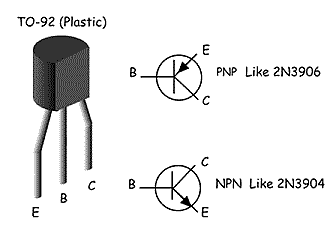

So what is the transistor? It is actually a tiny device that processes signals and data. Traditionally, as a solid-state semiconductor device, it has a variety of functions such as detection, rectification, amplification, switching, voltage regulation and signal modulation. Whether it is a laptop, a smartphone or a digital thermostat for everyday use, use it. It can be said that it is almost the core element behind every electronic device. It is the transistor in the development of shrinking size, only today's thin and light notebooks.
Facing such powerful components, scientists naturally will not miss any opportunity for improvement. Two mechanical engineers are trying to use new methods to create flexible "fluid transistors" that can be deformed. Finding new materials is a first step, but hard metals such as copper or silver, or toxic liquid metals such as mercury, have been ruled out. The researchers used indium and gallium in rare metals to make a mixed liquid Alloy, can be injected directly into the rubber inside, so that the circuit as the skin, soft and flexible.
- The team was inspired by a study of capillary instability
It turned out that the melting point of indium at room temperature and pressure of 156.61 degrees Celsius, very soft, much lower than the hardness of lead, can be scored with a nail. The melting point of gallium is only 29.78 degrees Celsius, is liquid under normal temperature and pressure, but also has a solid structure of a solid complex. In collaboration with North Carolina State University scientist Michael Dickie, the researchers found that liquid metals can be used not only to make flexible circuits but also as electrical switches.

In the new "fluid transistor", the switching function can be achieved by turning on or off the connection between two liquid metal droplets. At both ends of the circuit, if one end of the voltage is reduced, the metal droplets will move together and fuse into one, forming a conductive "metal bridge", if the voltage is equal at both ends, the metal droplets will automatically disconnect the circuit no longer power ups.
Foreign media pointed out that this "sticky" metal unlimited potential use of ways, in essence, "fluid transistor" is a more complex switch, and the liquid alloy metal can be achieved under the premise of non-toxic flexible control circuit , And succeeded in imitating the characteristic of the traditional transistor only with a small amount of voltage.
Research papers for this project have been published in the journal Advanced Science, and in an essay by engineer Carmel Majdi, the team was inspired by a study of the capillary instability. In life, people often see that turning on the faucet will cause the water to flow from a steady stream to a single droplet as the flow rate becomes extremely low. This property has a scientific name, known as Rayleigh Taylor instability.

Researchers need only to find ways to induce such instabilities in liquid metal alloy droplets that solve the problem of droplets being transferred between one drop and two drops in a "fluid transistor."
Once the material can be programmed to change the structure, its function changes accordingly
After a series of tests on droplets of sodium hydroxide solution, Ma Jidi and colleagues found that the instability of the droplets can be driven by the coupling reaction between the external voltage and the electrochemical reaction. The principle is that the coupling reaction causes the oxide gradient to be generated on the surface of the droplet, causing a gradient in the surface tension of the droplet, eventually turning one droplet into two droplets.
Mr. Jidi pointed out that in the experiment, two droplets are similar to the "fluid transistor" in the source and drain, with the help of the field effect principle, can be programmed to connect and disconnect the circuit, and even can be used to create and Reconstruction of physical circuits!

Whenever you can change the application of materials through programming, then the method is almost endless. Once the material can be programmed to change the structure, its function changes, and even internal tissues can be reorganized to repair itself in extreme conditions. Researchers imagined that future "fluid transistors" made of liquid alloys will be used in manufacturing areas that require significant physical structural deformation, such as a bionic bird-shaped flying robot. With liquid alloy blood vessels bones of the robot, whether it is contraction or open wings, the wing can follow the circuit deformation, reconfiguration, to maintain normal operation, regardless of the impact of morphological changes.

Obviously, the new electronic components and alloys are also suitable for the manufacture of liquid computers. Scientists even propose to combine the future of liquid computers with biomaterials to understand the internal conditions of the human body more directly, such as bionic prostheses. They come into direct contact with human tissues to act as disease monitors and to help patients recover the function of the affected area.
In addition, some search and rescue-type robots can also use them to replace parts, so that when damaged, they can self-update the circuit, thereby increasing work efficiency, as the Terminator series of movie villains, robot T -1000 same. Foreign media said that although these Imagination sounds like science fiction now, but one day, the flexible computer will become the same as today's ultra-thin laptop, everywhere. !

References for further reading:
- https://venturebeat.com/2013/03/21/ibm-creates-liquid-based-transistors-that-can-process-data-like-the-human-brain/
- http://hexus.net/ce/news/general/111848-metallic-fluid-transistor-heralds-liquid-computing/
- https://bits.blogs.nytimes.com/2013/03/21/i-b-m-research-points-to-circuits-that-mimic-the-brains-design/
- https://www.curezone.org/forums/am.asp?i=1754717
- https://cen.acs.org/articles/90/web/2012/07/Molybdenum-Disulfide-Enables-Flexible-Transistors.html
- http://www.leopard.t.u-tokyo.ac.jp/research/inaba/inaba3.html
- https://en.wikipedia.org/wiki/Fluidics
Support @steemstem and the #steemstem
project - curating and supporting quality STEM
related content on Steemit
This post has received a 0.52 % upvote from @drotto thanks to: @mike11.
Greetings! I am a minnow exclusive bot that gives a 5X upvote! I recommend this amazing guide on how to be a steemit rockstar! I was made by @EarthNation to make Steemit easier and more rewarding for minnows.