What Makes Shakedown Hawaii Work
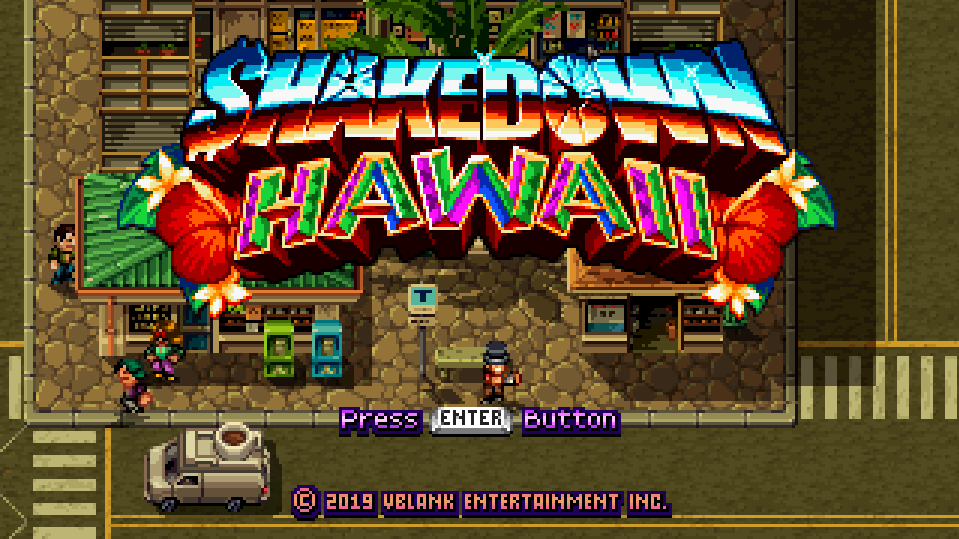
Because Epic's having an epic sale (more appropriately, the Epic Mega Sale, which runs through June 13), I got Shakedown Hawaii. Normally $20, you can get it for just $10 right now, because they're giving $10 off any game costing $14.99 or more.
It's a game that I was tentatively interested in; I played Retro City Rampage, its predecessor, and didn't really stick with it very long, but I went through all of Shakedown Hawaii as quickly as I could after getting it, because it's just that compelling a game. Let's look at why it's so good from a game designer's perspective.
Screenshot captured by me.
Defining Scope
Shakedown Hawaii knows exactly what it wants to be right out of the bat. It's going to be a GTA-clone or, more accurately, perhaps a GTA-demake, borrowing more from the modern parts of the series than the early ones. I'm not familiar enough with GTA to really tell you which it more resembles, but it really feels kind of like the Saints Row series, which were definitely more influenced by late-series GTA.
The Core Gameplay Loop
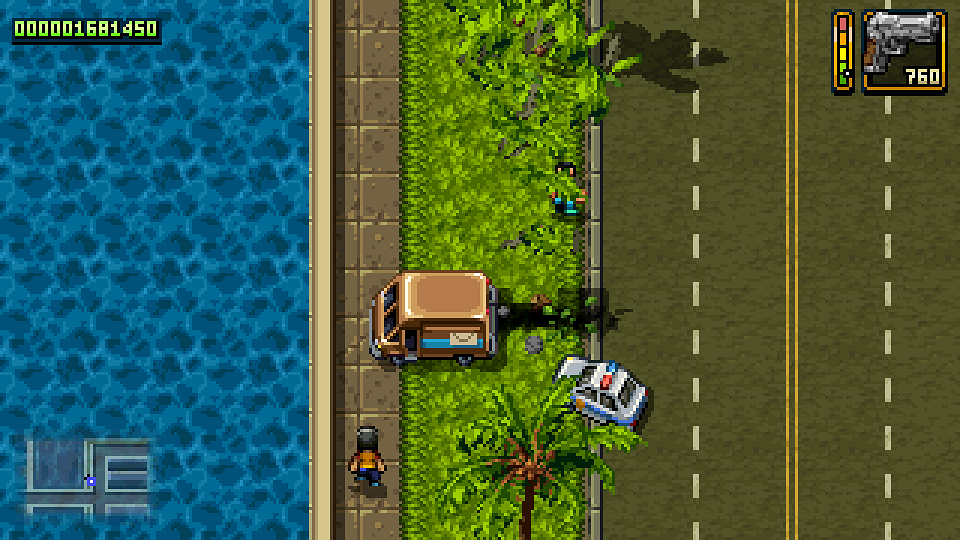
The actual core gameplay is probably best defined as the run-and-gun style open world gameplay. It's simple, but not so simple as to be incredibly boring, and it's made up for with lots of action (constant score tracking, picking up collectables, etc.) that keep things going. It's driven by just a few rules, but they're constantly pressing the player.
And once it settles on its rules, it's remarkably intuitive. You can jump, shoot (there's auto-aim toward enemies, so you don't even need to be particularly precise), enter and exit vehicles, and that's more or less it.
This also means that the game itself is capable of being incredibly self-explanatory. Missions are fairly simple; you get a goal (defeat all enemies, go somewhere, light trees on fire, etc.), and then you wind up going about that goal by following on-screen cues.
It's almost passive in nature, in part because the difficulty level is not generally high (there are a few segments where the game becomes more challenging, but they are the exception to the rule).
The other element here is a lot of constant side-objectives. You need to shakedown stores before you can purchase them (in a sort of meta-loop element), and you also wind up going through a variety of other systems. Arcade challenges, police chases, and the missions themselves (which often intrude in the form of a cell-phone call) provide a constant flow of stuff to do, which keeps the game moving smoothly. Repeated things, like stealing and delivering coffee trucks to reduce the overhead of the coffee shops selling "fair trade" coffee and destroying delivery trucks to increase the appeal of retail shopping versus online delivery, help to provide a boost to the player's income but also give an opportunity to push the player forward with a meaningful (though perhaps not incredibly so) action that can move the game forward.
Take a wild guess what happens next. Screenshot captured by me.
King of the World Island
The whole game takes place within a framing narrative of restoring a multinational corporation that has fallen on hard times to its former glory. This is part of a wonderfully subversive and satirical story (the protagonist gets "business tips" from consumer watchdog reporting in a move straight out of Machiavelli), which drives the game forward with humor and connection to the characters who have more of a tendency to succeed by luck than any merit of their own. Imagine if Homer Simpson ran a business, and was evil.
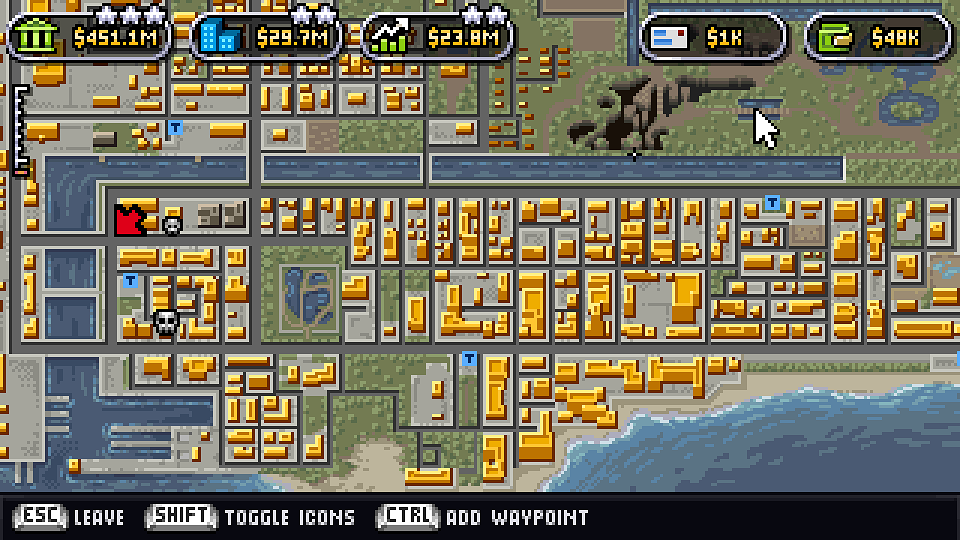
There's a greater gameplay implication of this as well; you get money which you can use to buy things based on the businesses that you own, and you have an explicit goal of owning all the property on the island.
It's a quest that takes about a dozen hours, which is probably for the best because it ends before it gets stale, but not before you can get a sense of satisfaction from it.
There's something to be said for the nature of this: it really feels like it took a lot of the elements that have been pushing themselves into other games (e.g. Ubisoft's Assassin Creed II and Brotherhood), but used them in a way that actually made sense. There's not a whole lot of stuff to actually do with the money, but there's a sort of reptile-brain satisfaction from owning everything that's compelling, and since it's wrapped in an explicit goal on behalf of the protagonist it doesn't just feel cheap.
Screenshot captured by me.
Aesthetic
The pixel art retro-styled aesthetic can be grating in some cases, but in Shakedown Hawaii VBlank really manages to elevate it beyond the usual limitations here. There's lots of visual effects when you're in the right moment (e.g. pixel shading so that there's a functional day/night system, lots of particles going all over the place), and it comes together in a nostalgia trip.
I think in particular of the old Shadowrun game for Genesis when I played Shakedown Hawaii, and it's something that has a powerful language for the target audience; the pixel-art is crisp and clean while the music is sufficiently synthy to satiate an audience seeking a simpler time of pre-microtransaction games, both in feel and style.
The lack of a lot of features that creep into modern games is nice too; it's an entirely asocial experience, and that's okay. No ads for other games, no intrusions from extra features, no DLC. It's a throwback in more ways than just visually, and the message comes across: this is a game that's going to be simpler than what you're used to, but it's still going to respect you.
Wrapping Up
Shakedown Hawaii is an excellent game, and its design is focused around meeting expectations and fulfilling them. It has very simple gameplay loops and a simple narrative layer over the top of those loops, but it manages to satisfy players by how it targets their desires.
This post was shared in the Curation Collective Discord community for curators, and upvoted and resteemed by the @c-squared community account after manual review.
@c-squared runs a community witness. Please consider using one of your witness votes on us here
To listen to the audio version of this article click on the play image.

Brought to you by @tts. If you find it useful please consider upvoting this reply.