Revolutionary New Windmill Blade Design
Dr. Eric Loth, the chair of the Department of Mechanical and Aerospace Engineering at the University of Virginia School of Engineering, will be leading a team to build a prototype of a new type of windmill that is intended to be less susceptible to wind damage[1].
The team is being funded by a $3.56 million federal grant from the U.S. Department of Energy to build a prototype windmill configured such that with "hinged" blades the blades can fold backward during high winds. The concept is based on how limbs on palm trees have enough flexibility to fold back in high winds to keep the tree from being destroyed.
Allowing the blades to fold back in high wind puts lower stress on the blades so they can be made lighter. In turn, with lighter blades they can be made larger with a corresponding increase in the power output of the windmill. Good idea.
Now think about it, $3,560,000 to add hinges to a windmill? Where do you sign up for a job like this?
Dr. Loth goes on to say:
Palm trees achieve their resilience by a lightweight, segmented trunk structure that can bend in the wind
I think I should officially join the team now.
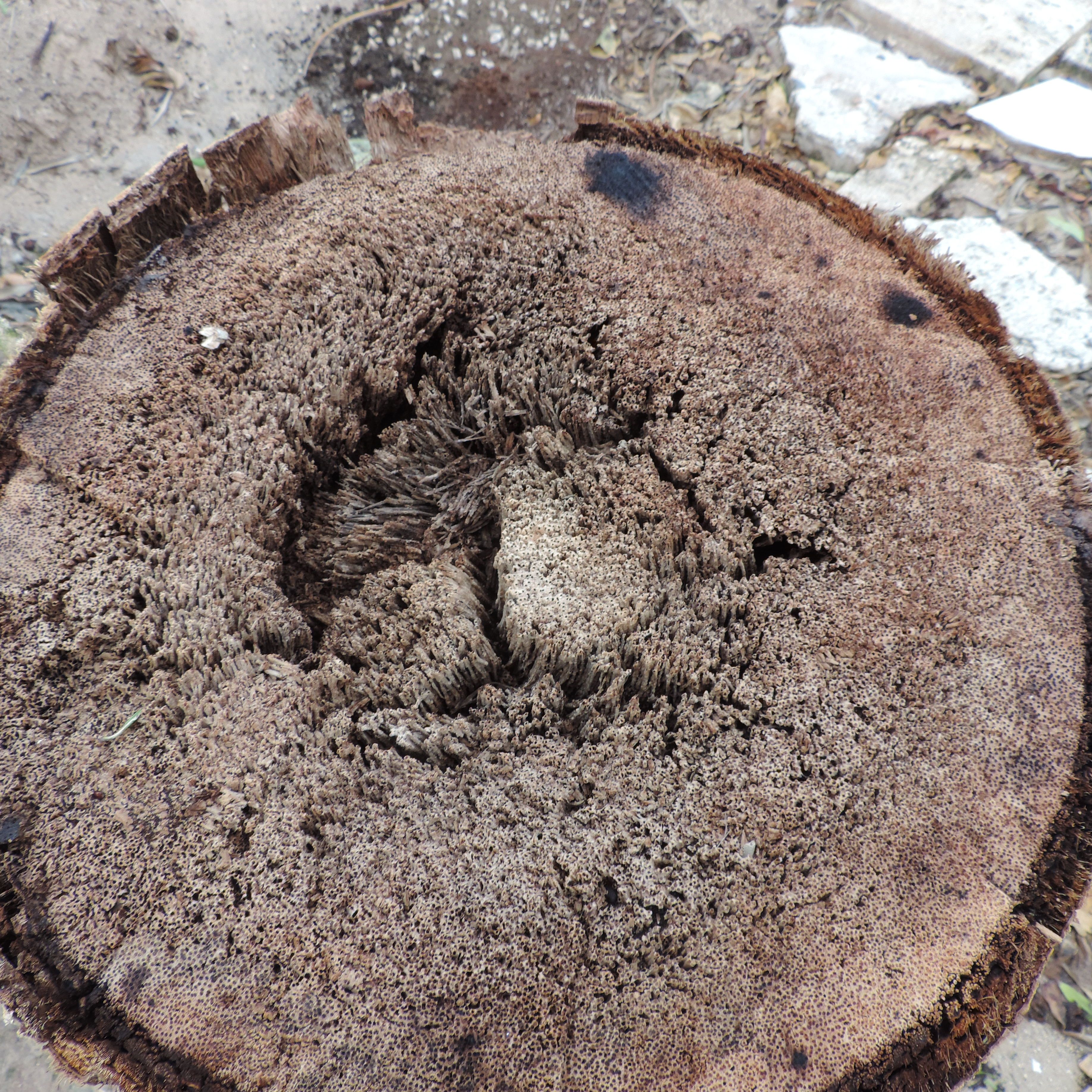
Here's a photo of a stump from a coconut tree that had to be cut down after it died. I'd like to make note here that no coconut trees were harmed in support of this article. If you click the image to see it full size, you can see the inside of the coconut tree is made up of thousands of strands. From the photo the strands seem to get more dense as you look from the center to the outside of the tree trunk.
All of these strands are what gives the trunk of the tree the strength and flexibility to withstand the high winds. The strands would act almost as a wire rope when the tree started bending in the wind. At the same time, maybe when the tree is still alive the strands can move relative to each other, giving flexibility.
After all, it's not just the blades that have to withstand the high winds, it's also the support. The segmentation on the trunk of the tree may help with flexibility but mainly if from the growth of the palm from the inside out, one leaf at a time forming all those strands.
Dr. Loth, I'll be looking for my cut of that $3.5 million. I'll send you the address to just add it to my Steemit account.
Strangely enough when I was looking into this I did find something interesting. The official grant from the DOE [2] is for $3,711,703. Seems like there is around $150,000 missing already. I suspect the University took it but I have to wonder if this could be my cut for helping out or was there a big research team party somewhere to study the palm trees. Piña coladas for everyone!