Surfactant Agents
Surfactant Agents
source
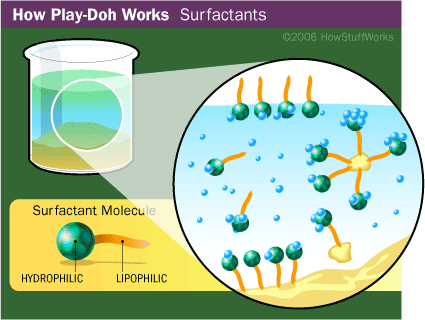
Substances that have the characteristic of modifying interfacial interactions through the promotion of adsorption phenomena, are known as surface agents or surfactants and are among the most common products used in modern chemical technology. Its areas of application are very extensive, it could almost be said that each industrial application has a suitable surfactant given the great versatility of this type of molecules (Perales, 2001).
Also, nature, anticipating our own ingenuity, presents varied and vital applications of surface agents without which our biological system could not work, including the same membranes that contain living cells.
Two examples of the action of natural surfactants, closely related to current applications, are the action of bile acids in the emulsification and transport of fat in the digestive process, and the action of pulmonary lubricants, which make the exchange mechanism possible. of oxygen and carbon dioxide between the lungs and the blood, since the transfer of oxygen is only possible due to the presence of the so-called pulmonary surfactants. Preterm infants, who have not yet formed lungs, must be treated artificially with surfactants to survive (Hallman, 1993).
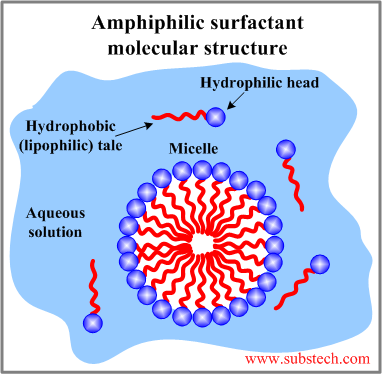
The basic structure of a surfactant can be schematized in the following way:

source
The hydrophobic part is a linear or a branched hydrocarbon chain, while that a hydrophilic part is an ionic group or a strongly polar group.
source

source
Main Families of Surfactants
In a generic classification of surfactants can be said to exist four large groups:
• Anionic surfactants: possess functional groups that ionize in aqueous solution causing organic ions with a negative charge and responsible for the surface activity. They commonly contain groups soluble, sulfates and sodium sulfonates. They are the most used in powder detergent formulations for laundry and products liquids for use in the dishwasher.
• Cationic surfactants: have functional groups that ionize in aqueous solution causing organic ions with a positive charge and responsible for the surface activity. They are mainly compounded quaternary ammonium. They have the advantage that they are compatible with non-ionic and amphoteric surfactants and the disadvantage of being incompatible with the anionic surfactants. Likewise, his detersive capacity and his biodegradability are low and its economic cost is higher than that of anionic and nonionic surfactants. They are usually used as agents emulsifiers at pH lower than 7, also have properties softeners and disinfectants.
• Nonionic surfactants: In aqueous solution do not cause ions. They have functional groups with high affinity for water, which makes them soluble in it. Some are condensation products of oxide-ethylene with phenolic or fatty materials. They are compatible with all types of surfactants. They constitute a group of surfactants of wide and varied application. In general, they have low foaming power and tend to be liquid or pasty products.
• Amphoteric surfactants: have functional groups that can be ionized in aqueous solution conferring the compound the anionic character or cationic, according to the conditions of the medium. They are not used much as raw materials for detergents. Some provide an excellent foaming and low level of cutaneous and ocular irritability so that they are very appropriate in shampoo formulations. They are compatible with all types of surfactants.

source
I hope you liked it, for more information you can visit:
- https://knowledge.ulprospector.com/3106/pc-surface-active-agents-surfactants/
- http://www.essentialchemicalindustry.org/materials-and-applications/surfactants.html
- http://www.cleanfax.com/carpet-care/anionic-nonionic-cationic-what-do-they-all-mean/
- https://www.sciencedirect.com/topics/agricultural-and-biological-sciences/surfactant
- https://www.chemicalbook.com/ProductCatalog_EN/1813.htm
COMMENT - VOTE - FOLLOW - REESTEM
Thank You.!!
You seem to have a name kind of similar to mine.
Buen post! Completo y fácil de entender. Saludos
Gracias, que bueno que te ayudo la información.