Fatty Alcohols Ethoxylated
Fatty Alcohols Ethoxylated
source
This subfamily of nonionic surfactants comprises the ethoxylated derivatives of the fatty alcohols. Most of these fatty alcohols lack surfactant properties due to their insolubility in water, so they are reacted with polyoxyethylene; this gives them the desired hydrophilic character.
The ethoxylated fatty alcohols are obtained from alcohols derived mainly from coconut oil, tallow oil or synthetic straight-chain alcohols, to which a given level of moles of ethylene oxide (EO) is coupled.
It should be noted that the value "n" (average number of moles of ethylene oxide) that appears in the molecular structure does not have to indicate the ethoxylated chain length of the majority compound, since, for example, a mixture rich in molecules with 2 OE and chains with 16 OE can take as a mean value 9 OE, although there are hardly any molecules with this number of units of ethylene oxide.

source
As a result of the synthesis method, the ethoxylated fatty alcohols are composed of a complex mixture of oligomers, the average length of which is comprised of 1 and 20 ethoxylated units. This distribution of oligomers generally adopts a Poisson distribution (Swisher, 1987; Pilc, 1987) and affects the physicochemical properties, biodegradability in the medium and its final use (Wang, 1993, Ahel, 2000).
Ethoxylated fatty alcohols for commercial use are also complex mixtures of homologs with an even number of carbon atoms in the alkyl chain comprised between 12 and 18, are called oleochemical ethoxylated alcohols and represent 40% of the total production of ethoxylated alcohols. There are also ethoxylated oxo-alcohols derived from linear olefins or tetrapropylene. Linear oxo-alcohols are mixtures of linear alcohols and mono-branched alcohols with alkyl chains of 11 to 15 carbon atoms, which constitute the remaining 60% of the total production of ethoxylated alcohols (Marcomini, 2000).
A peculiar characteristic of these surfactants is that their solutions in water become turbid when heated and they end up precipitating. This is because at high temperatures the molecular movement breaks down the hydrates. The temperature at which the turbidity is reached (cloud temperature, CP) depends on the degree of ethoxylation. These substances can be liquids or hard solids, depending on the degree of ethoxylation.

source
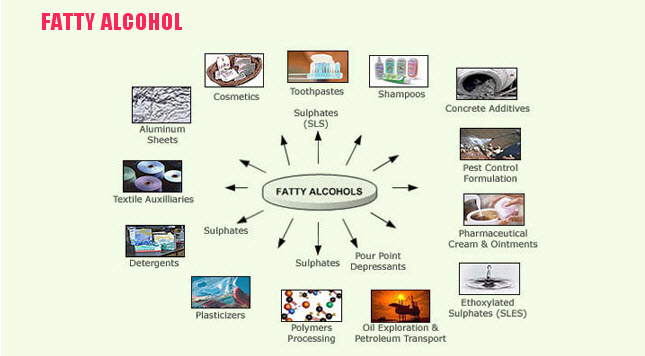
The ethoxylated fatty alcohols are used as O / W (oil-water) and W / O (water-oil) emulsifiers. Usually, mixtures of several of them are used, since this increases their capacity to stabilize the emulsions. They are good detergents, but their low foam formation makes them, in principle, unattractive in the manufacture of gels or shampoos and especially suitable for controlled foam formulations. Also, those compounds that present higher HLB (hydrophilic-lipophilic balance) are used as stabilizers.
Also, they are compounds resistant to the hardness of water. Regarding the ease of elimination of ethoxylated fatty alcohols from wastewater, in principle, these can be eliminated by traditional biological treatment processes, or by more advanced processes such as ozonation (Brambilla, 1993) and carbon adsorption. active. The linear ethoxylated fatty alcohols are degraded by hydrolysis of the ether bond, followed by oxidation of the two resulting portions. Primary biodegradation can reach values above 97% (Szymanski, 2000; Battersby, 2001), although the ultimate degradation can be significantly lower.
source
I hope you liked it, for more information you can visit:
- http://www.rimpro-india.com/articles1/surfactants-widely-used-in-industrial-processes-fatty-alcohol-ethoxylate,-fatty-acid-ethoxylate.html
- http://sitem.herts.ac.uk/aeru/footprint/es/Reports/1357.htm
- https://www.helmag.com/en/products/chemicals/products/details/product/fatty-alcohol-ethoxylate/
- http://www.shreechem.in/fatty_alcohol_ethoxylate.html
- http://www.heraproject.com/files/34-f-09%20hera%20ae%20report%20version%202%20-%203%20sept%2009.pdf
COMMENT / VOTE / FOLLOW / REESTEM
Thank You.