Civil works structure -structural system [Basic concepts] part #1
Hello steemians!
Today I want to talk a little about a fundamental issue in civil engineering, architecture and construction in general: structures of civil works and structural system
These concepts must be handled by all professionals who are in the area of engineering and construction, which is the description of the ideas and needs of the client.
What is a structure
A structure is an assembly of elements that maintain a form and its unity, having as objective to resist the loads resulting from its use and its own weight giving shape to a body, civil work or machine. Examples of structures are: bridges, towers, buildings, stadiums, roofs, ships, planes, machinery, dams and even the human body.

Structural system
It is a set of elements or independent elements to form a single body and whose objective is to give solution and a specific civil problem. The way of assembling and the type of member assembled the final behavior of the structure and the different structural systems. The elements are not distinguished as individuals but the structure is in itself a continuous system as in the case of domes, continuous slabs or macros and walls, and are analyzed following the concepts and basic principles of mechanics.

Types of structural systems
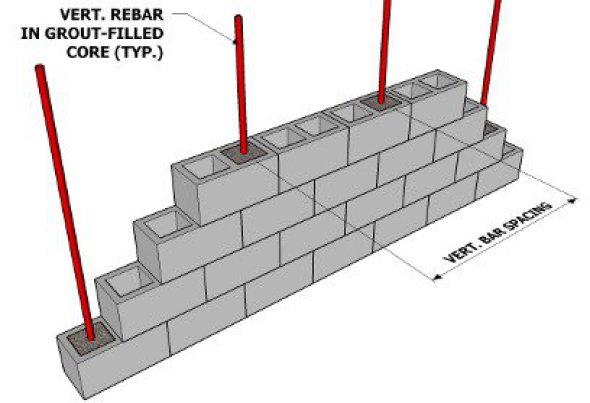
Portante walls
It is also called a tunnel system, it is known to be organized between vertical plates (walls), which function like loading walls, and horizontal plates (slabs). This system generates a great resistance and lateral stiffness, but if the arrangement of the means can be done in one direction or it will use a tool.
Advantage
It is a system that is constructively quick to execute, since steel formwork with an "inverted U" shape is used, which, organized on the site, allows the walls and slabs to leave simultaneously. You can build a level of 1200 m2 every 3 days, that is, it has a high performance. Compared to a traditional system, the Tunnel system can cost between 25 and 30% less. In addition to its rapid execution, the fact of having walls allows a saving in costs in the construction of the walls of the blocks and the frieze of the same. It is a system that well configured is not prone to collapse, as it offers great resistance to lateral efforts. As it is a very rigid system, where almost no lateral displacements occur, the non-structural elements do not suffer considerable damage. It ends up being a much lighter structure than the system contributed, and thanks to its lateral stiffness buildings of more than 30 stories high can be built
Disadvantages
Being a system of great rigidity, it will be exposed to great seismic efforts, which must be dissipated by the foundations, this means that it must be supported by a soil with a high load capacity. Because they have slabs of thin thickness, the length of the branches of the sewer facilities is limited. In some cases, it is necessary to increase the thickness of the slab where the bathrooms are located to reach the slopes. Since the walls are continuous, it hinders the distribution of internal spaces, since their use is limited to homes and hotels.
System Aporticado
It consists of beams and columns, connected to each other by means of rigid nodes, which allows the transfer of bending moments and axial loads to the columns. The resistance to the lateral loads of the frames is mainly achieved by the flexing action of its elements.

Advantage
Allows more distributions in the internal spaces of the building. They are very flexible structures that attract small seismic stresses. They dissipate large amounts of energy thanks to the ductility of the elements and the great hyperstatic nature of the system.
Disadvantages
The system in general presents a low resistance and rigidity to lateral loads. Its great flexibility allows large displacements which produces damage to non-structural elements. It is difficult to maintain drifts under regulatory requirements. Because of its high flexibility, the long and long term place system, which is not recommended in soft soils. The use of this structural system is limited to low or medium structures. Since as the building has more floors, the dimensions of the columns would have to be larger, which can make the project economically and architecturally unfeasible. For buildings with rigid gantry systems it is estimated that in less exposed areas, it can be closed around 20 floors, and for high risk areas, around 10 floors.
Vaulted systems
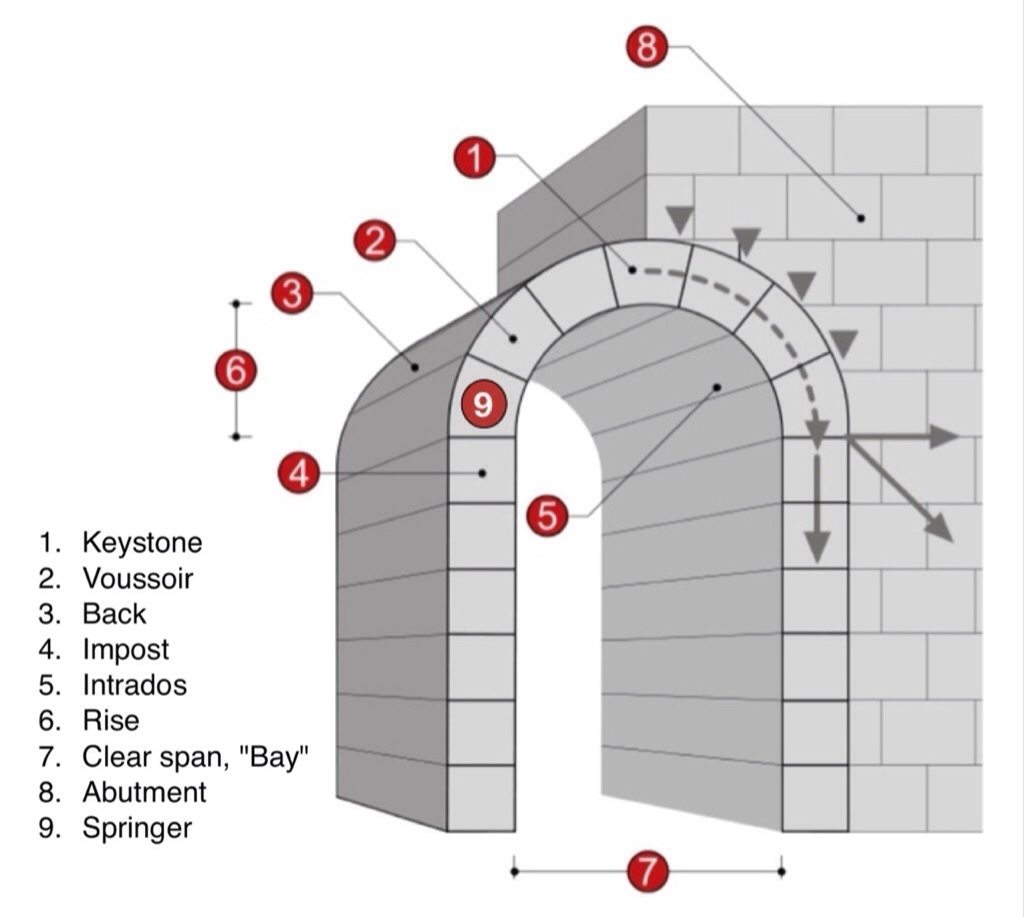
Arc and dome The basic concept of the arch is to have a structure to cover spaces, using only internal compression. The profile of the arc can be derived geometrically from the load and support conditions. For an arc of a section that is not fixed in the form of resistance to a moment, with the same level and with a load uniformly distributed throughout the section, the resulting shape in the curve of a second degree or parabola. It was a system widely used in Mesopotamia and in the European Middle Ages. To use it, you need materials that support the compression efforts, so they have traditionally been built in bricks or ceramic stone. This system was widely used in the Byzantine Empire, being its best-known example, Hagia Sophia, Istanbul.
Elements that make up a specific structural system
slab
A foundation slab is a concrete plate resting on the ground which distributes the weight and loads of the building on the entire support surface.

beams
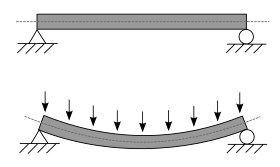
Rigid architectural element, generally horizontal, designed to support and transmit the transversal loads that is somewhat close to the support elements.
column
It is a vertical and elongated architectural element that usually has structural functions, although it can also be erected for decorative purposes. Ordinarily, its section is circular, because when it is quadrangular it is usually called a pillar, or pilaster if it is attached to a wall

Foundations
It is the part of the civil structure that is in contact with the ground or the rock. Its function is to support the loads of the structure to the ground and provide a stable support system. To be a resistant one so as not to break by shear

- For more information, visit the first link
This post has received gratitude of 0.43 % from @appreciator thanks to: @josealbertomg71.