The Water | Food Engineering
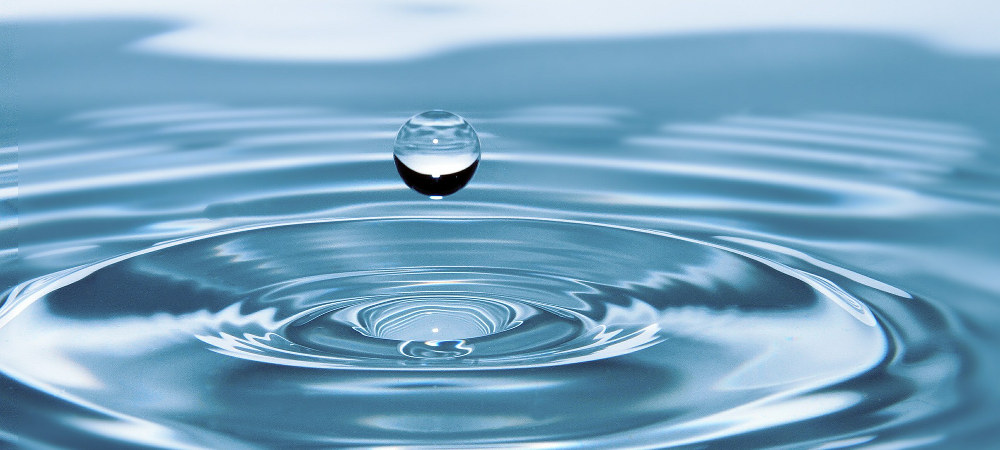
Water is a vital compound for all the biochemical processes that occur in cells. One of its most important properties is that water can be maintained in a liquid state over a wide range of temperatures, which allows it to have many biological functions due to its physical capacity to transport substances, dissolve others and maintain them both in solution and colloidal suspension.
Water also intervenes in photosynthesis and in many enzymatic reactions of hydrolysis, which is considered fundamental for the life of the planet. This compound helps in the conversion of certain complex materials such as polysaccharides, proteins, fats, etc.), to simpler forms easily assimilated by plants and animals. Another quality of water is that it can provide a favorable environment for the development of microorganisms, plant and animal cells. In food we can find a water content of about 96 and 97% of the composition of these, and even in foods considered or called dehydrated that are apparently dry, there may be between 10 and 12% water, so that all foods are considered to have water content except ordinary salt and table sugar.
In food engineering it is very important to know their physicochemical properties, as these will influence the design of processes to transform food and obtain good dehydrated products or good frozen or rehydrated products.
It also has a vital importance in food preservation, because, we can prevent the growth of fungi, microorganisms, yeast and bacteria, simply by rescaling the available water with processes such as lyophilization, salting, dehydration, freezing and concentration.
In the food industry water has various uses and is of utmost importance as it is used in the production, formulation, food supply, in the generation of steam, in sanitary facilities, irrigation of gardens, etc. It is also used in cooling systems, washing machines and equipment, among other things.
For the production and formulation of food it is very important to take care of the water quality, because in many occasions the water is the cause of unwanted reactions that reduce the sensorial properties and the nutritional value of the food. There are many factors that can cause problems such as salts and ions that water contains, microorganisms can also cause damage and this is why it is one of the main topics of study in water.
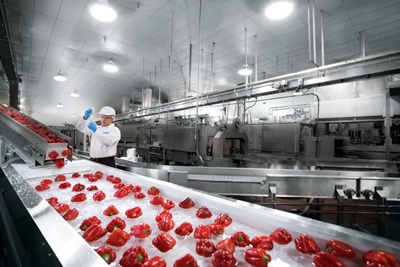
The case of iron and copper present in water is also a big problem, since it catalyses the oxidation reactions of the unsaturated molecules, producing rancidity and discoloration of different pigments. The water, although it is colorless and unsightly, can impregnate undesirable smells and flavors in food, due to the industrial contamination of the aquifer mantles.
The food industry is a large consumer of water, but also generates large effluents that pollute rivers, aquifers, seas, lakes, etc. This is why the wastewater must be treated, to generate a significant pollution that triggers an imbalance of the ecosystems.

The water molecule is constituted by two hydrogen atoms joined in a covalent form to an oxygen atom, this molecule is highly polar and creates three-dimensional structures due to the hybridization of molecular orbits and p of oxygen. This molecule does not have a certain charge as such, but it does have a powerful electric dipole that allows it to create stable hydrogen bonds with other molecules, the same or different but polar in nature.
Physicochemical properties:
The water shows very particular properties that stand out even more, when compared with hydrides of the same group of the periodic table to which the oxygen belongs, this due to the formation of three-dimensional structures mediating hydrogen bridges.
The amounts of energy necessary to pass from one state to another, as well as the conductivity are properties already determined for this compound, these are parameters that help to understand certain phenomena that occur with the water molecules.

A very important property is that water is a good solvent because of its high dielectric constant, it dissolves non-ionic substances with a polar character, such as sugars, alcohols, aldehydes, ketones, amino acids, etc. It should be noted that the dissolution takes place when the concentration of the water is much higher than that of the solute; however, when it is low, the substances do not dissolve, they only hydrate, and form very viscous fluids or even gels, in which the water is also retained by hydrogen bridges in a three-dimensional network.
There is a phenomenon called surface tension, this happens with the molecules that are in contact with the air, which behave in a very different way to those that are not. These molecules that are in contact with the air form an elastic film and this phenomenon is called surface tension. This is why sometimes we see ants walking on water.
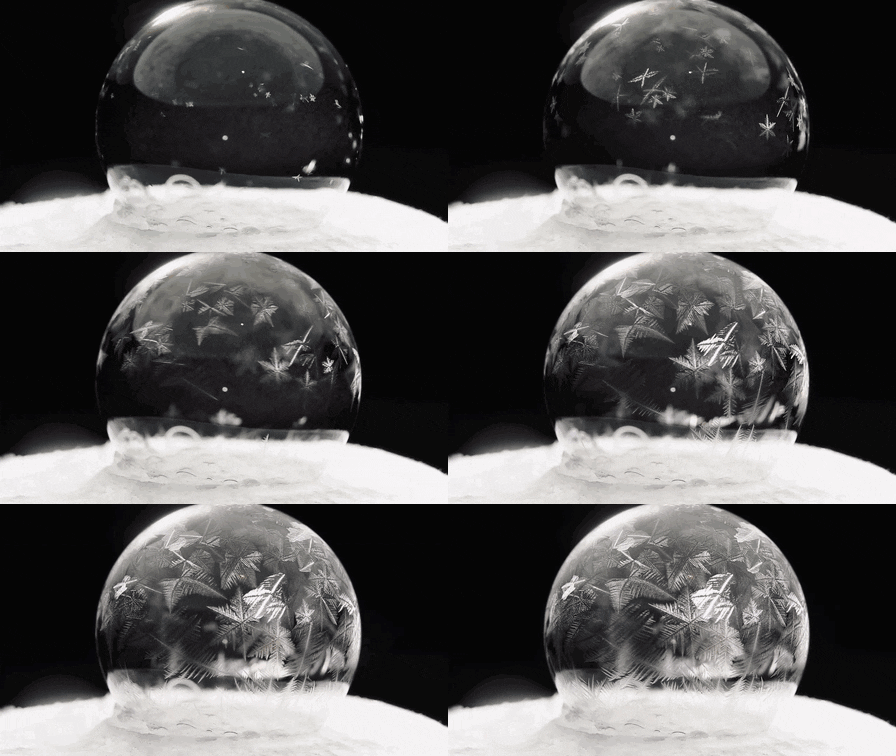
In our planet, water exists in three physical states, gas, liquid and solid, this according to the amount and intensity of hydrogen bridges it contains. The conversion of one state to the other is carried out by modifying the pressure and the temperature. For example, in an atmosphere of pressure, these states depend exclusively on temperature, we find then that at 0 ° C it appears as ice and at 100 ° C as steam.

We can talk about the triple point of water that occurs at a temperature of 0.0099 ° C and at a pressure of 4.579 mm of mercury, at this point it is considered that the three states are together in equilibrium.
Water in a liquid state establishes hydrogen bridges and creates a three-dimensional structure. These joints are uniformly distributed throughout the water molecule, forming a uniform network. Water in the solid state is known as ice and this is a more ordered and diametrical structure of water molecules joined together by means of hydrogen bridges. As mentioned above, the ice melts producing liquid water at 0 ° C and in this process only 10% of the hydrogen bridges are broken. Ice is four times more thermal conductor than liquid water.
Do you know why ice floats in liquid water? This happens because the density of the ice is less than that of the liquid water; the density of ice at 0ºC is 0.9168 g / cm3, while that of water at the same temperature is 0.9998, and at 20ºC it is 0.9982.

In animal and vegetable tissues water is not evenly distributed. There are many reasons, for example the incompatibility of water with lipids means that it is not present in these areas. Another example is the case of cell cytoplasm, which has a high percentage of polypeptides capable of retaining more water than organelles that lack similar hydrophilic macromolecules.
In the processed products this situation of heterogeneity of the distribution of water also occurs, because its components are in different forms of dispersion. It is for this reason that in some foods the freezing point of one part can be -20 ° C and another zone of the same food can freeze at -40 ° C. There is free water in the food or freezing water, which is very volatile and is the first to be lost when heating or the first to freeze, this is responsible for water activity.
As mentioned above, for simplification purposes, water is divided into free and bound water. Free water would be the only available for the growth of microorganisms and to intervene in other transformations. The bound water is attached to the solid surface and does not act because it is not available or immobile. So it can be said that the colligative, rheological and texture properties of a food depend on its water content. This content also definitely influences physical, chemical, enzymatic and microbiological reactions.

Then knowing this we can say that the activity of water is that fraction of water that is capable of promoting changes in food and this fraction has mobility and disponiblilidad. This has an empirical value that allows to predict the stability and the useful life of a product and has a lot of relation in the control of the processes of dehydration and rehydration, the migration of storage moisture and many other factors.
Water activity is an intrinsic activity and is related non-linearly to the moisture content by curves or isotherms of absorption and desorption.
An intermediate moisture food has long shelf life, they do not need rehydration or cooling to conserve, so they are suitable for those countries where refrigeration is expensive or does not exist. In its preparation benzoates and sorbates are added to avoid fungi and yeasts.
An intermediate moisture feed is manufactured by removing water or adding highly hydratable solutes that retain water. The reduction of the water content causes the concentration of other substances, such as acids, which lower the pH and contribute to the microbial stability of the food.
Microbial activity can be inhibited by freezing or reducing the temperature. This is shown by the Arrehenius equation. This is due to the fact that foods, because they have dissolved substances of low molecular weight, such as salts and sugars, have areas rich in solutes whose freezing temperature is considerably lowered and not all the water turns to ice in the freezing, but remain liquid sections rich in solutes.
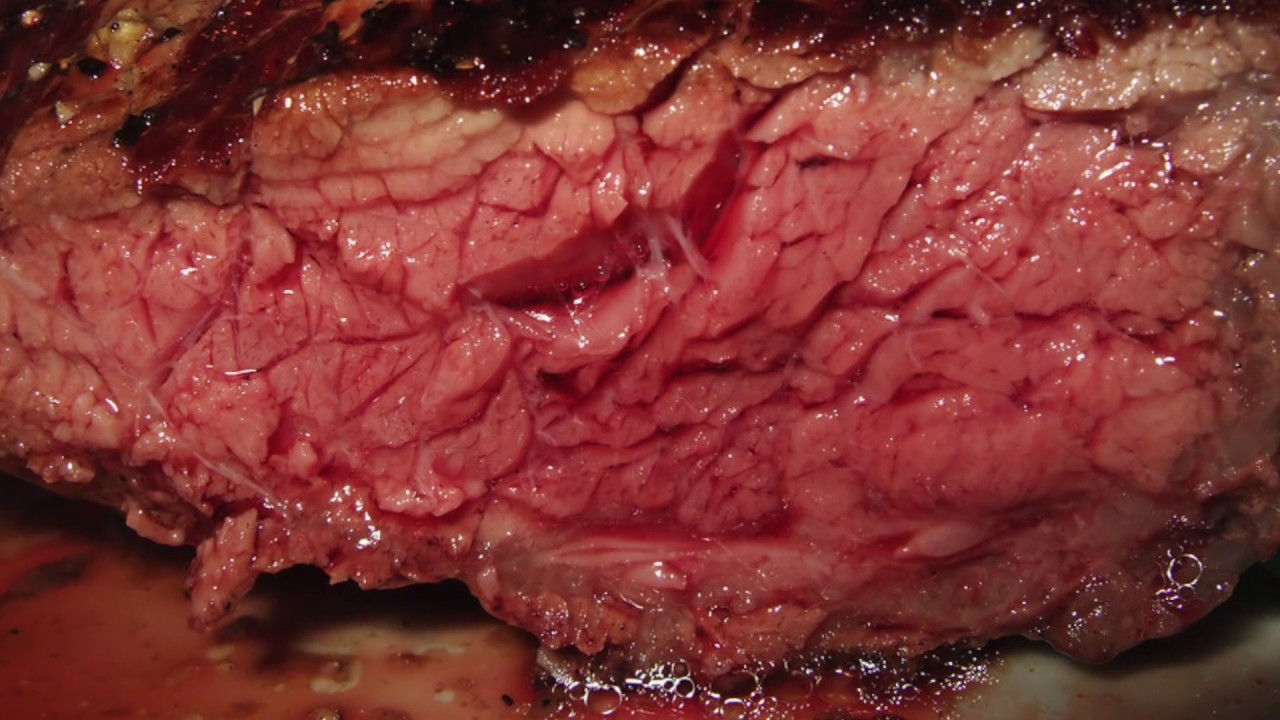
The freezing speed determines the formation and location of the ice crystals; when done quickly (minutes at very low temperature), many small needle-like crystals are produced along the muscle fibers of the meat; on the contrary, if it is carried out slowly, a smaller number of crystals is induced, but larger, in such a way that each cell contains a single central mass of ice. Slow freezing is more harmful than rapid freezing because it mostly affects the cell membrane and also establishes intercellular crystals that have the ability to unite the cells and integrate large aggregates.

Ice crystals do not maintain a constant size in storage at low temperatures, but continue to grow at the expense of smaller ones, because they have a larger area than large ones.
Water is a compound that influences the quality and safety of food. Its molecular structure allows to produce and formulate foods with greater shelf life, which allows to increase the availability of these for people.
Water is present not only in the formulation and elaboration of food, it also has a wide use in industrial processes and is used for the maintenance of machinery and equipment. Something of utmost importance is that as citizens we take care of the sources of water, because if they are contaminated, they would generate many problems and even affect our functioning as living beings.
Bibliographic reference
Salvador Badui Dergal. "Food chemistry" Fourth edition. Pearson Addison Wesley.
Image sources 1,2,3,4,5,6,7,8,9,10.