NASA APOD #338-344
#338 Tomorrow's picture: May 22, 1996
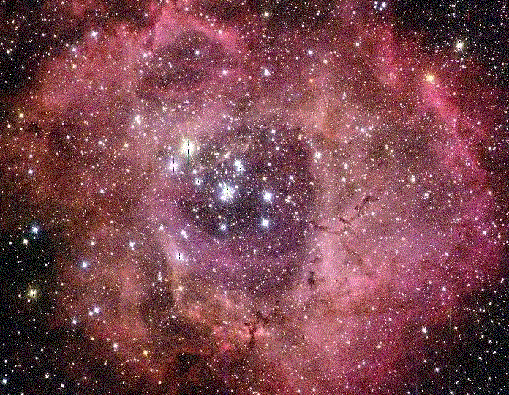
“mbedded in the center of the colorful and photogenic Rosette Nebula is a bright, young open cluster. The bright blue stars in this cluster, labelled NGC 2244, emit ultraviolet light that knocks electrons away from hydrogen atoms. When the electrons fall back, they emit the red light which distinctively defines the glow of all emission nebulae. The Rosette Nebula is thousands of light years distant, but light would take only about 100 years to cross it. The Rosette Nebula is not difficult to observer and, although faint, actually appears larger than the full moon."
Copyright: Public domain
#339 Tomorrow's picture: May 23, 1996
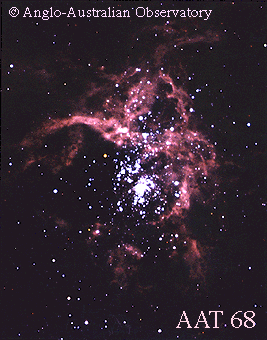
“The largest, most violent star forming region known in the whole Local Group of galaxies lies in our neighboring galaxy the LMC. Were 30 Doradus at the distance of the Orion Nebula -- a local star forming region -- it would take up fully half the sky. Also called the Tarantula Nebula, the red gas indicates a massive emission nebula, although supernova remnants and dark nebula also exist in 30 Doradus. The bright knot of stars just below center is called R136 and contains many of the most massive, hottest, and brightest stars known."
Copyright: Anglo-Australian Telescope
Board
#340 Tomorrow's picture: May 24, 1996
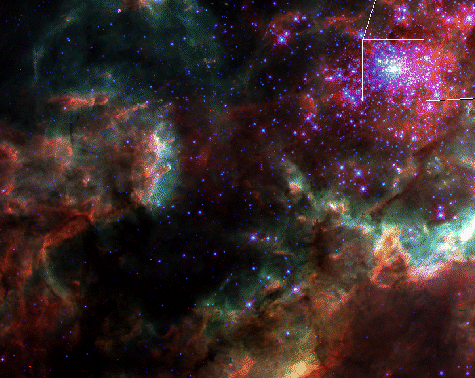
“In the center of 30 Doradus lies a huge cluster of the largest, hottest, most massive stars known. The center of this cluster, known as R136, is boxed in the upper right portion of the above picture. The gas and dust filling the rest of the picture is predominantly ionized hydrogen from the emission nebula 30 Doradus. R136 is composed of thousands of hot blue stars, some about 50 times more massive than our Sun. 30 Doradus and R136 lie in the LMC - a satellite galaxy to our own Milky Way Galaxy. Although the ages of stars in R136 cause it to be best described as an open cluster, R136's density will likely make it a low mass globular cluster in a few billion years."
Copyright: Public domain
#341 Tomorrow's picture: May 25, 1996
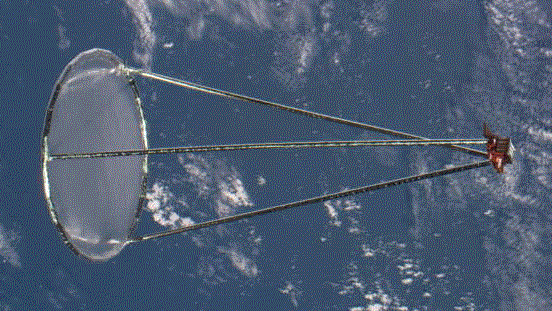
“High above the Earth the Space Shuttle Endeavor launches a new type of instrument - an inflatable antenna. The officially designated Inflatable Antenna Experiment was released Monday, May 20th, as part of a Spartan satellite - which contains many scientific experiments. The antenna is roughly the size of a tennis court and is even visible from Earth. At the end of the mission, the antenna will be jettisoned while the rest of the Spartan is recovered by the Shuttle. The function of an antenna is to broadcast radio messages, and the large dish at the end helps focus radio waves into a narrow beam which can be detected over long distances."
Copyright: Public domain
#342 Tomorrow's picture: May 26, 1996
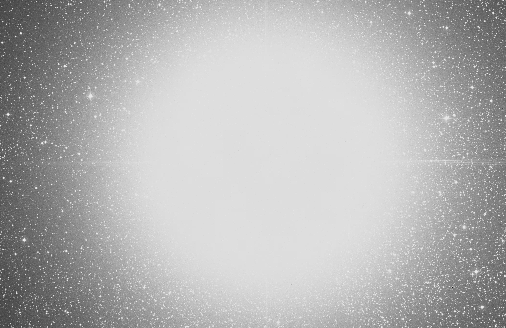
“The closest star system to the Sun is the Alpha Centauri system. Of the three stars in the system, the dimmest -- called Proxima Centauri -- is actually the nearest star. The bright stars Alpha Centauri A and B form a close binary as they are separated by only 23 times the Earth- Sun distance - slightly greater than the distance between Uranus and the Sun. In the above picture, the brightness of the stars overwhelm the photograph causing an illusion of great size, even though the stars are really just small points of light. The Alpha Centauri system is not visible in much of the northern hemisphere. Alpha Centauri A, also known as Rigil Kentaurus, is the brightest star in the constellation of Centaurus and is the fourth brightest star in the night sky. Sirius is the brightest even thought it is more than twice as far away. By an exciting coincidence, Alpha Centauri A is the same type of star as our Sun, causing many to speculate that it might contain planets that harbor life."
Copyright: STSci Digitized Sky Survey, Anglo-Australian Observatory
#343 Tomorrow's picture: May 27, 1996
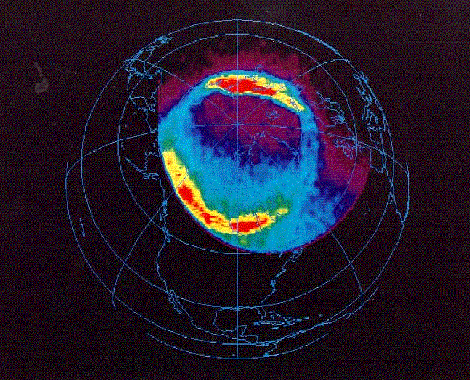
“What do aurora look like from space? The POLAR spacecraft answered this by photographing an auroral oval surrounding the north pole of the Earth, causing displays on both the night and day side. The auroral sub-storm, pictured in false-color above, developed within 15 minutes and may have lasted as long as on hour. Aurora are caused by charged particles streaming away from the Sun and towards the Earth. As the particles fall to Earth, they spiral along magnetic field lines and cause colorful radiation. The UVI experiment onboard the POLAR spacecraft is equipped with special filters that allow it to see aurora in a band of ultraviolet light where sunlight is relatively dim. The more red the emission depicted in the above photo, the more intense the radiation. Earth's continents have been drawn in for clarity"
Copyright: Public domain
#344 Tomorrow's picture: May 28, 1996
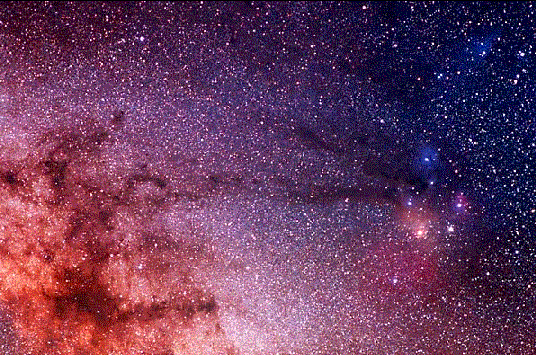
“The dark nebula predominant at the lower left of the above photograph is known as the Pipe Nebula. The dark clouds, suggestively shaped like smoke rising from a pipe, are caused by absorption of background starlight by dust. These dust clouds can be traced all the way to the Rho Ophiuchi nebular clouds on the right. The brightest star in the field is Antares. Many types of nebula are highlighted here: the red are emission nebula, the blue are reflection nebula, and the dark are absorption nebula. This picture has been digitally enhanced."
Copyright: Jerry Lodriguss
Upvote! Resteem! Comment! As you like it! Thank you for attention!