How Stars be

The Milky Way Galaxy has an average of 1 to 2 star formation per year. When viewed from astronomy point of view it is seen as a very rapid stage. He has solved his science and physics developments in human history in the late 19th century. Stars known for their ability to energize the house are known to be a mixture of Helium and Hydrogen at the end of the Big Bang. In today's technology, we can make a clear determination about the birth and death of stars. Astronauts are a model for the birth of stars.
What are the materials that will take place in space during the birth of stars?
1- Bart Droplets 
In space, dust and gas are concentrated in a small area. These gases and dust are called "Bart Drops" in Science. When we look from the outside, this space in space is seen as a black spot. But there is a lot of star formation in this region. As a result of the heat from outside coming out of this region, the star starts the birth. The first person to discover this area was Bart BOK in 1940. Bart Drop is located in IC 2944 H II region. It contains hundreds of newborns and pre-births. It can be observed in sub-millimeter or radio zones to study the precursors.
IC 2944 H II Physical Properties
       - temperature 50-100 Kelvin
       - Mass is 1-100 solar masses.
       - H2, H1 gas is coming to the scene.
1- Black Field Light
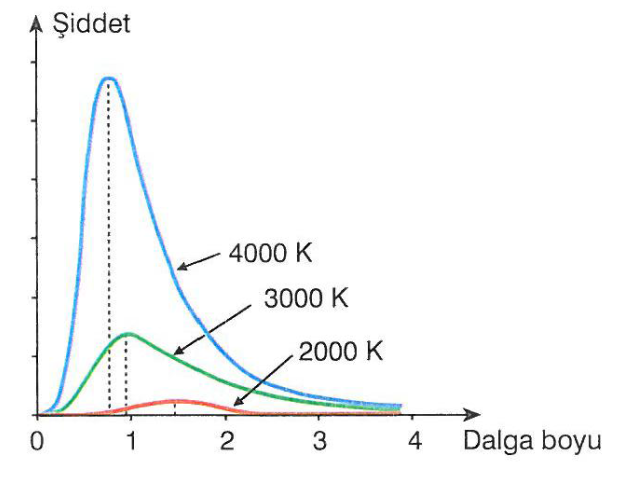
A thermodynamic equilibrium is called the black cistern, because of its own temperature. Every object brings a ray of light due to its own temperature. However, in the fluctuation dimensions of these assemblies, there are different violence. Hot bodies In the low, cold bodies radiate more in the infrared regions. When the temperature increases, the radiation that we have made in each region is also increasing. Hot objects radiate more radiantly than cold objects. The following mathematical table will be clearer.

Horizontal axes show the wave length and vertical axes show the amount of the blend. We need to pay attention to a cismin maximum wavelength with black "T = 3500" temperature. Briefly, as temperature increases, radiation increases. For example, in regard to heating a nail in the picture below, it appears white because the nail is warmer than the other areas. When we look towards the cold zone below, we see that it is yellow.
2- Hertzsprung-Russell diagram

It is a chart showing the stars' effective temperature and radiation power. These charts were created in 1910 by Henry Norris Russell and a Ejnar Hertzsprung.
Sun type star formation
Some of the dust clouds in the area where the stars are located enter the process of collapsing with their own gravity. With the continuation of this precipitation, the temperature of the dust cloud increases. Just like a competition between pressure and gravity. After a while, the dust cloud that starts to divide is divided into pieces. The temperature of each part is 10 Kelvin.
As a result of increasing density, the divisions are no longer as old as the old ones. The parts become light-proof to their own radiation. At this time the temperature is very low. 10 K is near the surface, 100 K is at the center.
As the interior is no longer exposed to light, there is an increase in the central temperature. It reaches up to 10 000 K.
The warmed and intensified cloud core is called Protostar in this case. At this stage, the cloud makes a black body on its surface. At this stage, the Protostar enters the H-E diagram.
The next stage, Hayashi Evresin, also reduces the brightness of stars. The temperature is rising.
The temperature of the cloud reaches 10 million and now it enters the fusion reaction. After that, a new star is born.
When it comes to this stage, the star is now a main star. Until the equilibrium is destroyed by spending the Hydrogen in it, the main arm remains at the same point.
This phase also left the Star Mains.
At this stage Helium begins to shrink. Gravitational energy emerges. The temperature in the core is rising.
Now the core temperature is increased by 100000000. Helium enters the "triple-alpha" fusion at this stage. As a result, carbon is beginning to form.
The resulting carbon is squeezed because there is not enough temperature. Heat will increase as a result of compression.
It is now a hot and small star in this stage.
NOTES:
If some of the divided parts do not have enough mass, they enter the cooling phase without becoming a star.
Such successful stars are called "Failed Star".
A solar-mass star is about 10 billion years on the Main Arm. When the fuel runs out, the is

Congratulations! This post has been upvoted from the communal account, @minnowsupport, by ÖMER KOÇ from the Minnow Support Project. It's a witness project run by aggroed, ausbitbank, teamsteem, theprophet0, someguy123, neoxian, followbtcnews/crimsonclad, and netuoso. The goal is to help Steemit grow by supporting Minnows and creating a social network. Please find us in the Peace, Abundance, and Liberty Network (PALnet) Discord Channel. It's a completely public and open space to all members of the Steemit community who voluntarily choose to be there.
This post has received a 0.24 % upvote from @drotto thanks to: @banjo.