Weak Logic: "Show Me The Transitional Forms."
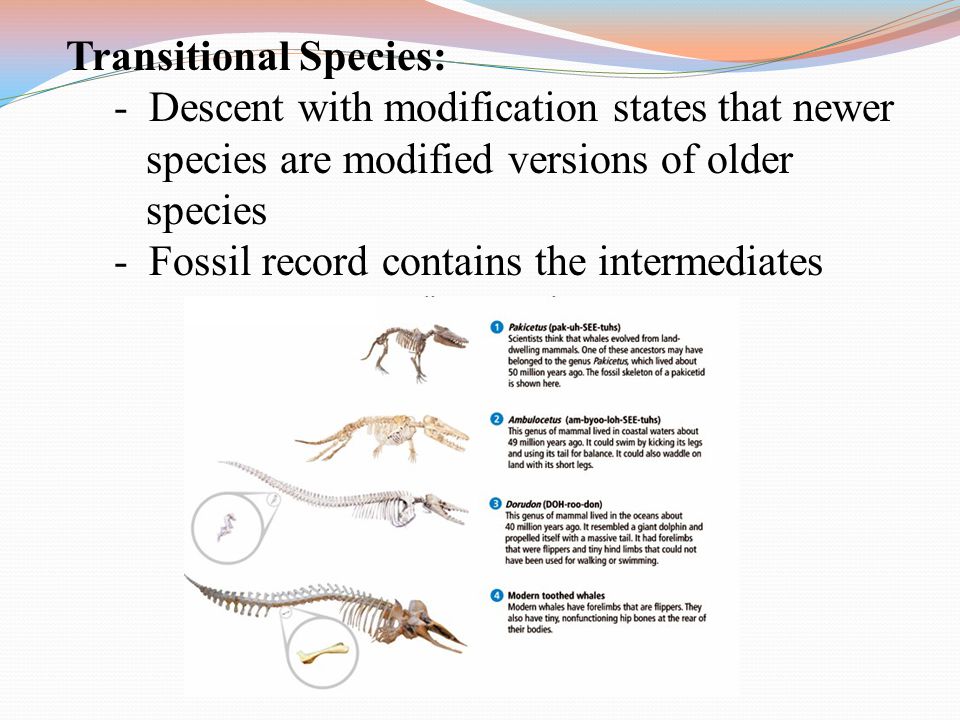
Earlier today on that, uh, other social media platform, I found a discussion about evolution. One participant in this discussion said, "Show me the transitional animals. Just one."
Sure. No problem.
Admittedly I hate citing Wikipedia just as much as the next guy, but Wikipedia serves as a useful starting-off point, and is often a place where someone heads first to learn a little bit about a subject, then can follow the source links to get more in-depth information. I wouldn't rely upon it exclusively, but it gets the job done. In any case, several people offered up that and similar links, but her response to those offerings showed not only a poor understanding of Evolutionary Theory in general, but also the question she was asking in particular.
She didn't want transitional animals, per se. She "believed in microevolution, not macroevolution", a common phrase you hear from laypersons without a solid scientific background or an interest in the subject matter (spoiler alert: there's no such thing, it's all evolution). What she wanted was for someone to point to something that was clearly in the process of transforming into something else, such that there could be no doubt this was the "link" between the two.
This is weak logic demonstrating an extremely ill-formed question. Unfortunately, it sounds like a perfectly reasonable request and it's the insidiousness of this 'clearly reasonable' unreasonable request that renders it so powerful in so many peoples' minds. To help the commenter in question understand why this demand is ill-formed and, in fact, impossible to meet, I proposed a much easier to understand analog question. I'm reproducing it here so others may find it and use it to help themselves or others to understand.
Consider the following scenario:
Every day for 70 years, I take a picture of a human. Starting with the day of his birth and ending on the day of his death (we'll assume he dies right on his 70th birthday), I snap a Polaroid. That's over 25,500 individual images. I then lay those images out in a long line: far left is day of birth, far right is day of death. It's literally possible to see every stage of this man's life, from infant to toddler, from toddler to young adult, from young adult to teenager, from teenager to adult, from adult to middle age, from middle age to old age, and old age to death.
With all those pictures to select from, my request should be simple: I need you to look at all of them and point out to me the exact point in this man's life when he became an adult. Not from a numerical standpoint, because that's dependent on many variables dictated by culture. Just look at the pictures and determine when, exactly, he became an adult.
We know it happens, because we know the changes all humans go through between birth and death. They're all documented. We know there is such a thing as infancy, childhood, and adulthood. This is undeniable, something no rational person on the planet would dispute. I simply need you to pick the day, the point in time, when he became an adult, then explain what the difference was between that picture, the picture immediately before it, and the one immediately after, that led to your answer.
That's impossible, isn't it? From day to day, we basically don't change. And yet if you look at a picture of yourself from 10 years ago, 15 years ago, 20 years ago, it's obvious that changes have occurred. Your inability answer my demand doesn't somehow disprove the fact that he moved from infant to toddler to young adult and so forth. The evidence for it is all there, we can see it happens, and yet we can't point to any specific instant when it occurred. Neither could any reputable or honest biologist point to a fossil and say, "This is exactly where the transition between A and B occurred." Especially because fossils themselves are exceedingly rare. Continuing with the 'one picture a day' example, suppose I task you with doing the same thing only I then remove 1/3rd of the images at random. How sure could you be you'd found the answer if you knew you were missing so much information?
Evolution is the same, only on a much, much, much larger scale. Consider instead of once a day, I took a picture once per hour, laid them all out, and asked the same question of you, and we're STILL not at a scale comparable to the geologic levels of time required to understand how evolution happens.
A request to see a transitional animal is ill-formed because every single animal currently alive today is a transitional animal. Every person reading this has small changes passed from his or her parents, and any children you have now or will have later will, by virtue of the way biology works, be slightly different from you.
An evolutionary biologist can no more point to the exact specimen in the fossil record where A became B than you could look at a series of photographs depicting the life-span of an average human and point out with any degree of certainty when that human became an adult without resulting to some arbitrary cultural measure like figuring out which picture depicted his 16th, or 18th, or 21st birthday, and saying, "That one."
I hope this example is easy to understand, and helps paint a clearer understanding of why this particular question (or really the question behind the question) is an example of weak logic. If you like it, feel free to use it in your own discussions, poke that 'upvote' button, and remember to never stop learning! :)
Good piece of science writing :)
I'm particularly interested in today's worldviews and all that week thinking about the evolution makes me sad. Christian theologians are to blame for that, I guess. Christianity has no serious answer to evolutionary ideas of life and human beings.
So they just playing intellectual games. Playing for time. (Maybe not such an answer exist anyway).
Great example. I think it's a very clear analogy to understand, but those opposed to evolution will still fail (willfully) to see the comparison.
That's true, but one thing I try to remember when having an online discussion or really a debate of any kind, is that the discussion really isn't for the benefit of me or the person I'm discussing something with. It's for those watching, reading, or following, who are honestly looking for answers to difficult questions. If I can provide a simple, reasonable, and non-condescending response, someone I never meet may very well find come away more informed because of it. And I'm totally satisfied with that outcome. :)
Excellent point. You're not going to convince the other debate team... but the judges and audience are another matter!
Congratulations @modernzorker! You have completed some achievement on Steemit and have been rewarded with new badge(s) :
Click on any badge to view your own Board of Honor on SteemitBoard.
For more information about SteemitBoard, click here
If you no longer want to receive notifications, reply to this comment with the word
STOPThx for share.... upvoted....I posted my art work and saw your post on new feed...plz do check on my art for your support... thx u.... I followed U now..