Erythrocytes transport for oxygen
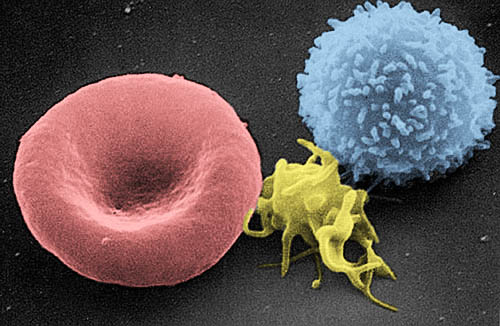
[Scanning electron micrograph of blood cells. From left to right: human red blood cell, thrombocyte (platelet), leukocyte](By Electron Microscopy Facility at The National Cancer Institute at Frederick (NCI-Frederick) - [1], Public Domain, Link).
Everyone knows that red blood cells are an oxygen carrier. They take oxygen in the lungs and deliver it to the body tissues. But what is interesting is the size of the red blood cells. Erythrocytes are much larger than the thickness of the blood capillaries. Human erythrocytes are very small elastic cells of a disc-shaped biconcave form with a diameter of 7 to 10 μm. And the average diameter of the capillary is 5 μm. How does red blood cells manage to penetrate the farthest corners of our body. It's very simple, the red blood cells are twisted by a tube. So they are flat, then it is not difficult at all. And in this way, red blood cells enter the capillaries. Plus, this increases the area of contact of red blood cells with the walls of the capillaries, which in turn increases the oxygen output.

[Transmission electron microscope image of a thin section cut through the pancreas(mammalian). This image shows a capillary within the pancreatic tissue(acinar cells in this image). Note the abundance of rough endoplasmic reticulum in the acinar cells. There is a red blood cell within the capillary. The capillary lining consists of long, thin endothelial cells, connected by tight junctions. The image shows fenestration of these endothelial cells. The image also shows synaptic vesicles in the neuron(nerve cell) next to the capillary. JEOL 100CX](By Louisa Howard - http://remf.dartmouth.edu/imagesindex.htmlhttp://remf.dartmouth.edu/images/mammalianPancreasTEM/source/14.html, Public Domain, Link)
But the red blood cells are not always in this state. For example, when we drink alcohol, or the acidity of the blood rises, they swell(explain why the erythrocyte swelling occurs below
) and, as a result, "stick together". The result is not difficult to imagine that they can not pass through thin capillaries, than they deprive the most distant cells of oxygen. With drinking, the story is such, probably many people know - it causes the effect of intoxication when brain cells do not get oxygen.
Lack of oxygen, it is possible to obtain and mechanically, blocking the breath. Of course, this method is very rude, but nevertheless it can cause the same sensations, dizziness and poor coordination of movements that occur when the drunk person is clogged with red blood cells by the capillaries of the brain. Is that it is more painless and softer.
By the way there is an opinion that this may be the cause of strokes. Strokes a stroke, usually not during drinking, but every other day. This is because the alcohol is still in the blood and the red blood cells stick together, and the person can exercise, which increases the chance of blockage of the capillaries in the brain and as a result of the stroke. Statistics say that most often a stroke occurs, a day after drinking ...
Erythrocytes contain protein, which in principle determines their acid component. But in addition, it contains low-molecular substances in red blood cells, which, to a large extent, lowers the osmotic pressure directed outward into the blood, thus creating only a small excess of pressure necessary to maintain the shape of the erythrocyte. If the external pressure as a result of increasing the acidity of the blood rises, the red blood cells swell. Acquiring a spherical shape in a flat place. Which in turn does not allow him to curl up and penetrate the thin capillaries ...
SteemSTEM is a community project with the goal to promote and support Science, Technology, Engineering and Mathematics on the Steem blockchain. If you wish to support the steemSTEM project you can:
Contribute STEM content using the #steemstem tag | Support steemstem authors | Join our curation trail | Visit our Discord community | Delegate SP to steemstem
This post has received a 0.26 % upvote from @drotto thanks to: @leonid96.
Hey @leonid96. If you want to be upvoted by the stem community you should refrain from using bid bots. It would also be good if you included some more information why the RBCs swell when you consume alcohol. Intoxication is probably more due to the activity of alcohol on the nervous system. It acts as a depressant on certain systems (like your self control) or as a stimulant (urinary system). Cheers!
Thank you @lesshorrible, to be honest, I can not understand what are so bad bots, they that enrich me, no, almost always goes to zero ...
Concerning drunkenness, I mean, a condition when you are not confidently holding your feet ... Of course, alcohol, like any narcotic substance, acts on the nervous system ...
But alcohol is not the main reason. It can be a food that is acidifying blood. Erythrocytes swell and stick together in so-called columns ... which makes their passage difficult. It will be said to the seats that it is not right to take aspirin in such a case. Although aspirin does not allow erythrocytes to stick together, but since this is an acidic substance, the erythrocytes of the swelling become even larger ...
The principle of swelling is based on the acid-acid balance. Movement occurs from the acid medium to the alkaline medium. If the blood is acidic, then the movement is directed to the erythrocytes .... This is the basis of the prince's nutrition of our body ...
I don’t make the rules, people just don’t like when others are using them. Cool, I believe that you know about this topic, but you should include this in your post and cite sources (preferably scientific sources). Good luck! Cheers!
Have a nice day, thank you!