Oberon: Uranus Satellite

Size comparison of Earth, the Moon, and Oberon. Image source: [1]
Oberon is the outermost natural satellite of the largest moons of the planet Uranus. It was discovered by William Herschel on January 11, 1787. Oberon is very similar to the moon Titania in both size and composition of the surface and albedo that is between 0.25 and 0.3 being its gray appearance and quite uniform to Except for some bright rays emerging from some craters.
Oberon has a diameter of 1,523 kilometers, has no atmosphere and its average density is 1.6 g/cm³. Its orbital period is 13.5 days. It is composed of 50% water ice, 30% silicate rock and 20% methane-related carbon and nitrogen compounds.
The surface shows little evidence of internal activity, other than some unknown material that apparently covers the soil of many craters. Several large impact craters can be seen.
More details here: Oberon
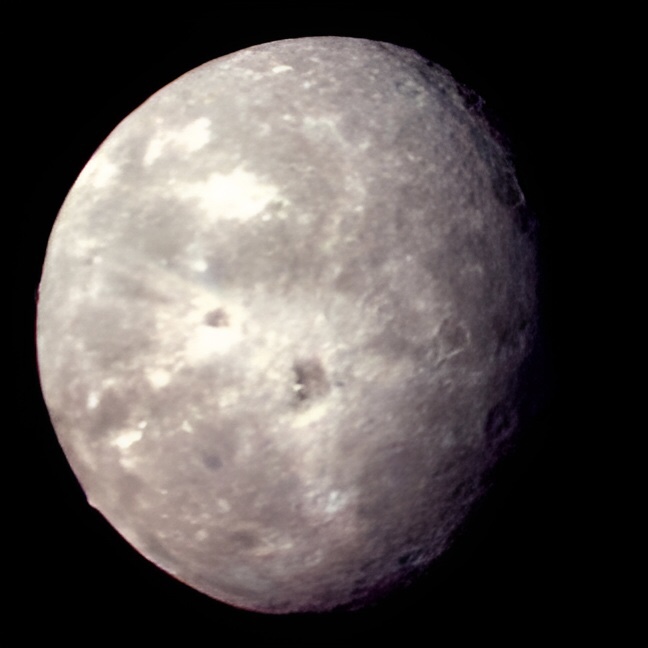
The best Voyager 2 image of Oberon. Image source: [2]
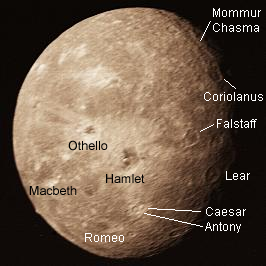
A photo of Oberon. All named surface features are captioned. Image source: [3]

Keep it up. Very informative! 😊