Galaxies: NGC 925 - NGC 1569
NGC 925

NGC 925 imaged with the 32 inch telescope at Mount Lemmon Observatory. Image source: (1)
NGC 925 is another of the galaxies that hides the constellation of the Triangulum, often neglected, although it shares many characteristics of M33, his older sister. It is 30 million light-years away. Hubble accurately estimated this distance by observing the Cepheid stars. It is a SAB (s) d galaxy, a barred spiral with considerable elongation (parameter indicated by the letter "d"). The "s" refers to the absence of a ring in the bar, a structure that sometimes forms inside. It was discovered in 1784 by William Herschel and after studying its kinetic properties.
One of its peculiarities lies in a patent asymmetry that dominates the galaxy in all its corners. It presents a homogeneous and continuous south arm, relatively normal, whereas the northern one appears subdivided in multiple zones without apparent order, as if it were a flocculent galaxy. In addition, the center of the bar does not correlate with the dynamic center of the galaxy, which has given astronomers think. It could be due to the presence of a giant H1 (neutral hydrogen) cloud of one million solar masses that is interacting with the galaxy, although nothing contradicts the hypothesis that it is due to an interaction with another galaxy.
More details here: NGC 925
NGC 1569
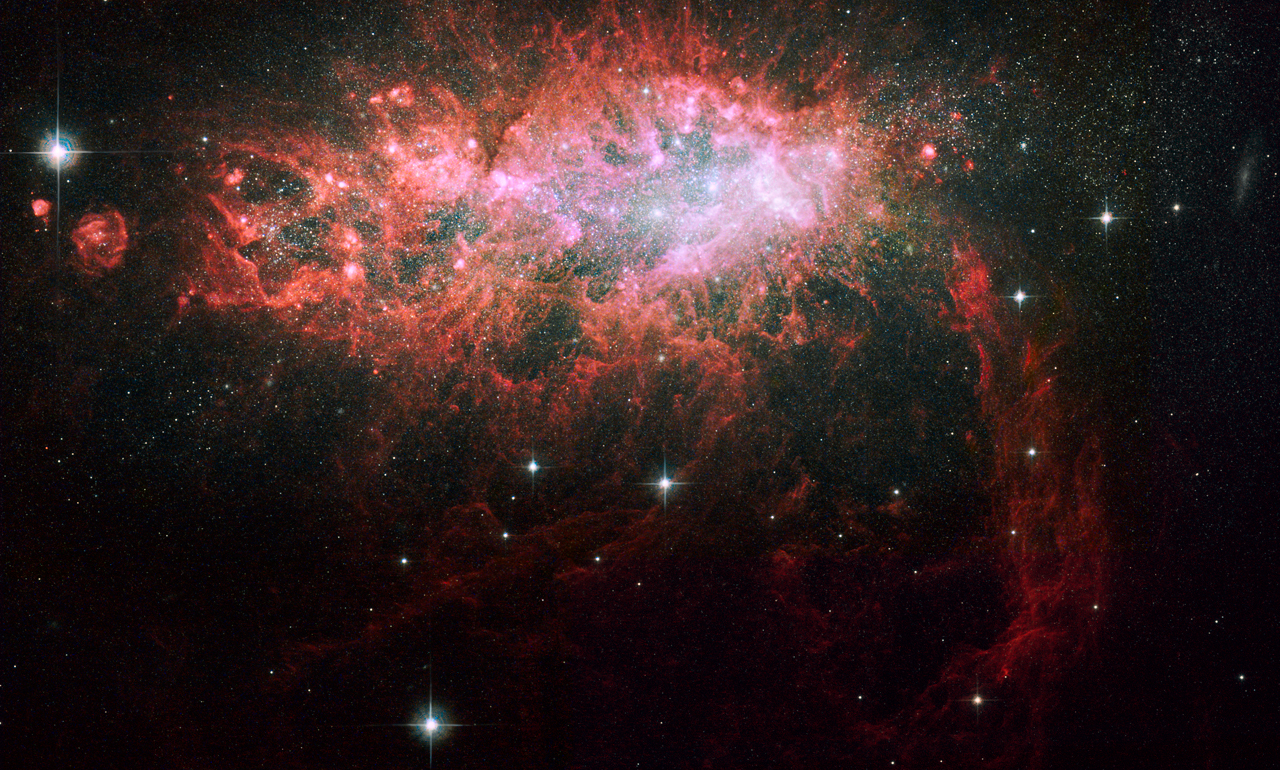
A Hubble Space Telescope (HST) image of NGC 1569. Image source: (2)
The great spiral galaxies often seem to take all the glory by displaying clusters of young, blue, and bright stars in beautiful symmetrical spiral arms. But small irregular galaxies also form stars.
The nearby dwarf galaxy NGC 1569 is a focus of vigorous stellar birth activity; The enormous bubbles it exhales sift through the main body of the galaxy producing, also, brilliant blue star clusters. This galaxy suffered a sudden stellar birth access 25 million years ago, which subsided when the first human ancestors populated the Earth. NGC 1569 is an irregular dwarf galaxy located 7 million light-years away in the constellation Camelopardalis.
NGC 1569 is especially suitable since it is one of the closest starbursts galaxies. It houses two prominent recent massive clusters that could compete with the globular clusters of our galaxy, plus a large number of small stellar clusters comparable to the lax open clusters of our environment.
More details here: NGC 1569

Center of NGC 1569 as imaged by the Hubble Space Telescope. Image source: (3)
