Chemistry Express: An Introduction

Welcome!
This is the beginning of a series of small simple articles on different chemistry topics. The articles aim to summarize and highlight the most important points to remember, whether you are a student or just interested!
Chemistry is all about the small; the science of the actions and the reactions going on in the microcosm that create all the beautiful elements and combinations we see around us.
The elements
Elements are the 118 basic substances of matter that hold different physical and chemical properties. They cannot be chemically broken down into simpler substances. Their basic unit is the atom; everything in the world is made of atoms! An element is a substance that is made entirely from one type of atom.
All elements are listed in the following picture, the periodic table of elements. If you are thinking of a substance that's not in the picture, it means that your substance is a combination of atoms of different elements, called a molecule!

image credit
What is an atom?
Imagine cutting a piece of carbon in smaller and smaller pieces. Will there be a time where you can no longer cut it into a smaller piece?
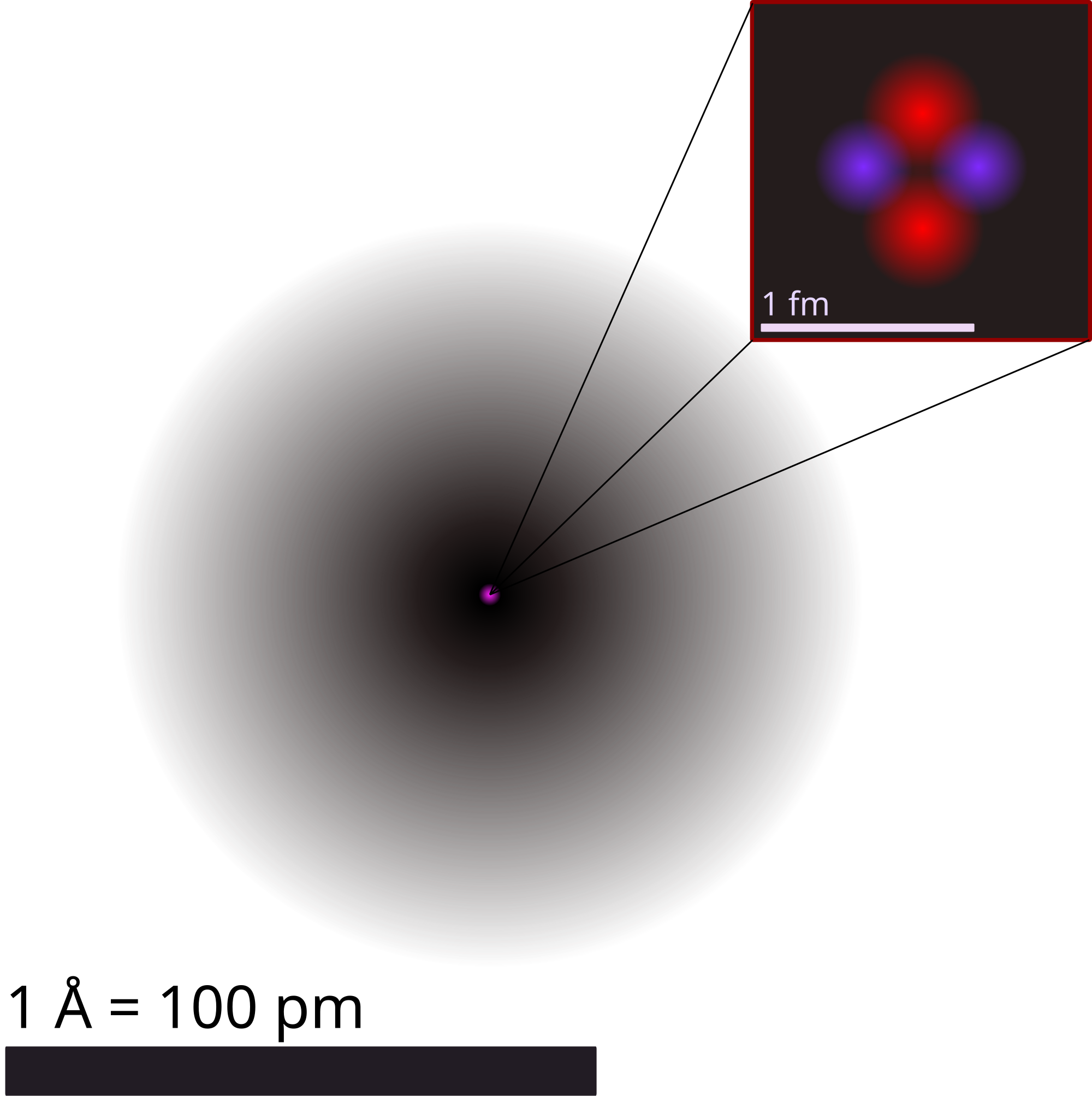
The atom is the smallest ‘piece’ of an element. Atoms are really tiny! They are about 1 million times smaller than a grain of sand!
An atom cannot be divided anymore and still keep the properties of its element. If an atom is divided, it will cease to be that element and will break down to the particles all atoms are made of.
Atoms are made of three main particles: protons (positively charged), neutrons (no charge) and electrons (negatively charged).
Most space inside the atom is empty. Most of their mass is concentrated in their nucleus, that contains protons and neutrons. Electrons are outside the nucleus and randomly spin around it, forming a 'cloud'.
What gives an element its properties?
The difference between an atom of one element and an atom of another is defined only by the number of protons each one has! Hydrogen has one proton, helium has two, lithium has three, and so on.
Each element has different variants, called isotopes. These variants are defined by the number of neutrons.
The number of electrons defines the overall charge of the atom; it also reveals which other elements the atom likes to interact with. For example, if an atom happens to have more electrons than protons, then it has an overall negative charge and will attract atoms with a positive charge! This atom is now called an ion.

image credit
This concludes our first lesson. If you like this content, follow me for more @elemenya
Special thanks to @kyriacos for his logo design!
Great content @elemenya . Keep them coming. I like how you simplify things.
Thank you for your logo design @kyriacos !
Nice job! Great to see more people talking about chemistry!
Oh, I just realized you are doing something similar! Mine will be different though, just simple, summarized main points. For anything more analytical, I will refer people to you :)
The more people talking about the fundamentals of science the better IMO. I'm looking forward to your future posts. :)