Forgotten audio and video formats : DAT
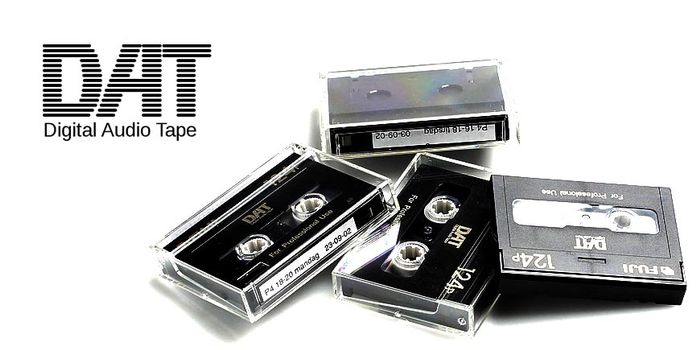
While the audio cassette has been a joy for music lovers for more than twenty years of good and loyal service, the arrival of the CD has opened the door to digital technology in homes at the beginning of the 1980s. For the first time, a storage medium offers a much higher musical fidelity than the various analog processes then used by the record industry. Although this undeniable quality is a delight for music lovers who have the means to equip themselves during this period, the magnetic tape is making resistance, particularly thanks to its recording capacity, which is highly appreciated by the general public. Faced with this popular enthusiasm for an outdated but functional format, the engineers of the famous firm Sony tried to propose a new alternative for the domestic market with the creation of the DAT.
Make something new with old technology !

Decreasing from Digital Audio Tape, DAT is the result of a research work centered around a versatile musical storage medium. Since the recording of digital data on a medium such as CD was clearly not within everyone's reach, Sony's objective was to offer a more affordable format that would be able to reproduce the sound properties associated with digital. Marketed in 1987, the DAT is similar to a smaller audio cassette. At first glance, nothing differentiates these two formats. However, the difference is in the writing process of the helicoidal type data. This technology, which will be reused much later on the mini-DV, operates through a rotating drum overhung by magnetic heads that will read and write the tape. The data is recorded in the transverse direction of the tape and not vertically as on a simple cassette, thus increasing the density of stored information.

By doing so, Sony has succeeded in offering a medium with a large storage capacity. A two-hour DAT offers no less than 1.3 GB of data ! Three and four hour versions will be released later, containing respectively 2 and 4 GB of data ! As such, many IT companies have used DAT to perform their backups.
A little technological gem disowned!
From a sound point of view, this format is exemplary in terms of restitution. Because in addition to recording and playback without any compression, the DAT has several sampling frequency modes, ranging from 32khz / 12 bits (audio cassette), through 44.1khz / 16bits (CD), to finish on 48khz / 16bits (DVD), or even beyond with 96khz / 24 bits ! In addition to all this, the format offers a tracking system similar to the CD ! Unfortunately, with little support from publishers and record companies, due to the risk of massive copies, the format is difficult to install in homes. Despite all the efforts of Sony to democratize the use of support, it will remain confined to the professional domain, to the firm's great displeasure ! The DAT will disappear from the shelves in 2005 and will be a new commercial failure for Sony...
I think not many people are aware of the potential of DAT, but I think its position now is good. Great review!
** This post will be proposed to be curated by the @celfmagazine project **