Mathematical explanation - electric charge
Hello friends of steemit, continuing with my explanations about the science of mathematics, today I want to make reference in this post about the electrical charge and the relationship it has with this science, and other related as physics, here I will be presenting basic deficion concepts , I will talk about the history, also about the properties of the load and to complement this information, I will establish some example of exercises applying the load properties on a body.
Electric charge
The electric charge is an intrinsic physical property of some subatomic particles that is manifested by forces of attraction and repulsion between them through the mediation of electromagnetic fields. The electrically charged matter is influenced by the electromagnetic fields, being, in turn, generator of them. The so-called electromagnetic interaction between charge and electric field is one of the four fundamental interactions of physics. From the point of view of the standard model, the electric charge is a measure of the capacity of a particle to exchange photons.
One of the main characteristics of the electric charge is that, in any physical process, the total charge of an isolated system is always conserved. That is, the algebraic sum of the positive and negative charges does not vary over time.
The electric charge is of a discrete nature, a phenomenon demonstrated experimentally by Robert Millikan. For historical reasons, the electrons were assigned a negative charge: -1, also expressed -e. Protons have a positive charge: +1 or + e. The quarks are assigned fractional charge: ± 1/3 or ± 2/3, although they have not been observed free in nature.
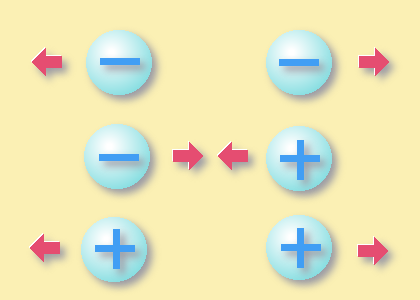
Type of interaction (attractive or repulsive) between charges of the same and different nature.
Units
In the International System of Units, the electric charge unit is called coulomb or coulomb (symbol C). It is defined as the amount of charge that passes through the cross section of an electric conductor in a second, when the electric current is one ampere, and corresponds to:
1 coulomb = free electrons
History
Since Ancient Greece it is known that rubbing amber with a skin acquires the property of attracting light bodies such as pieces of straw and small feathers. Its discovery is attributed to the Greek philosopher Thales of Miletus (ca. 639-547 BC), who lived about 2,500 years ago.
In 1600 the English physician William Gilbert observed that some materials behave like amber when rubbed and that the attraction they exert manifests on any body, even if it is not light. As the Greek name corresponding to amber is ἤλεκτρον (ēlektron), Gilbert began to use the term electric to refer to all material that behaved like that, which originated the terms electricity and electric charge. In addition, in Gilbert's studies you can find the differentiation of electrical and magnetic phenomena.
The discovery of the attraction and repulsion of elements when connecting them with electrical materials is attributed to Stephen Gray. The first to propose the existence of two types of charge is Charles du Fay, although it was Benjamin Franklin who, studying these phenomena, discovered how the electricity of bodies, after being rubbed, was distributed in certain places where there was more attraction; that's why he called them (+) and (-).

Experiment of Benjamin Franklin's kite
Nature of the load
Electric charge is an intrinsic property of matter that occurs in two types. These now bear the name with which Benjamin Franklin called them: positive and negative charges. When charges of the same type are repelled and when they are different they attract. With the advent of the relativistic quantum theory, it could be formally demonstrated that the particles, in addition to presenting electric charge (be it null or not), present an intrinsic magnetic moment, called spin, that arises as a consequence of applying the theory of special relativity to quantum mechanics.
Elementary electric charge
Current research in physics suggests that electric charge is a quantized property. The most elementary unit of charge was found to be the charge that the electron has, that is about 1,602 176 ( 487(40)x10^-19 ) Coulombs (C) and is known as elementary charge.The value of the electrical charge of a body, represented as q or Q, is measured according to the number of electrons that have excess or defect.
This property is known as charge quantization and the fundamental value corresponds to the electric charge value that the electron has and to which it is represented as e. Any charge q that exists physically, can be written as N x e being N a whole number, positive or negative.
By convention the charge of the electron is represented as -e, for the proton + e and for the neutron, 0. The particle physics postulates that the charge of the quarks, particles that make up protons and neutrons, take fractional values of this elementary charge . However, free quarks have never been observed, and the value of their charge as a whole, in the case of the proton sum + e and in the neutron, adds 0.
Although we do not have a sufficiently complete explanation of why the charge is a quantized quantity, which can only appear in multiples of the elementary charge, various ideas have been proposed:
Paul Dirac showed that if there is a magnetic monopole, the electric charge must be quantized.
In the context of the Kaluza-Klein theory, Oskar Klein found that if the electromagnetic field were interpreted as a secondary effect of the curvature of a topology time space M x S ^ 1 then the compactness of S ^ 1 would lead to the The linear moment according to the fifth dimension would be quantized and hence the quantization of the load was derived.
In the International System of Units the electric charge unit is called coulomb (symbol C) and is defined as the amount of charge that at a distance of 1 meter exerts on another amount of charge equal to a force of
A coulomb corresponds to the load of electrons.The value of the charge of the electron was determined between 1910 and 1917 by Robert Andrews Millikan and at present its value in the International System according to the last list of constants of the published CODATA is:
Since the coulomb may not be manageable in some applications, because it is too large, its submultiples are also used:
Often the CGS system is also used whose electric charge unit is the Franklin (Fr). The value of the elementary charge is then approximately
Properties of the charges
Principle of conservation of the load
In accordance with the experimental results, the principle of conservation of the load establishes that there is no destruction or net creation of electric charge, and affirms that in all electromagnetic process the total charge of an isolated system is conserved.
In an electrification process, the total number of protons and electrons is not altered, there is only a separation of the electric charges. Therefore, there is no destruction or creation of electric charge, that is, the total charge is conserved. Electric charges may appear where there was not previously, but they will always do so in such a way that the total charge of the system remains constant. In addition, this conservation is local, it occurs in any region of space no matter how small.
Like the other conservation laws, the conservation of the electric charge is associated with a Lagrangian symmetry, called in quantum physics invariance gauge. Thus, by Noether's theorem, each Lagrangian symmetry associated with a uniparamétrico group of transformations that leave the invariant Lagrangian corresponds to a conserved quantity.The conservation of the load implies, as does the conservation of the mass, that at each point of the space is satisfied an equation of continuity that relates the derivative of the density of electric charge with the divergence of the electric current density vector, said equation expresses that the net change in the charge density (p) within a predetermined volume V is equal to the integral of the electric current density J on the surface S enclosing the volume, which in turn is equal to the electric current I intensity:
Invariant relativistic
Another property of electric charge is that it is a relativistic invariant. That means that all observers, regardless of their state of motion and speed, can always measure the same amount of charge, unlike space, time, energy or the linear moment, when a body or particle It moves at speeds comparable to the speed of light, the value of its charge will not vary.
Electric charge density
The electric charge density is called the amount of electric charge per unit of length, area or volume that is on a line, a surface or a region of space, respectively. Therefore it is distinguished in these three types of load density, represented by the Greek letters lambda (λ), for linear load density, sigma (σ), for surface charge density and ro (ρ), for density of volumetric loading.
There can be both positive and negative charge densities. It should not be confused with the density of charge carriers.
Although the electric charges are quantized with q and, therefore, multiples of an elementary charge, sometimes the electric charges in a body are so close to each other, that it can be assumed that they are evenly distributed by the body of which they are part The main characteristic of these bodies is that they can be studied as if they were continuous, which makes their treatment easier without losing generality. There are three types of electric charge density: linear, surface and volumetric.
Linear charge density
It is used in linear bodies such as, for example, wires.
Where Q is the charge enclosed in the body and L is the length. In the International System of Units (SI) it is measured in C / m (coulombs per meter).
Surface charge density
It is used for surfaces, for example a thin sheet metal such as aluminum foil.
where Q is the charge enclosed in the body and S is the surface. In the SI it is measured in C / m2 (coulombs per square meter).
Volumetric charge density
It is used for bodies that have volume.
where Q is the charge enclosed in the body and V the volume. In the SI it is measured in C / m3 (coulombs per cubic meter).
Ways to change the electrical charge of bodies
Electrification is called to gain or lose electrical charges, usually electrons, produced by an electrically neutral body. The types of electrification are the following:
1 . Electrification by contact:
When we put a charged body in contact with a conductor, a load transfer from one body to the other can be given and the driver is charged, positively if he "gave up electrons" or negatively if he "won" them.
2 . Frictional electrification:
When we rub an insulator with certain types of materials, some electrons are transferred from the insulator to the other material or vice versa, so that when they separate both bodies are left with opposite charges.
3 . Load by induction:
If we approach a negatively charged body to an isolated conductor, the repulsion force between the charged body and the valence electrons on the surface of the conductor causes them to move to the farthest part of the conductor to the charged body, leaving the closest region with a positive charge, which is noticeable by having an attraction between the loaded body and this part of the driver. However, the net charge of the driver remains zero (neutral).
4 . Charging by the photoelectric effect:
It happens when electrons are released on the surface of a conductor when irradiated by light or other electromagnetic radiation.
5 . Charge by electrolysis:
Chemical decomposition of a substance, produced by the passage of a continuous electric current.
6 .Charging by thermoelectric effect:
Means producing electricity by the action of heat.
Below is a series of basic exercises where the basic properties of the electric charge, including the application of coulomb's law, apply:
References
1 . Eric W. Weisstein (2007). «Charge» (in English). Retrieved on February 12, 2008.
2 . Load and start systems gm 11 cf pag 9 in Google books.
3 . Profs. Casatroja - Ferreira. "Electrostatics". Retrieved on February 21, 2008.
4 . Willians Barreto (2006). «Electric charge». Retrieved on February 26, 2008.
5 . «The NIST Reference on Constants, Units, and Uncertainty: elementary charge». NIST 2006. Retrieved on February 28, 2008.
6 . «Electromagnetism and Optics». Archived from the original on June 3, 2007. Retrieved on February 27, 2008.
Bibliography
Landau & Lifshitz, Classical Theory of Fields, Ed. Reverté.
Segura González, Wenceslao, Relativist field theory, eWT Ediciones, 2014.