UNDERSTANDING YOUR TEMPERAMENT.
The book of Roman 7:15-24 revealed the cry of the despair felt by every natural human being who laments of his/her weaknesses in carrying out the will of God or to do what is morally good.
Romans 7:15-24 (NIV):
15 I do not understand what I do. For what I want to do I do not do, but what I hate I do. 16 And if I do what I do not want to do, I agree that the law is good. 17 As it is, it is no longer I myself who do it, but it is sin living in me. 18 For I know that good itself does not dwell in me, that is, in my sinful nature.[a] For I have the desire to do what is good, but I cannot carry it out. 19 For I do not do the good I want to do, but the evil I do not want to do—this I keep on doing. 20 Now if I do what I do not want to do, it is no longer I who do it, but it is sin living in me that does it. 21 So I find this law at work: Although I want to do good, evil is right there with me. 22 For in my inner being I delight in God’s law; 23 but I see another law at work in me, waging war against the law of my mind and making me a prisoner of the law of sin at work within me. 24 What a wretched man I am! Who will rescue me from this body that is subject to death?
In the ancient world, people were fully aware of gross abnormalities in human behavior. However, they were not able to diagnose the cause of these weaknesses in man; hence they attributed them to the intervention of the gods.
Hippocrates (460-370) refused to subscribe to the views held by the ancient people as regards to the cause of moral deficiencies of man. Rather he saw these problems as something that is caused by an in built traits in every man which he called temperament.
To support this view Dr. Tim Lahaye said “we are what we are by who we are”. He further stated that temperament influences everything you do from sleep habits to study habits, to eating style and the way you get along with others.
Humanly speaking, there is no other influence in your life more powerful than your temperament or combination of temperaments. That is why it is important to know your temperament; which is the purpose of this post.
WHAT IS TEMPERAMENT?
Both Dr. Tim Lahaye and Dr. Prosper Ayawei defined temperament as the combination of inborn traits that subconsciously affect man’s behavior. These traits (i.e. distinguishing qualities of characteristics) are arranged genetically on the basis of nationality, race, sex and other hereditary factors. These traits are passed on by the genes. Some psychologists suggest that we get more genes from our grandparents than our parents. This explains why children in most cases resemble their grandparents than their parents.
WHAT ARE THE BENEFITS OF UNDERSTANDING YOUR TEMPERAMENT?
a. It will help you to know your strength and weakness and learn to overcome them, while maximizing your strength.
b. It will help you to know your limitations and what you can do better.
c. In choosing career your understanding of your temperament blend will play a major role e.g. if one is an introvert he many not do well in anything that involves much talking e.g. sells man etc.
d. It will lead you to go to God for the transformation of your weakness into strength.
e. It will help you know how to relate to people either as a manager or employee, even in your family life.

TEMPERAMENT DISTINCTIONS.
EXTROVERT AND INTROVERT
We want to begin with this concept just for better understands of the temperament theories not with reference in hierarchy or seniority of thought or concept. Carl G. Jung (1875-1961), divided personality types into extraversion and introversion.
Introvert according to him is shy, reserved and altruistic (i.e. unselfish) type of person.
While the extrovert is sociable outgoing, talkative and well distinguished personality.
HYPPOCRATES FOUR DISTINCT TEMPERAMENT CONCEPT:
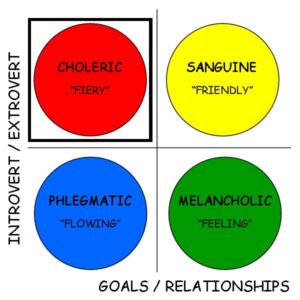
He distinguished four temperaments at work, namely: the sanguine, the choleric, the melancholy and the phlegmatic.
He goes on to say that a person’s temperament depends on the “Humor”, that is the type of blood he/she has.
WILLIAM SHELDOM FOUR DISTINCT TEMPERAMENT CONCEPT
During Second World War (1942) he published his work on temperament. His view fall in line with that of Hippocrates about temperament, however, he gave another name to those four distinct temperaments with two grouping.
i. Extrovert
ii. Endomorph
iii. Mesomorph
iv. Sanguine
v. Choleric
- INTROVERT
i. Am bimorph
ii. Ectomorph
iii. Melancholy
iv. Phlegmatic
DISCOVER YOUR TEMPERAMENT.

After carefully examining the temperament chart below, you may find your dominant temperament by making a list of the trait that stand out in your life. Start by naming your strength first, then find the corresponding weakness on the wheel.
There are several factors to keep in mind when trying to discern your temperament.
No particular temperament is better than the other; hence all the four temperaments have their inherent strength and weakness.
No one is characterized by just one temperament. Since our parents or grandparents contribute to our make up, every one is a blend of at least two and sometimes three temperaments.
For examples, a sanguine choleric may be 60 percent sanguine and 40 percent choleric etc; but the more dominant one temperament is the easier it is to diagnose the personality.
Sometime it is impossible to determine the secondary temperament. Naturally, a person with two prominent temperaments or a combination of three temperaments would be difficult to diagnose, because he may not have extreme strength or weakness that makes diagnosing easier i.e. the person may not be extremely extrovert or introvert and as a result have a balance character.
More about the career of the 4 temperament.
A sanguine: Endomorph: with his cherishing will do well as a sales man, nurse, doctor or anything that has to do with entertainment.
Choleric: Mesomorph: will be a good leader, motivator and productive as long as it does not require too much meeting or committees and long range planning because he has no time for all these.
Phlegmatic: Ectomorph: can do well in teaching, librarians engineering, electrician, carpenters. He can also do well as a leader in industries and companies.
Melancholy Ambimorp has the highest intelligent quotient more than other temperaments. He is creative and imaginative with strong perfectionist tendencies. He is a good artists, musician, scientist and educator. He gets involved in humanitarian services and the medical profession.

In terms of life career the sanguine can be a good actor, salesman, speaker etc.
The choleric can be a good builder, producer, leader etc.
The melancholy can be a good artist, musician, inventor, philosopher, professor, secretary etc.
The Phlegmatic can be a good diplomat, accountant, teacher, technician etc.
GOD CAN TRANSFORM YOUR WEAK POINTS:
From our passage we discover that temperament is our “old nature” what men need is “a new nature” this new nature is imparted to men when he receive Jesus Christ into his life.
Read 2Cor. 5:17; 2Pt. 1:3-4. The coming of the holy spirit into the heart of a repentant sinner will take care of his weakness and help to maximize his strength. Gal: 5:22-23, Phil. 4:13, 2Tim. 1:7
All we need to do is to surrender ourselves to God.
Romans 12:1-2 (NIV):
Therefore, I urge you, brothers and sisters, in view of God’s mercy, to offer your bodies as a living sacrifice, holy and pleasing to God—this is your true and proper worship.
2 Do not conform to the pattern of this world, but be transformed by the renewing of your mind. Then you will be able to test and approve what God’s will is—his good, pleasing and perfect will.
Hum...not really sure I fit in any of the 4 categories! I guess I am unique!