Why Do People Willingly Disobey Law?
Law is the rule of any country which is recognized as the regulating factor of human actions and which may be employed when the rule is broken by the citizens. It is a legal force that ensures sanity in the society.

Laws are always enacted for ‘good’ reasons. Without law, it is impossible to think of a society or community. Life in a lawless society will be brutish, short and nasty as Thomas Hobbes argued.
Despite the fact that these laws are for the good of man, some persons abuse it. Abuse in this case is from the authorities who think they are above the laws enacted since they are ‘leaders’. The popular saying is: 'law is no respecter of anybody' but we know this is not totally true.
Without digressing from the crux of this piece, I intend to ask why we disobey law even when we know the thing in question is prohibited or unlawful.
In Nigeria, it is an offence to import frozen foods because the government believe it is dangerous to our system. There is a clear law that prohibits importation of turkey, chicken or any frozen foods to Nigeria. But we know there are many shops with imported frozen foods in Nigeria.
Nigeria has porous borders which is one major problem. Not all these borders are properly guarded and even the ones that are being guarded are guarded by ‘corrupt’ officers who collect bribe and allow these products into the country. Bribery is an offence and importation of frozen foods is another offence but people engage in the two freely.
Why do we disobey law?
Also, the government banned importation of vehicles through land borders because those vehicles are either substandard or the importers do not pay duties. This is another major problem created by the same porous borders. So the dealers of these vehicles go to Cotonou to buy ‘cheap’ vehicles and bring them into Nigeria via the borders by bribing some officers. In most cases, the government get little or nothing from the importation.
So the government of the Cotonou and the dealer make good profit while Nigeria as a country make little or nothing from such business. This made the government to ban importation of vehicles by land borders. The right route for any vehicle into Nigeria is through the sea.
This is a law that all dealers and the customs officers are aware of but the dealers still smuggle vehicles through the land borders. We hardly work at night in this part of the world and this is the time these dealers bring in their vehicles. In most cases, they bring them into Nigeria without any officer noticing them and when they are caught, we hear about some and many are settled on the spot.
Why do people disobey law?
For some months (during this Buhari's administration), we have been in recession for reason known to the economists and the present administration. Luckily, we got out of it two or three months ago and inflation reduced drastically. Many things were experimented before we could reach where we are today. Most of those things were trial and errors but in the end, some paid off. One of the strictest law by the present administration is war against importation of rice. When this law was in full force, a bag of rice was very expensive. This is because the Nigerian farmers could not meet the demand to deliver the expected quantity of rice to feed about 190 million people. This made those with foreign rice to increase the price. It was during this period that nylon rice was discovered in Nigeria! You can imagine how callous fellow human being can be just because of money.
To correct this, money was pumped into the agricultural sector, state like Lagos and Kebbi went into partnership to produce Lake Rice. These things yielded in the long run and the price of rice reduced drastically.
Despite the restriction on the importation of rice into the country, we have many foreign rice in the country. People still smuggle them in bags. Just yesterday Saturday 2 December, 3, 309 bags of rice was seized by Nigeria Customs.
Why do people disobey law?
Perhaps, this is due to poverty? I doubt if this is true because a car dealer is logically a rich man because to start car business, you need good and reasonable capital. To deal in rice business too, you need reasonable capital. Or could it be that they are doing it to ‘help’ those who could not afford the new cars (for the auto dealers)? Or those smuggling rice are doing so to reduce the inflation at that time? If so, why are they still doing the business (smuggling)?
Disobedient is always followed by sanction and in most cases jail term. So why would people risk their lives to get killed by officers or go to prison when they know the consequences of their actions?
There are many laws against smuggling, killing, stealing etc, but people still do these things. WHY?
@Euronation would like to hear from you.
Thanks for reading!
@euronation team is a group of people with common goals and desires. The team was created with the intention to create awareness around steem ecosystem, getting new members on board the program, nurturing as well as mentoring towards excellence and helping them to find strong footing in the program. We guide new members on the ethos of steemit, how they can be creative and come up with amazing ideas and impact the community at large.
The team is made up of:
I guess we live for the moment, this results in us choosing short term benefits over long term. Mind you some people are just anarchist by nature.
Hello @blessedman939
You are right. I still don't know people do the wrong thing when they know it is wrong.
The law cannot make whole, love conquers all...
@doctorvee
this is not about whether law can make you whole or not! It is about going against what the law stipulates! If the law says something is wrong, then it is wrong as far as the country is concerned. This has nothing to do with love.
Thanks.
I think that many people could make very reasonable arguments against the following:
In all of the examples given, the justifications for the law are not readily apparent, and whether the law is enacted for 'good' reasons is unclear. In fact, many economists would argue that the examples shown are to protect particular industries from the competition of imported goods, while doing harm to the rest of the country through higher prices or inferior quality of goods.
Whenever it is not readily clear why a law has been passed, or how it actually accomplishes the intended objections, the less likely the law is to be followed, especially when there is profit to be made from disobedience.
An unjust law is no better than tyranny, and even an honest man may show greater integrity in the breaking of the law than in the upholding of it.
Hello @josephsavage
you need to understand first the meaning of '' when it is used on word (s). By using that, the word 'good' becomes personal or subjective. Meaning the interpretation of that word is personal.
It is also possible that a law might be enacted to favour the elites especially when you look at it from Karl Marx angle. However, whether you accept it or not, a lawless society is not better off the ones we have now. You cannot protect what you think law cannot protect in a lawless society.
Also, saying 'an unjust law is no better than tyranny' does mean an unjust law is that which is tyrannical in nature. You need to understand that the fact that a law appears 'unjust' does not mean it is a tyrannical.
You also need to explain further what you mean by 'unjust' because in reality, what appears unjust to you might not be unjust to me.
Thanks for your time.
Thanks.
Unjust:
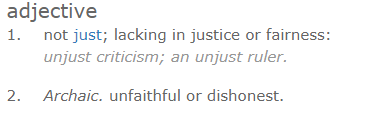
Just:

Tyranny:

Tyrannical:
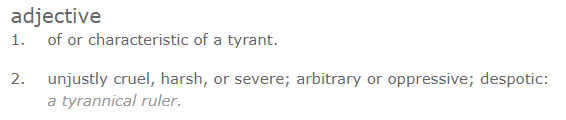
source for all words: dictionary.com
The common theme is fairness v. arbitrary.
There is a common term in civic discourse called "Rule of Law."
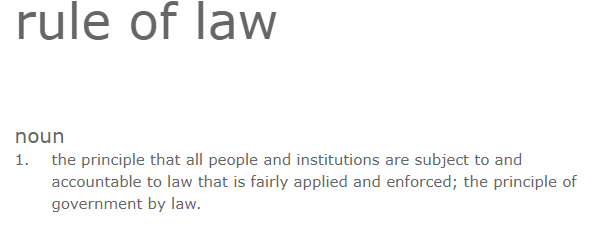
Fairly applied and enforced. In my opinion, all of the examples you gave violate the rule of law. Even if honest in intent, they fail in practice because of the arbitrary enforcement. With rampant corruption blocking the enforcement, it is just as likely that the laws are there so that bribes must be paid, rather than for any social good.
Moving past the arbitrariness to the underlying laws, they select out specific groups for favor and harm other groups to provide that favor. People go hungry because rice is illegal to important. People are so desperate to eat that they buy rice on the black market and take risk of it being made of nylon. If that is not lacking fairness (from unjust definition) or is not oppressive (from tyrannical definition), then I don't know what is.