Lets Go Scientific - Young's Experiment
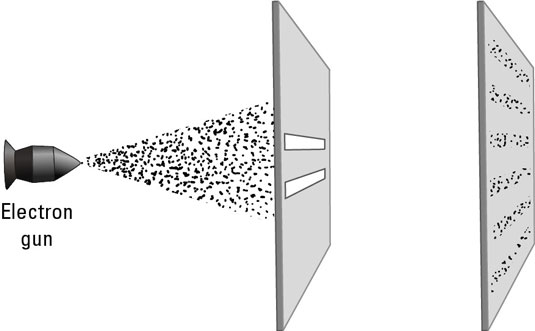
We saw that if we take a source that emits electrons, and we want to measure the location of their fall on the screen, and by making the source intensity so small that it emits electrons individually one by one, we will find that if we open only one of the two slits, that the electrons will behave in the expected way that the particles behave, and they will fall on The screen in the ring corresponds to the open slit. Whereas if we open the two slits together, we will get an interference pattern as shown in the following illustration:
How can the electrons that we usually assume emanated from the source as particles produce a interference pattern such as waves?
How can an electron, when passing through one of the two slits, be affected whether the second slit is open or not? Rather, how does he know that the two slits are open together or that only one of them is opened? Could the electron have passed through both slits and interfered with itself? And when we put a measuring device at one of the two slits in order to reveal to us the location of the electron's passage, we find that the interference pattern disappears, and that the electron behaves as if it is a particle again, as if it knows that we are observing it and decided not to act as a wave !!!
So what is really happening?
Trial measuring device
Here, we must check the way we measured it if the electron passed through the first or second slit. One of the methods of measurement includes that we place between the source of electrons and the barrier that contains the two slits of light, as in the following diagram:
Of course, the drawing is just a very simplified diagram, in which the distance between the two slits is greatly exaggerated, but it is important that the idea reach. And now, for the electrons that reach the screen, we assume that what would happen is the following: If the electron passes from the upper slit, it will interact with the light beam shown on the shape in red, and we will know from this that it passed through this slit. Whereas if that had not happened, we would assume that the electron had passed through the lower slit. When the experiment is performed, the interference pattern disappears and the electron behaves again as a particle.
Someone might say, perhaps that the intensity of the light beam has ruined the behavior of the wave electrons, and that we have to weaken its intensity a lot so that it becomes a group of photons (a photon is a light particle) that comes out successively. But here we will face a new problem: either the issued photon can interact with the electron and measure it for us, or that the electron will pass without interacting with any of the photons and we will not be able to measure its position, so will we then get a mixture of an interference pattern with the pattern that is formed When does an electron behave like a particle when measured by a light beam? And when you do the experiment, we find that this is really happening!
What is going on?
Someone might say, the problem is with the type of measuring device used, and we have to change the measurement method to verify this. Indeed, when conducting the experiment, we find that whatever method is used to know the slit through which the electron passed, whether we use a light beam or a bubble chamber 2 or ... etc., the result is the same: when we design the experiment so that we do not know from which slot the electron will pass, we will find an interference pattern on the screen And that the electron behaves like a wave. Whereas, when we design the experiment so that we measure from which slot the electron has passed, the interference pattern disappears and the electron behaves like a particle again !!!
Here and before continuing, a popular myth about this experience, which has been promoted in the many simplistic and non-specialized sources you are talking about, must be refuted. Some people suggest when talking about this experiment that the presence of a conscious observer who is measuring is what makes this strange behavior appear, but as we have seen this speech is not true, as a light beam or bubble chamber or any physical group interacting with the electron to determine from which bitter crack will lead For these strange results, nothing to do with awareness of the matter here.
So let us continue to think in a scientific way, and as we are supposed to do always, to investigate what is happening here.
This post has received a 34.4 % upvote from @boomerang.
This post has been rewarded by the Steem Community Curation Project. #communitycuration06
ps: You seem to be posting mostly on Steem blockchain.
Consider joining Project.hope community.
We like to share publications related to technology, blockchain, AI and economy, marketing etc. Link: https://steemit.com/trending/hive-175254