Apple Tree: Illustrations for Pruning Advice
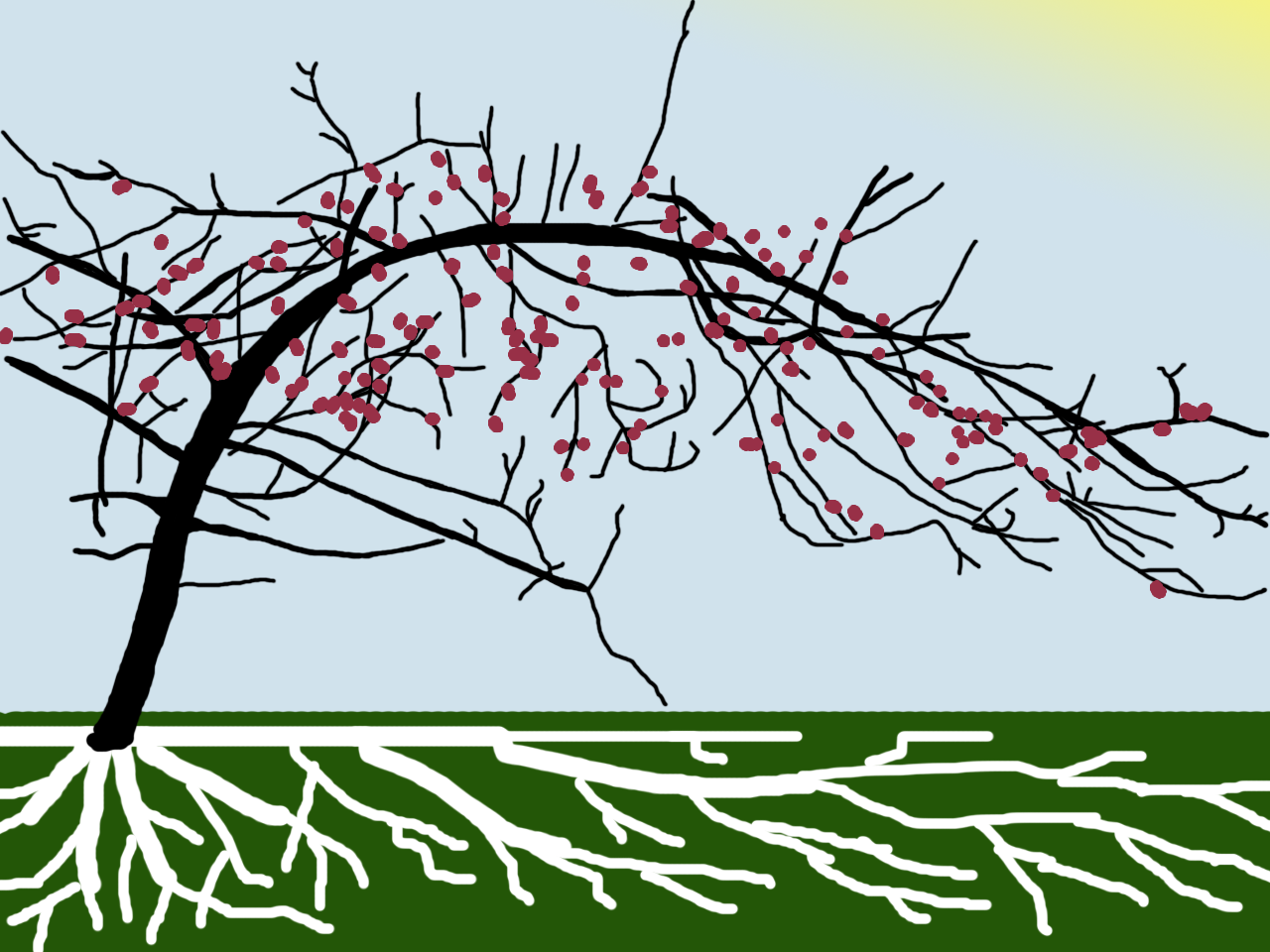
In today's article, I have designed various artistic illustrations to show suggestions on how to prune a real apple tree that needs some tender loving care. The text of this article features explanations to further describe important design decisions for restoring an apple tree on the brink of falling over.
Introduction
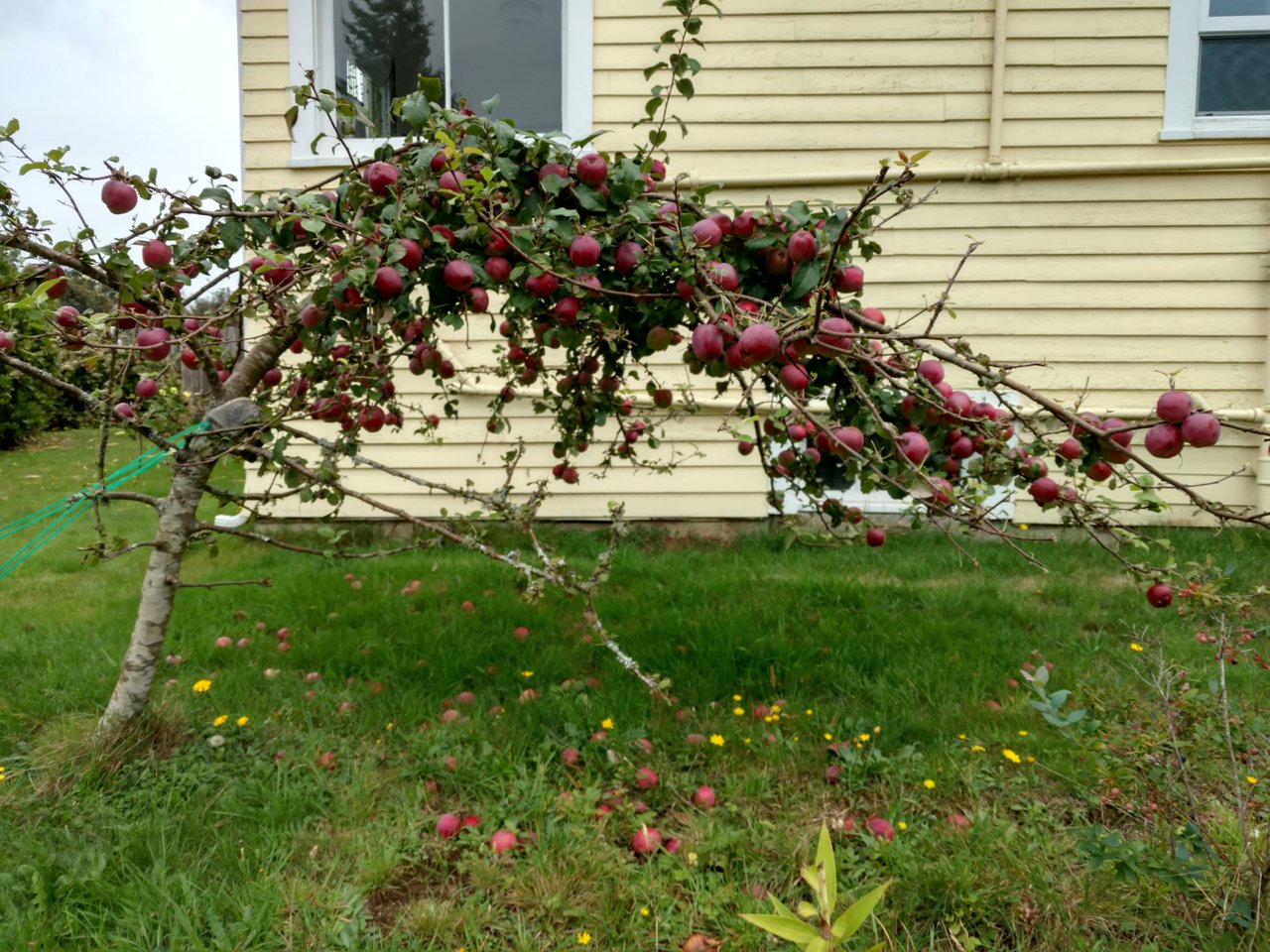
Above is the apple tree that needs to be pruned. This tree is a #photograph from
@kimberlylane of her tree. She bravely agreed to let me offer some @creativetruth advice on how to help improve the tree. Using photoshop, I sketched out the tree, and imaging where the roots might be. In this way by reworking this original sketch, I was able to test out various scenarios for pruning to develop the best end result to my liking.
I am a hobbyist grower of bonsai trees, and a beginner in growing and training apple trees, so I'll do my best to share knowledge I've gained through experience and research.
In this article I will be describing the current situation of this tree, based entirely on the visual appearances, and describe options for improvement. Then I will be going in-depth into the pruning process. My illustrations will show where and when to prune, and forecast what sort of new growth to expect, and how to continue to the train the tree into a desirable shape for fruit production.
Analysis
This apple tree is currently in a style I call a weeping shape. Sometimes flowering trees and dwarf conifers are purposely trained to grow in the weeping shape. Ideally, the trunk goes straight up, and then it curls down like a candy-cane to spill a cascade of beautiful flowers or greenery down a tapered branch. I'm not sure, but I think the weeping shape of this tree is unintentional, and it has clearly become a problem.
The upside-down-frown is visibly sad! The main trunk extends in a lateral arching direction and causes the base to tip over towards the ground. The base of the tree is becoming weaker and weaker, and it might one day lay down and die if the weight of the tree limbs and apples continue to bear down on it. All it would take is a single heavy storm to smash this tree down. A sudden gust of wind. Perhaps a fallen branch from a nearby tree will slam into it like a baseball bat. The entire tree could snap at the base. It would become a ruined mess in an instant.
Ideally, apple trees are usually trained to be in style known as a central leader or a vase shape, also known as an open center. A perfect tree has a strong upright trunk heading up in a perfect vertical angle from the soil. The more thick and vertical the trunk, the more weight it can bear. A strong vertical trunk can withstand side-forces, such as wind gusts. It can support asymmetrically heavy branches alternating on either side. A strong upright trunk is ideal!
Through good pruning practices, an apple tree should be formed so that the branches are spaced apart from each other along the main trunk. Many growers prefer that no branch is growing closer than 10 inches from another branch node on the trunk. This allows room for branches to divide off. It also provides space for fruit to hang from, which will likely pull the branch down lower in time.
Long stringy branches heading upwards will initially have upward arches, but as they get too long and heavy, they will droop downwards into frowns. Therefore, it is a good idea to prune some of the longest whip-like branches to be shorter when they are still young to encourage these branches to thicken. This will also cause more back-budding, which is great because a designer has more options for choosing which branches to keep when it's time to prune. When the shortened branches thicken up after a few years, they will hold their upright arch in a strong shape. A good tree needs a strong structure to hold up hundreds of stems, leaves, and fruit.
A small, well-designed tree that lives a long time can bear more fruit than a large, poorly-designed tree than lives a short life.
Options
- Starting Over
- Replanting
- Amending
- Pulling
- Staking
- Pruning
- Grafting / Air-Layering
Staring Over
Sometimes the best option for a tree in miserable shape is to start over. When the tree is too big and misshapen, sometimes it needs to be cut down completely, and grow a new tree in its place. Do it right the first time, and it can add years to your own life not having to worry about it anymore. Apple trees are a fairly high-maintenance type of tree, but ideally we can train the tree to grow so it requires the least amount of maintenance. The better the tree is planted and trained in the first few years, the better the tree will perform on its own for the rest of its lifetime.
Replanting
Replanting the tree is good choice for small trees. For a tree in this shape the goal would be to angle the majority of the trunk into a more upright direction. We would use a few strong steel stakes to firmly tie the tree so it stays at the properly planted angle. Rubber pads around the ties will prevent the string from harming the bark. A lot of people like to cut off pieces of an old water hose to fold around the tree, and send the string or guy wire through it.
I've illustrated where the roots might possibly exist. Roots do not always head straight down for many feet. The top foot of the soil is where most of the feeder roots will likely reside. Also structural roots might extend outward far beyond the drop-line of the farthest branches. Digging up a large tree would likely destroy the entire lawn. Digging up an old tree will probably reduce the health of the tree greatly, because so many roots will be destroyed and pruned off in the process. It would take too many years for the tree to recover so it can grow healthy fruit again. Sometimes a tree will die when replanted on the wrong day of the year, or if improperly planted, or if the soil structure is poor, so plan carefully. Avoid fertilizing a newly planted tree, and give it some shade for a few weeks before exposing it to full sunlight. A sick tree isn't going to enjoy scorching sunlight and fertilizer any more than a person with the flu will enjoy a trip to the desert and a feast of protein bars.
Amending
This tree might not be a good candidate for replanting, however the soil can be amended to support stronger healthier roots. Wood chip mulch should be applied in a circle around the tree all the way out to the edges of the branches. Aeration to the soil, by poking down deep thin holes, would also improve the health the soil. Aeration allows water to reach the roots faster, and the soil to drain better. Rotten roots will not prevent a tree from tipping over. Lawns reduce the health of the soil over time, sucking out the nitrogen, reducing aeration, and building up thatch and moss over a hard clay layer. Tear off the sod layer, and cover with mulch to allow the soil to absorb moisture and dry off more naturally like a sponge. Also, mowing the lawn around a ring of mulch will be easier than working around the trunk. No more worrying about bumping into the tree, further weakening its base or scarring the bark.
Pulling
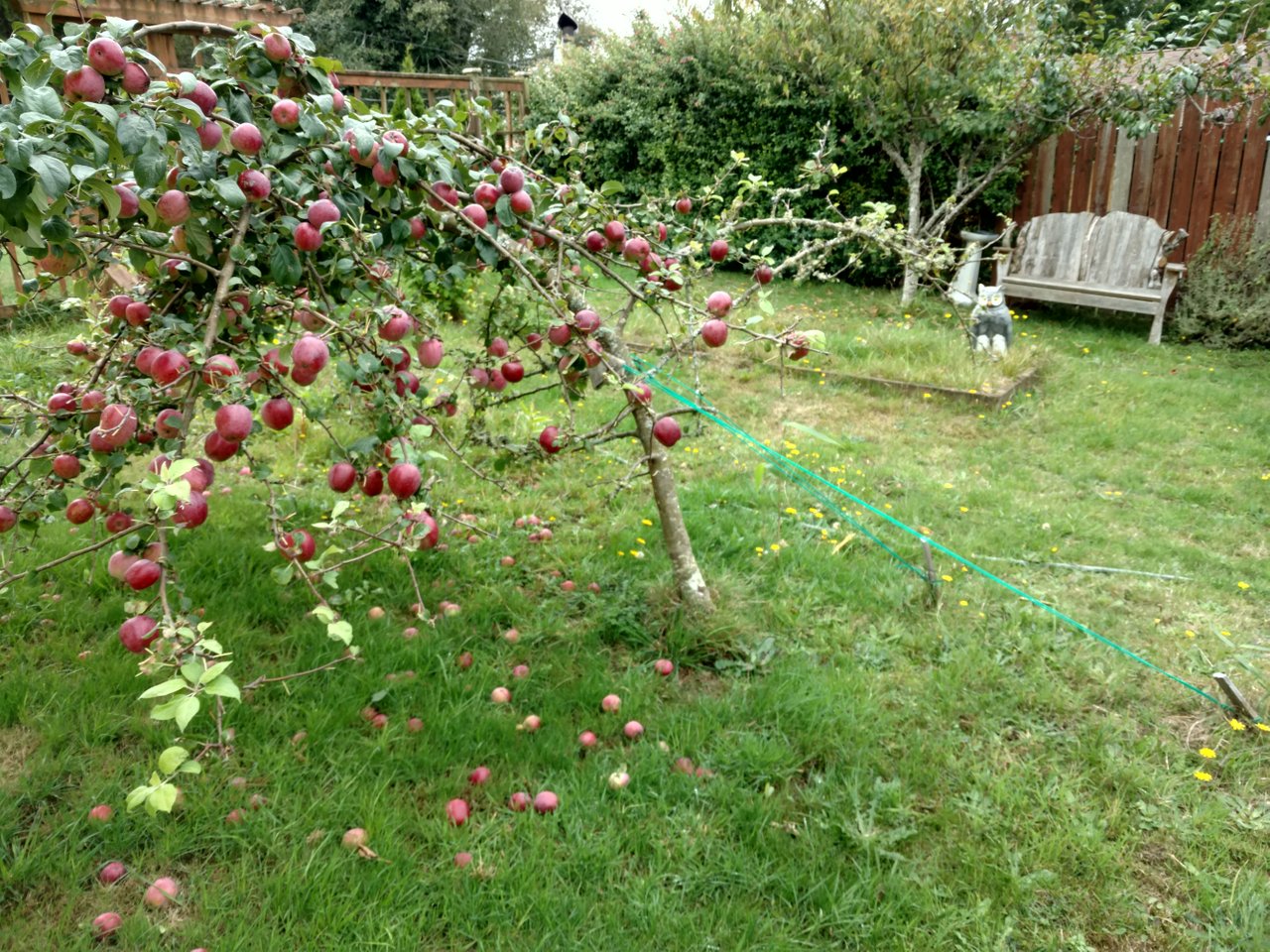
Amazingly, most of the research I found on the internet related to how to fix a leaning apple tree has been the same. Everybody seems to recommend using a stake and straps to pull the tree back into an upward shape. Generally tall steel stakes are pounded into the ground, and a strap with a ratcheting mechanism is used to slowly cinch the tree towards the stakes. I can see from the photo above that something like this has already been attempted unsuccessfully, but the stakes are too short. If the soil becomes soft and muddy, the tree might actually start to pull the stakes into the opposite direction. Not good!
Personally, I think pulling a tree is a very aggressive course of action. Unless the tree is able to flex into an upright shape from stretching it, excessive pulling could uproot the tree or cause stress and breaking to occur on brittle areas that are weak. I am not a fan of any solution to a tree that involves a permanent scaffolding system being used to hold the tree up like a crutch. If it isn't helping the tree to become stronger, then it is enabling the tree to become weaker. When the wood never exercises its muscles by lifting anything on its own, the old hanging wood might atrophy and rot.
Staking
Staking is also a bit late for this tree. It would have been good to stake this tree upright in its early years to help it develop a strong central leader, to ensure the tree stays vertical as the base starts to develop strength. Now that the tree has a curved trunk very low to the ground, stakes can be used to help prevent the tree from falling over. This might be a necessary precaution to help the tree endure storms and fruit season, until the new tree design is able to correct the balance of weight over the tree's center. Three stakes around the tree is ideal, as branches get churned in a circular sway pattern during high winds that can twist the tree to fall in any direction.
Pruning
Experts say that up to 30%, and no more, can be pruned from a tree every year. Anything more than that can weaken the tree to a state that it might not be able to safely recover from. It also means that you cannot prune another 30% from the tree later on in the same year. Nope! Not even 1% more later in the same year if you've already pruned the full 30% initially. You can also prune less, allowing the option to prune more later in the year, but try not to prune more than necessary for the health of the tree. If you aren't sure if something should be pruned or not, leave it alone!
There are two type of pruning cuts allowed: thinning and heading. Removing a branch entirely is thinning. Chopping a branch short so it leaves a stub is heading. Thinning is always better, because it encourages a smoother heal. Head pruning leaves ugly stubs and stumps all over the tree, and the tree will never look normal again. When heading a branch is necessary, always try to prune as close to a new young branch or bud as possible, to continue the branch into a new direction. Dead end cuts, with nothing growing out of it is bad, and the entire branch can die.
Pruning is the best option for this tree I recommend, and it's the strategy I have developed the most knowledge and experience in. The goal will be to restore the tree's shape into a better balanced shape. Low branches will be allowed to grow in lateral directions, but pruned to more reasonable distances. Medium height branches will be encouraged to grow diagonally up and outward. The top branches will be thinned, and the remaining ones will be allowed to grow almost straight up within a reasonable height.
Grafting & Layering
A final option, for more advanced tree experts is grafting and layering.
Grafting is the process of cutting branches or buds off of one area and re-attaching them to other areas of the tree. On a tree like this, the longest branches would be good candidates to prune off and graft onto branches that are too short. A skilled grafting artist can rebuild the tree into a better balanced shape by attaching branches instantly onto desirable areas. Some study of how to make grafting cuts is required, and grafting knives are very sharp and dangerous if not handled properly.
Personally, I am a bit skiddish of aiming the blade side towards my thumb, so I probably would not want to graft an entire tree.
Pruning scions off for grafting is done in January or February. The scions are saved for March a few weeks before buds open, when they can be grafted at a time when the tree has enough energy available to heal the grafted unions very quickly.
Layering is another advanced option. This tree is actually a perfect candidate for the process known as ground layering. To do this, you would bury the branch into the soil, and wait for roots to form. The downward branch that was previously weakening the tree can now become the tree's biggest strength. The big beefy limb in the ground will be forming healthy new roots that will add life and renewed strength to the tree. Beware, as this might also introduce disease to the tree. The fruit wood is not designed for rooting and disease resistance like the rootstock is.
Experiment by ground layering a small branch whip into the soil, see if it roots, and then prune it off and replant it. In this way, it creates an exact clone of the tree, which can be planted elsewhere in the garden, or trained to grow in a large pot.
First Year Plan
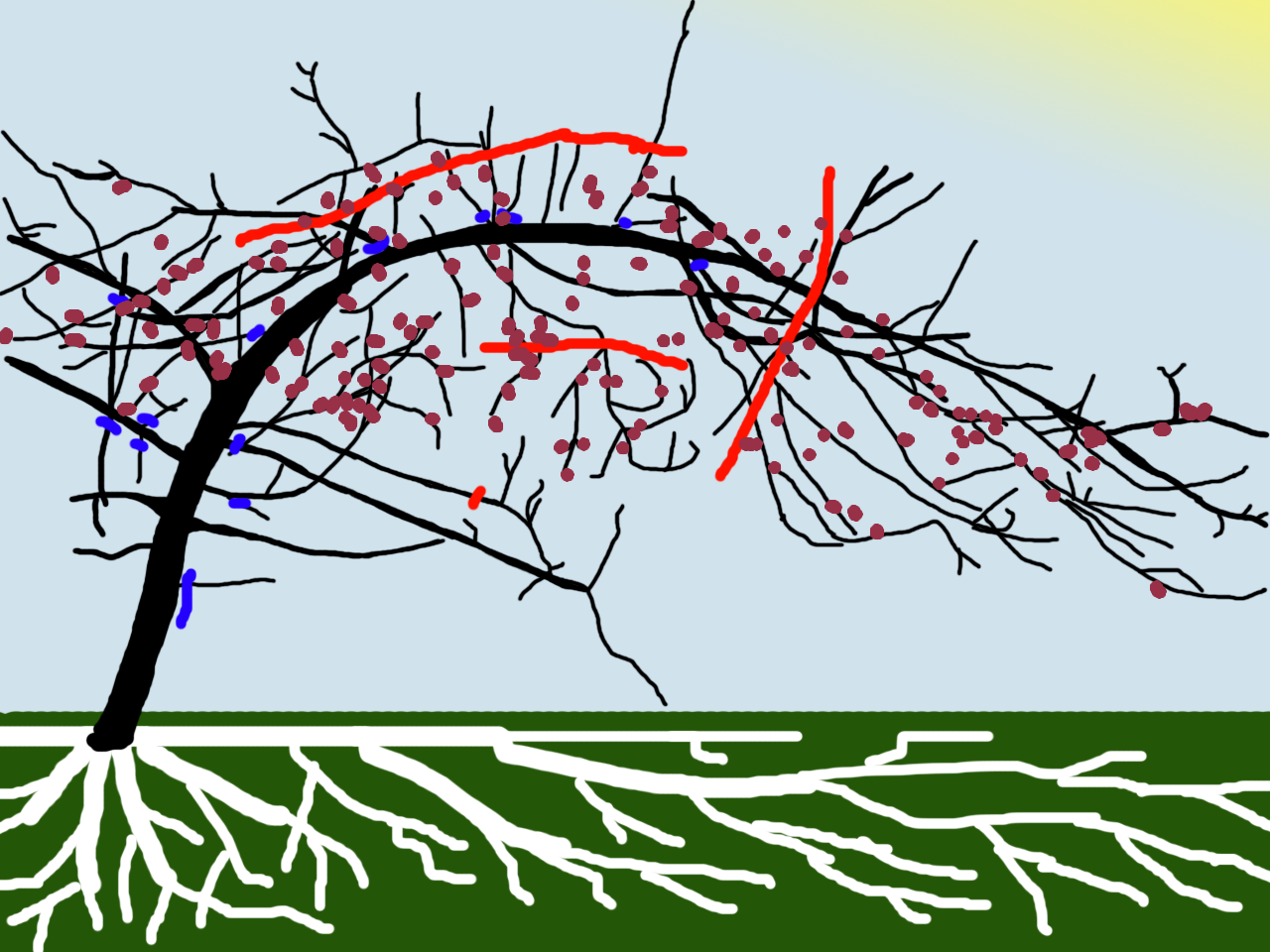
Assuming this tree cannot be replanted, pulled, or staked into a better angle, that leaves us no choice but to prune the tree.
In red, I have illustrated where I would make heading cuts. With a heading cut, I always prune as close to a bud or upward side branch as possible. The bud or upward branch will continue to receive lots of new growth energy, while the nearby wound will benefit by receiving healing energy to close the scar. Make the cut 1/4 inch to a full inch away so that a collar around the branch can help close the wound.
The blue lines I marked are the thinning cuts. Any branch that criss-crosses into other ones should be removed. Downward branches are removed. Branches that turn and twist into an angle that heads backwards into the tree center are also thinned out. Ideally, only branches angling out from the tree, like a pincushion, are left to remain. Be careful not to prune too much! We cannot prune more then 30% from the entire tree. Every pruned branch and leaf adds up as a portion of energy the tree has lost from its annual supply.
Anything that looks dead, shriveled, or diseased should be pruned from the tree before any heading or thinning cuts are made. This will instantly improve the health of the tree allowing more sunlight and air to pass through the center of the tree. Dead wood pruned from the tree can be removed entirely, and it does not count against the 30% living material that can be pruned. Diseased wood is still alive, so be sure to take that into the equation.
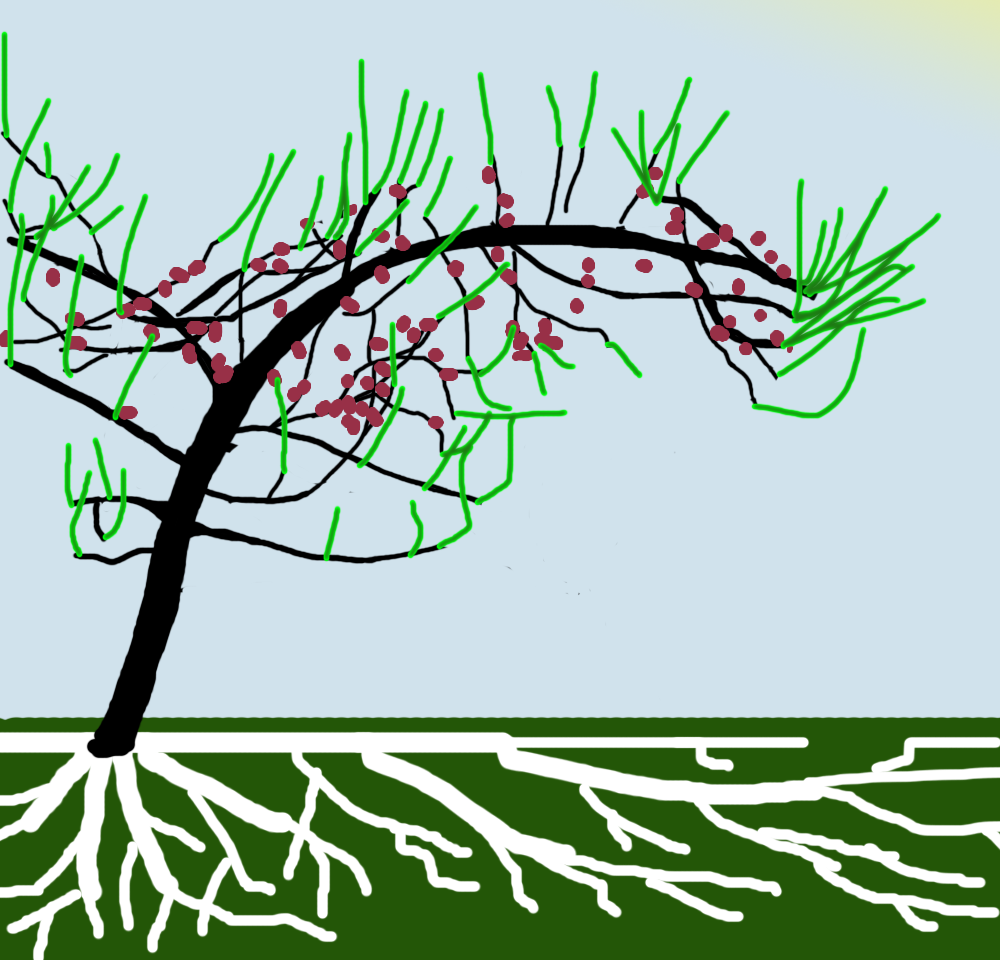
Above I have simulated where I think the new suckers will appear. They almost always appear at the branch tips first and head upwards. Another common place where suckers appear is around the rim of a thick heading cut. The large side branch that was pruned might become filled with several water sprouts. The arching trunk might also become overwhelmed with tons of suckers.
If you've already used up your 30% pruning budget for the year, you are going to have to leave ALL of these water sprouts untouched for the rest of the year, and let it grow. You'll get tall whips all over the place, and they won't bear any fruit... yet.
However, you can start working on angling the water sprouts into ideal directions. Make sure the whips on the far sides of the tree are not aiming straight up. Start to angle them up into diagonal and lateral directions. Get the branches to angle outward from a single center, in a dome shape, and less broom-shaped. There are various methods for training branches to grow into a desired direction. Good pruning is the best way. The next best way is to alter their growth direction with force.
You can use strings, wires, separators to space branches apart, and weights to pull branches down. Anything lightweight is ideal, because the tree already has a tendency to become heavy when fruit ripens.
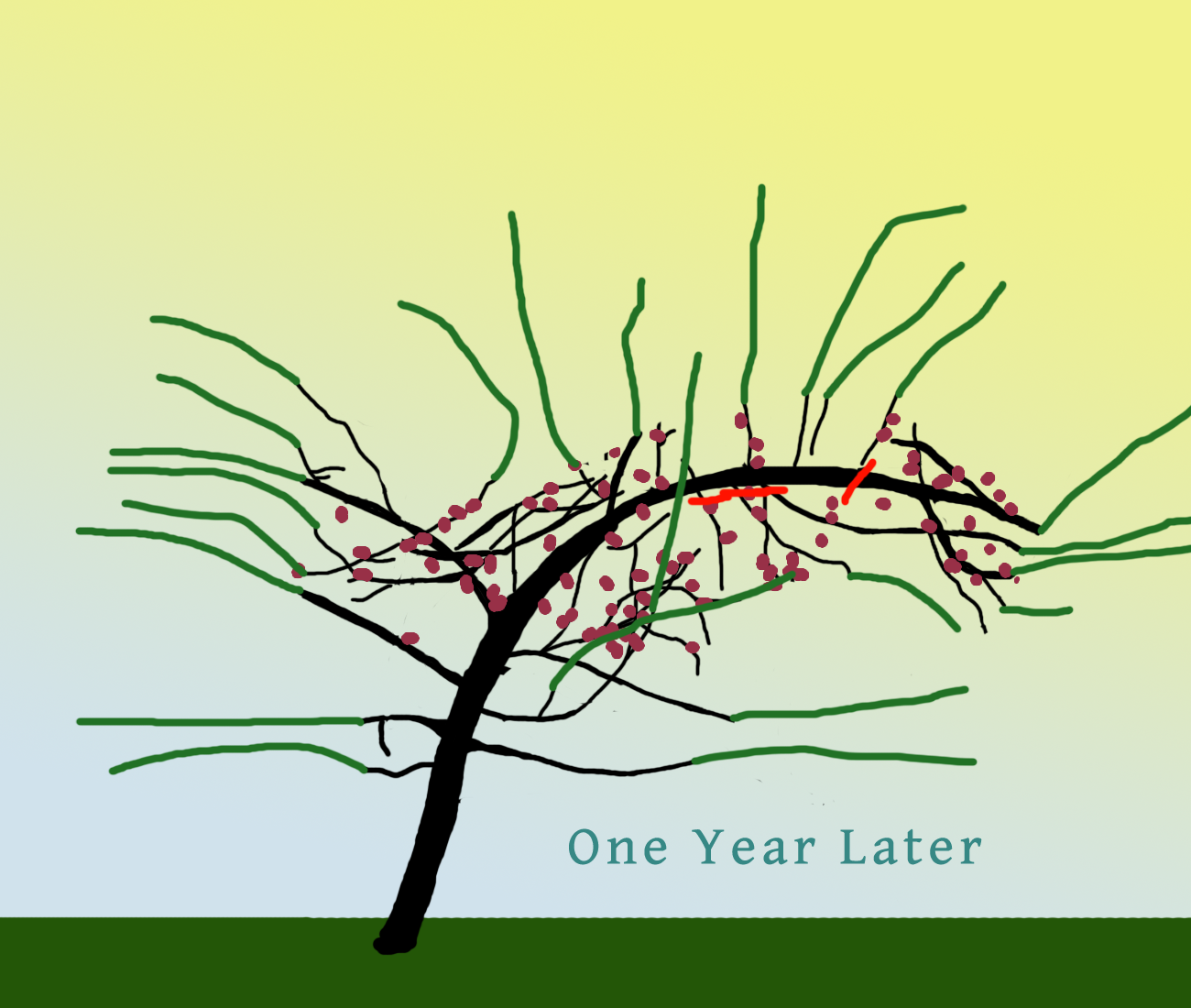
After the first year has ended, I would continue my plan to reduce the length of the weeping branch, to reduce its stress on the tree.
I would make this heading cut much more conservatively than the one I made last year. Most of the pruning budget would go into removing a majority of last year's water sprouts, and allow only the best ones to remain.
I also discovered some downward branches under the tree's arch. In bonsai we always remove branches underneath main branches, because they tend to be less healthy and block sunlight. It also tends to compete with the main branch, and might start to rub against nearby branches once its ends start to grow upward and weave through. Remove anything growing downward. Hopefully the low branches on the tree will receive more sunlight and vigor to fill in this open space.
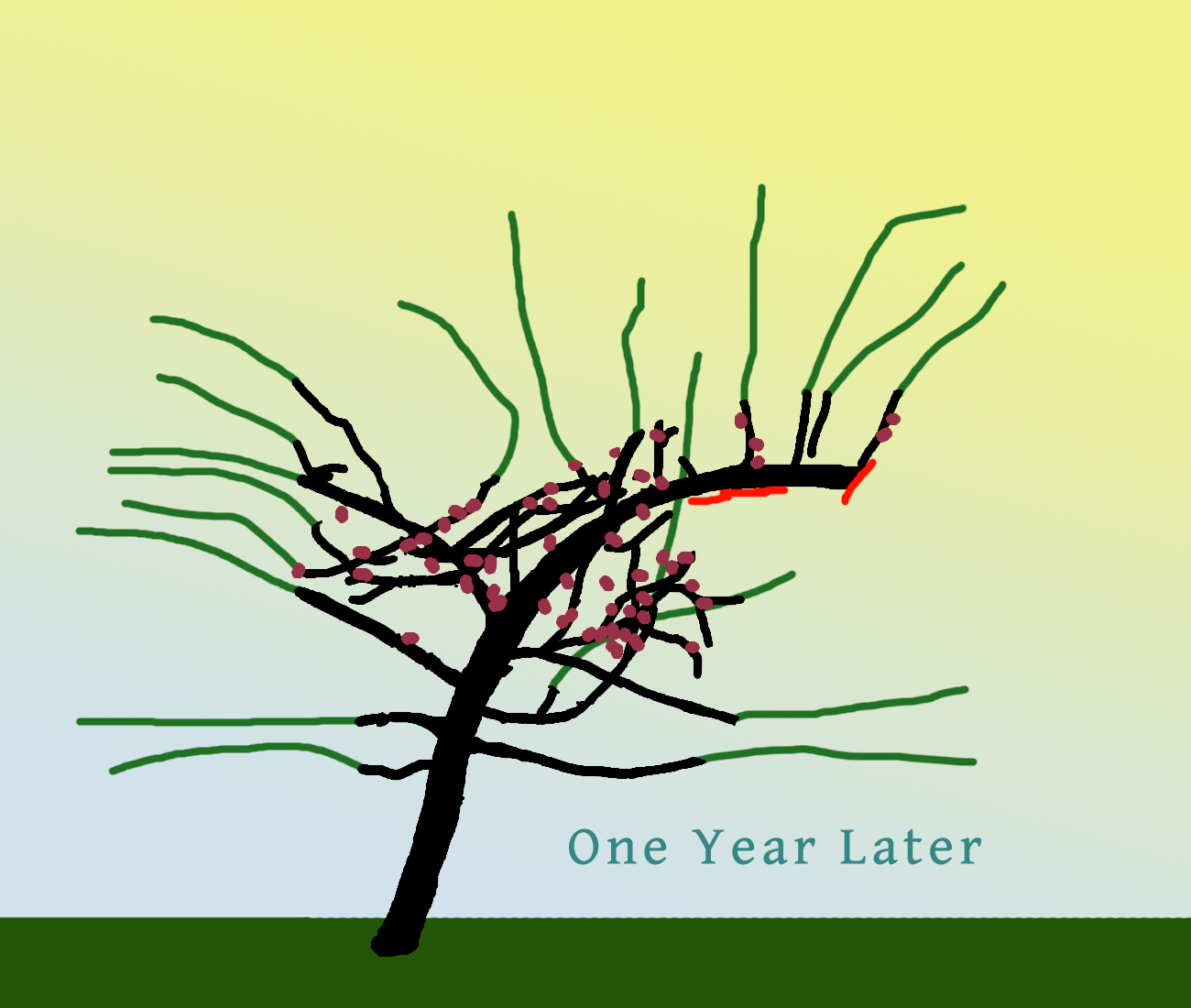
Now the tree is starting to look more like an ideal form. At this point the tree will probably still need to be staked upright, even though it looks better balanced. New young branches have formed on the left side, and they are helping to counter-balance the weight of the old shortened branches on the right side.
Keep an eye out for how much the branches and trunk are thickening every year. A good tapered root flair at the base of the tree will help the tree to stand up better on its own. I would not remove the stakes until I noticed a good wide taper forming at the base of the tree. If it isn't doing this, consider adding more mulch to the tree, aerating the soil, and add fertilizer in Summer and Fall.
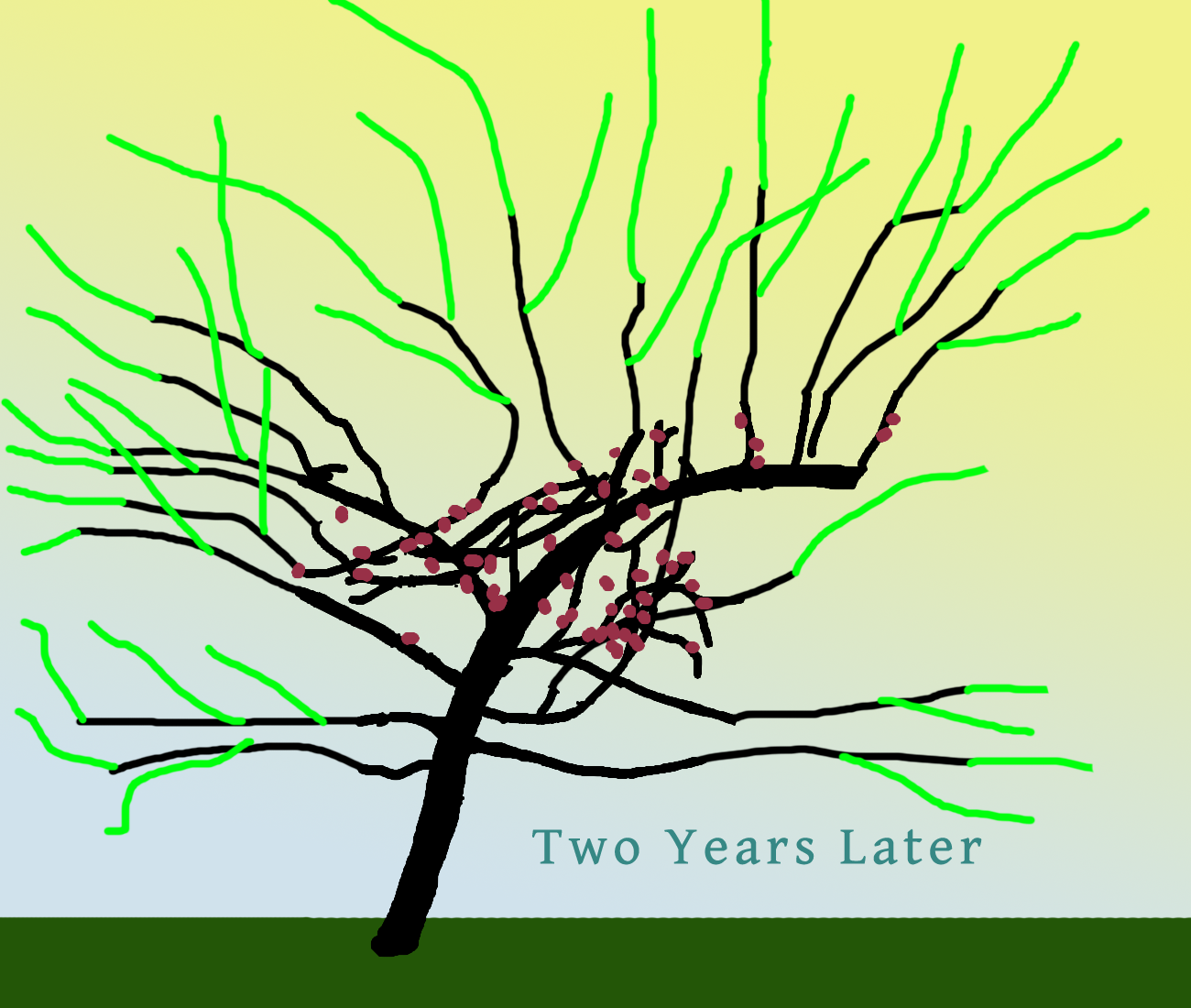
In the second year after pruning, The new wood from last year has hardened off, and it might even start to develop fruit spurs.
This tree is going to have a new problem to address. The branches are all going to want to grow sky-high! Focus again on reducing the number of water sprouts, to open the space between branches to keep things better separated and evenly spaced. Reduce the length of any branches that extend beyond the ideal tree silhouette. Keep the height in proportion so fruit can be reached without a ladder.
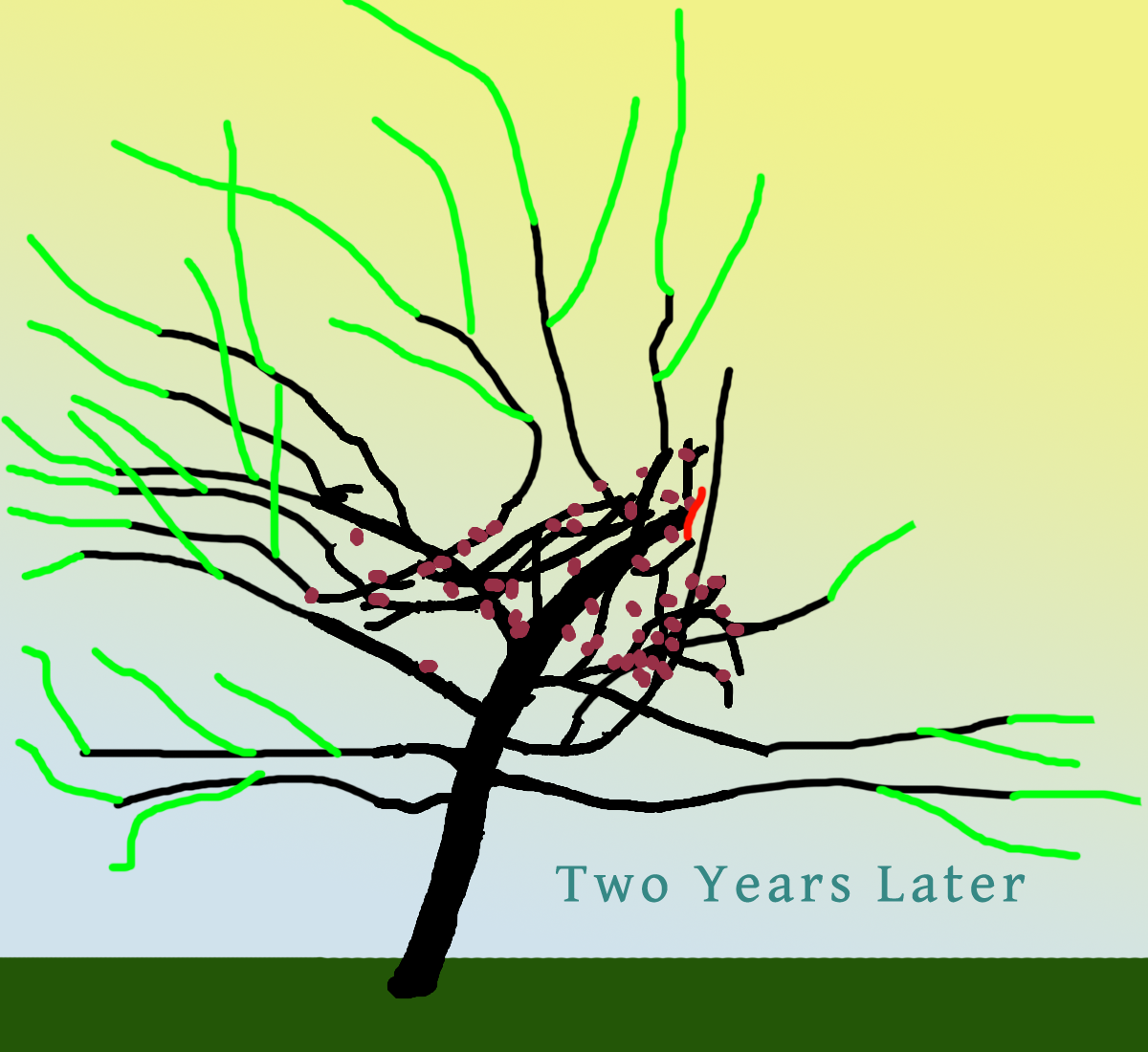
Finally, I would make one final heading cut to reduce the last piece of the downward weeping branch. At this stage, two years later, we can finally appreciate that the trunk is arching only upwards, and not downwards. Strength in shape has been restored, and branches on the left are now capable of counter-balancing all of the weight on the right. The silhouette of the tree on the right side also looks much better as the single branch will soon be replaced with many young branches than can more thinly fill the same space with lush new growth.
If at any point the tree begins to lean again, I would start to prune off some length from branches extending to the sides of the tree. Encourage most fruit to grow from the center, and less from the distant sides.
Keep an eye on tall tipping branches. When anything starts to obnoxiously lean over like a tall arch (imagine a jester's hat, except apples hanging down instead of bells), it can swing wildly in the wind and knock the tree over, and cause the tree to revert back into the shape it had two years ago. Prune off any heavily arching branches midway before they become a problem.
Conclusion
That was a thorough analysis, wasn't it?
I had fun drawing these illustrations and sharing some advice. Hopefully it was helpful and educational for many people to learn from. Growing an apple tree can be a lot of hard work, but it can also be a fun and creative experience to alter a tree's design into a new shape.
Surely there are experts more skilled than me that will probably scoff at my illustrations being very fanciful and not realistic at all. These are not meant to be accurate representations, but merely ideal themes I feel are good to aim for. Consult a skilled arborist before pruning an old fruit tree, because there are likely to be bad side-effects when a tree is poorly pruned. Bad pruning can lead to disease, cracked limbs, unsightly scars, and an over-abundance of clustered water-sprouts that can limit the life, health, and beauty of the tree. Do some research and seek advice from more than one source before deciding to take action on your own.
Let's hope @kimberlylane's apple tree continues to develop delicious sweet apples for many more years to come. Thank you @kimberlylane for allowing me to share your photos, and best of luck!
#pruning #apple #apple-tree #tutorial #illustration #art #learning #teaching #advice #design #creative
Yes, does look like I have my work cut out for me @sukhasanasister, but now with so many loving suggestions of how to care for my tree, I'll go to it with more joy!
I especially love the idea of burying a branch (ground layering) and beginning a new tree. Something I hadn't thought of.
Thank you so much for all of your careful consideration and reworking to figure the best scenarios.
Yes, in the weeping position and as a person who pays particular attention to my dreams (waking included) this gives me much more to ponder...
Reminds me of a childhood song, If you chance to meet a frown, do not let it stay, quickly turn it upside down and smile the day away.
Though I'm not a huge fan of pulling up grass, not because I want to save the old lawn, but because it's not easy work, I like this suggestion and can pull it up and add the wood chip mulch. In fact, I'd like to pull all of the lawn up in that part of the yard and plant more. In the past I had more of a garden there, but haven't had one the past couple of years and the grass just takes over. You can see where the owl sits in a raised bed of grass :( I did get a tiller and re-worked an area of my yard that also got away from me and have a nice patch of dahlia's growing this year which have brought much delight to me and my neighbors who are kept in constant supply of bouquet's and the deer that do sneak in don't eat them because they have no smell.
Speaking of deer, that is one reason the far side is smaller and no apples--there is a particularly intelligent doe in our neighborhood that gets on her belly and climbs through a hedge and she ate leaves and branches off from one side. I know, strange, but it did happen. Will I have to count that as part of my thirty percent? I'm imagining I might.
You're correct that my staking didn't work and crazy to think that the tree might actually start pulling away from them. I'll definitely have to get longer, stronger ones. And, it does sound like fun to angle new sprouts with force and prune to shape.
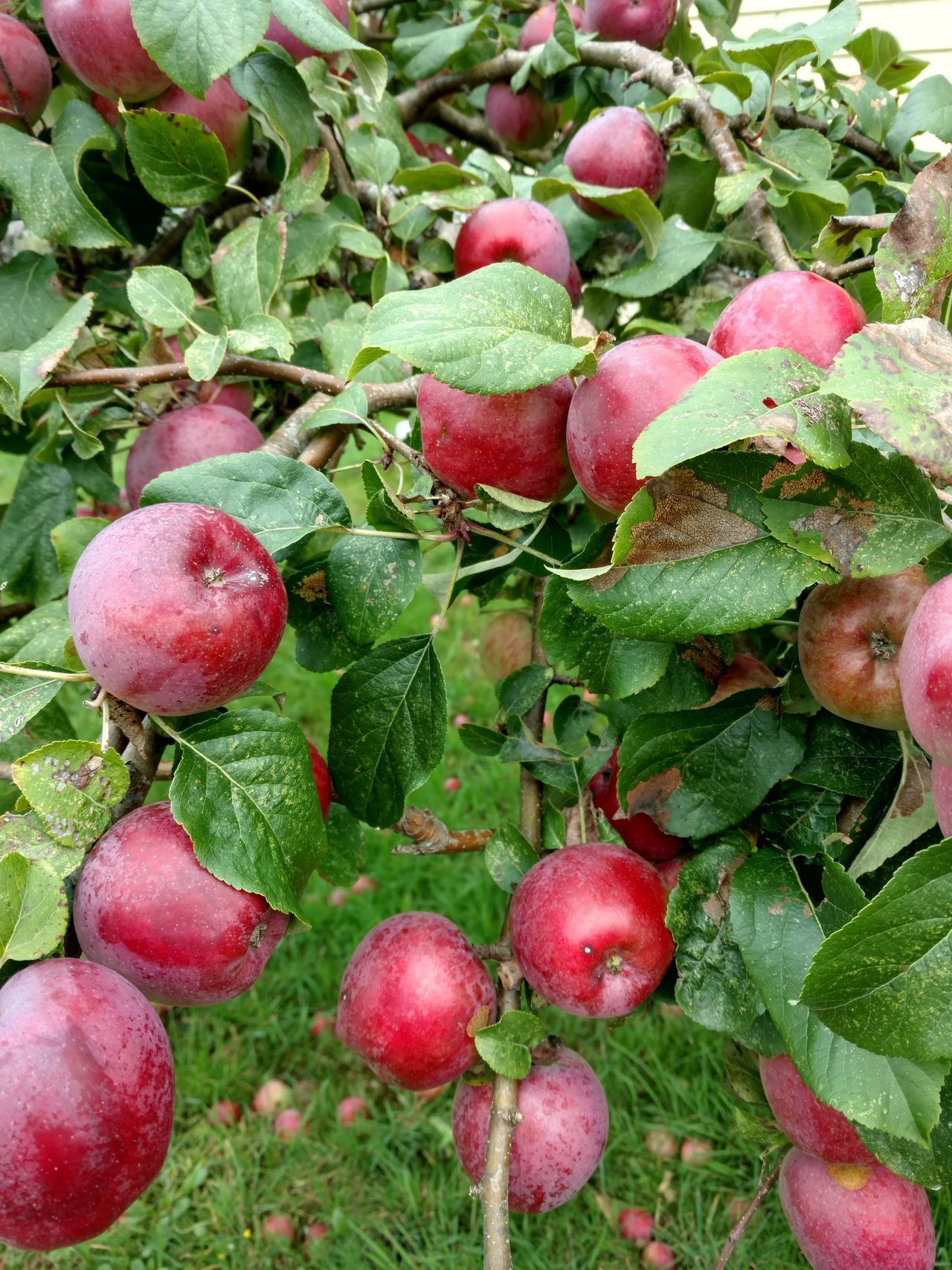
We've been eating the apples, my son came over the other day and picked a big bag to eat while driving around in his plumbing truck. But there are still apples on the tree. Do you suggest I start pruning right away, or should I wait a few weeks more for the apples to be done? I don't imagine we'll get any kind of a major storm in the next couple of weeks.
I do like growing things, especially house plants and it's also time to re-pot and divide a very large aloe vera. Wish I could share one with you in thanks for all of your help :)
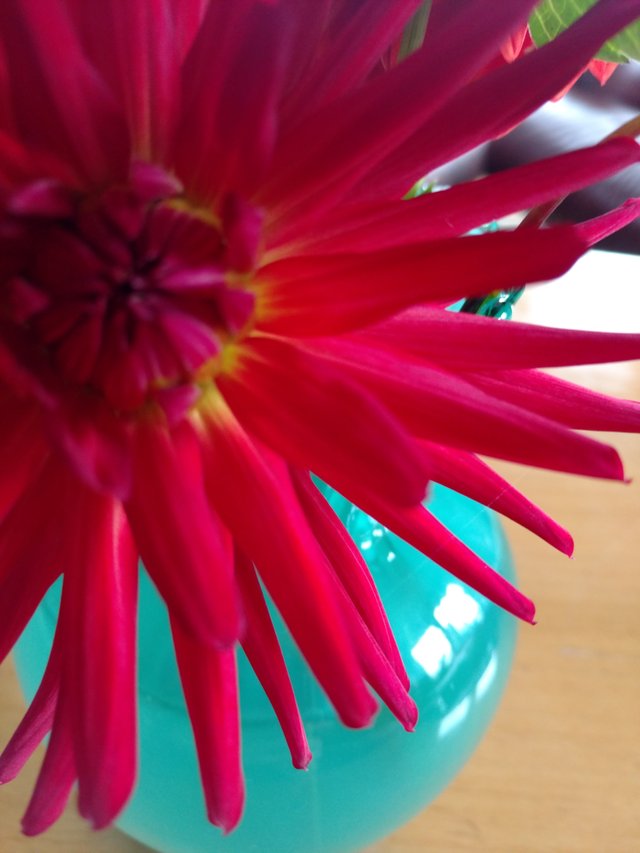
Here is a picture of one of my dahlia's for you :)
Nice flower photo. The flower pops the electric colors in the blue vase.
For info on companion plants for your apple tree, check out a past article I wrote to ideas.
https://steemit.com/gardening/@creativetruth/companion-plants-illustration-the-apple-and-fruit-trees-bundle
Maybe you are happy to share pieces of your tree with the wandering deer. Most people would probably seek to deter them from the tree in some way. When animals like deer, rabbits, and goats chew the bark away on the trunk, it could kill the entire tree in a matter of days. I've used foam rolls (normally used on pipes, also works on branches and thin trunks). and plastic screens in the past to protect my trees. Many people also wipe scented oils on their wood. I've heard of people using furniture polish. We used to use that on table legs to keep the dog from chewing on it.
Prune the tree when it becomes fully dormant, right before it starts budding. Usually this is in January and February for the Northern Hemisphere. It is too early to prune. When you harvest, the tree branches will respond by bouncing back upwards into the light now that the weight is gone. It might be a good time to train the branches with spacers and wires while the new wood is still slightly green. Monitor through the winter if wires or string appears to be strangling the bark, and retire it if necessary.
Only prune woody areas out of season when the tree is broken, such as after a storm or when an animal eats it. If there is risk of a storm with high winds, it is sometimes better to prune the tree into a stronger shape, so it doesn't whip around so much. New green wood can be pruned off sparingly in the Spring and end of Summer if you want the tree to focus on filling in new growth in areas that are lacking foliage. I also coat my wood in the spring with vaseline, a tip I learned to promote the wood to stay softer and hydrated, and produce many more thick buds.
Thanks :)
Yes, of course, not a smart question after you mentioned several times waiting until Jan/feb to prune and I even wrote it on my calendar! I guess I was just eager to get started after all of your valuable feedback. Suppose that means the first step of this project is tearing up the lawn.
No, I am not happy to share the tree with deer and all of the back yard is fenced off with a very tall fence none of the other deer have been able to get around--just this particularly smart one that comes through the hedge on her belly (not an easy task and none of the others have done it). My neighbor told me she got on top of a crate in his back yard, stood on hind legs and ate the limbs off from his tree too!
I've used weird smelling sprays to deter deer before and that's a good idea. One year I got several of those Victoria Secret body sprays for Christmas (all very powerful smells that were too sickening to use) so they worked great! I've got Vaseline so that's another great idea.
Thank you again!
Wow, sweet KL has her work cut out for her!!
But your diagrams look super promising.
I think there is advice in this post for any and every tree owner. Thanks a lot!
Thanks for this post. I've looked around quite a bit for info on this subject and I haven't found much. This one definitely helped me. My trees will be better for it!
Here is a great video on youtube displaying a real life analysis of what happens to branches based on where it is pruned. Also good visuals of ideal branch distances and what direction to correct their angles into.
I'll give it a watch!
An Apple tree is a very nice Bonsai subject and although it is hard to do it in a pot it is just possible to do it on the ground with an already grown tree. Making it lean over is really a good idea @creativetruth :D