/ Film Class #11 / Memories of Murder / Bong Joon-ho /

Memories of Murder (살인의 추억) is a 2003 South Korean crime-drama film co-written and directed by Bong Joon-ho.
Bong Joon-ho decided to deal with the adaptation of the Memories of Murder stage play by Kim Kwang-rim, which itself is based on the true events and murders that tormented South Korea in the mid-to-late 1980s, known as the Hwaseong serial murders, the crimes that took the lives of ten women aged between 14 and 71. Despite active police investigations and wide media coverage, the suspect has not been identified to this day.
''The first-known case of serial murder in South Korea took place against the backdrop of radical social and political transformation, as it was in 1987 that massive demonstrations forced the military regime to hold free elections, and in 1988 the Seoul Olympics announced the successful modernization of South Korea and heralded its arrival to the international stage as an industrial economy. Bong’s film is not specifically “about” these upheavals and changes, nor does it indulge in nostalgic yearnings for a simpler time. But Memories of Murder, in patiently and meticulously depicting the conflicts, habits, and fears of a society on the very edge of dramatic transformations, creates a haunting and wholly convincing figure of social change in the form of a perpetrator who is never brought to justice. What is most surprising about the film is not the lack of closure that stuns and haunts the viewer and detectives alike, but the unexpected scale of its ambitions. Memories of Murder, while our eyes are elsewhere as it were, succeeds in capturing the turning-point of modern South Korean history and binding it to the most unexpected and the most dreadful of modern human types, the serial murderer.'' (1)

PLOT
1986 Gyunggi Province. The body of a young woman is found brutally raped and murdered. Two months later, a series of rapes and murders commences under similar circumstances. And in a country that had never known such crimes, the dark whispers about a serial murderer grow louder.
A special task force is set up in the area, with two local detectives Park Doo-Man (Song Kang-Ho) and Jo Young-Goo (Kim Roe-Ha) joined by a detective from Seoul who requested to be assigned to the case, Seo Tae-Yoon (Kim Sang-Kyung). Park personifies the policeman who goes with his instincts and his fists, bloodily challenging every small-time crook in the area to confess. In contrast, Seo pores over evidentiary documents related to the case and inevitably the clash of styles leads to tense rivalry.
From the fact that not a single hair is ever found at the scene, Park takes off to search the area's temples and public baths for people with follicular disease, while Seo finds a pattern in the evidence of women wearing red on a rainy day as the victim's profile. On a rainy day, the detectives set up a trap in order to forestall another murder. The next day however, yet another woman is found murdered - with an umbrella speared through her pubis. The solution to the murders grows fainter and drives the detectives to ever greater despair. (2)

ANALYSIS
The film begins with the discovery of the first victim. The first of the three detectives that are on the case arrive at the scene where a group of children is playing nearby. They interfere with the investigation and destroy much needed technical evidence.
This prologue has two striking qualities that will continue to appear throughout the film. First of all, there is detective Park Doo-Man (played by the excellent Song Kang-ho) who is almost completely alone. There's no uniformed officers, no photographers, no forensic experts, and even more unique, this appears to be quite ordinary. He don't comment on why so few police officers is helping with the case (this is an important comment that the film is making, ridiculous investigation procedures), Doo-man only accepts it. It is simply ridiculous, surreal and unusual. The second quality of this unique scene is the sharp contrasts. The body of a young woman is lying dead in the grass. She's tied up with her own underwear, and she's been raped, killed and then being left to rot. A child has discovered the body. All this is an alarming setting for most of us, but what does director Bong Joon-ho do with this particluar scene? Does he add a haunting and threatening score? Does he shows the typical scene where the kids are too young to understand the seriousness of what has happened? No, instead he lighten the scene up with comedy as a young boy is mimicking everything Doo-Man says. An unusually innovative trick that totally breaks with the genres form. This brilliant prologue sets an unusual and unique mood for the rest of the film. (3)
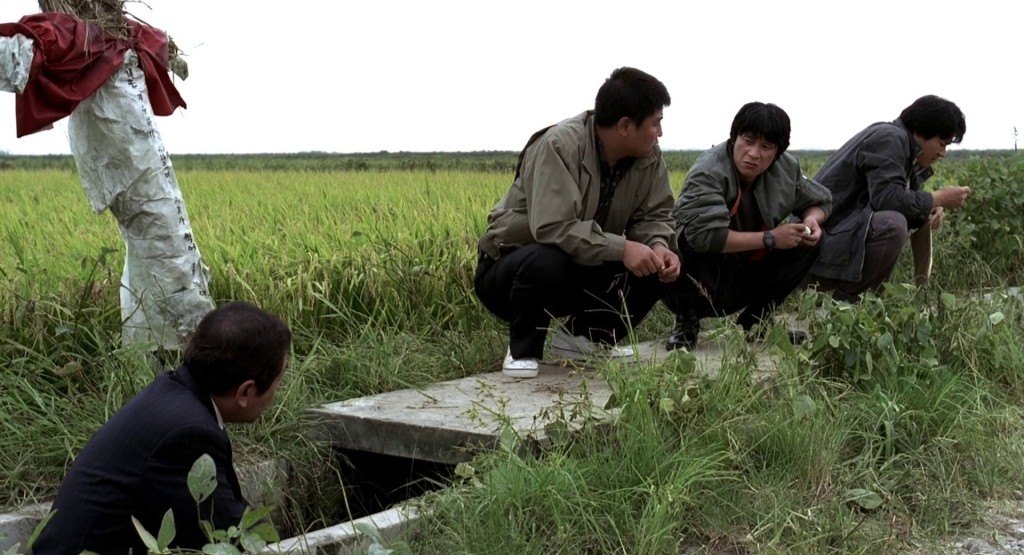
To close the case as quickly as possible, the detective follows the first lead he randomly gets. He arrests a mentally retarded boy of the village, who was said to follow the victim around. With the help of his fellow policeman Cho Young-Koo (Kim Roi-ha) they torture the poor boy in an attempt to extract a confession.
Meanwhile, a detective from Seoul shows up to help the provincial policemen with the case. Seo Tae-yoon is calm, competent and professional. He stands aside watching Doo-man’s methods, often smoking a cigarette or researching some documents in the background.
Further investigation leads to dead ends and Tae-yoon gets more and more frustrated. He is a competent detective from Seoul, trained to do this – he himself is surprised and infuriated that his system doesn’t work. Director Bong does play with the expectations that viewers are used to have from Hollywood films. (4)
''Bong is making light of the proclivity exhibited by Hollywood thrillers of mostly favoring style over substance. Bong injects a great deal of substance into his “generic” narrative but he utilizes the codes so well that he can make fun of the material while also using it to its fullest potential. '' (Modern Korean Cinema)

Memories of Murder is, however, perhaps most interesting for how it deviates from the murder mystery and police-procedural genres — Bong’s point is not to put his characters through the paces of a routine plot but rather to paint a trenchant portrait of life under a military dictatorship in the mid-1980s.
While Memories of Murder presents a scathing depiction of everyday life under an authoritarian regime, the serial murders, while they take advantage of the conflicts wracking South Korea (the detectives at one point are prevented from saving the life of a witness because they are attacked by enraged students), nevertheless open the way to the future. It marks the beginning of the future not only because the suspect gets away from the police at the end, but also because serial murder is the paradigmatic crime of modern industrial society. What is most shocking about serial murder is the apparent absence of any purpose, other than the inhuman and predatory enjoyment of killing. In traditional societies, violence is typically regarded as a means to an end. Serial murder is an extreme manifestation of the social purposelessness made possible by the modern industrial economy. The serial killer is normally inconspicuous, blending in so well with his environment that people are often taken by surprise whenever one of their acquaintances is found to have committed grisly and horrifying crimes.
The lack of closure in the film may mirror the lack of reconciliation and harmony in South Korean society, especially about its past, yet the crimes of the vanishing perpetrator haunts us in a different way than the crimes of the founders. For Bong, the unsolved crime provides a more powerful mode of commemoration than the unpunished crime of the founders. It occupies the gap between past and present that memory, always vainly, strives to overcome. It makes the protagonist yearn for the past, but without nostalgia. (1)
end scene:
Genre: drama/thriller
Directed by: Bong Joon-ho
Written by: Bong Joon-ho, Shim Sung-bo prema predstavi Memories of Murder Kima Kwang-rima
Cast: Song Kang-ho, Kim Sang-kyung, Kim Roe-ha, Park Hae-il, Byeon Hee-bong
Country: South Korea
Run time: 129'
(1) The Scandal of Bong Joon-ho’s Memories of Murder, pypaik, 2.6.2013. wordpress.com
(2) Asian Wiki, Memories of Murder
(3) Ole Holgersen, letterbox
(4) Agne Serpytyte, The Asian Cinema Blog
Memories of Murder is such a taut, effective thriller it's a shame you have to read subtitles to gauge just how good a movie it is. The film's storytelling strategy is unique and its point-of-view mutable and disarmingly subjective. What's most remarkable about it is the way Bong builds real suspense and plays the chilling moments straight while leaving himself room for nonsense and horseplay.
Great comment, hopefully you create movie and film related articles of a similar quality on Steem! I'll follow you and upvote that kind of content.
You should check out @namiks @nandan and@irime who see doing great work on movies like Marina.
Definitely check out @nandan 's review of Memories of a Murder from earlier this week.
Nice post keep it up.......
The distinction between the past, present and future is only a stubbornly persistent illusion.
- Albert Einstein
Congratulations @marinauzelac! You have completed some achievement on Steemit and have been rewarded with new badge(s) :
Click on any badge to view your own Board of Honor on SteemitBoard.
For more information about SteemitBoard, click here
If you no longer want to receive notifications, reply to this comment with the word
STOPKorean movies are interesting. Their culture is so prevalent in the way they act.
I remember reading about Memories of Murder and how the real scary thing is they revealed the killer mid-way, yet not really showing the face.