Stars #1

Image source [1]: A star-forming region in the Large Magellanic Cloud.
Hello friends, today we are going to talk about the stars and their classifications. A star is a type of astronomical object consisting of a luminous spheroid of plasma held together by its own gravity. The nearest star to Earth is the Sun.
In astronomy, stellar classification is the classification of stars based on their spectral characteristics. Electromagnetic radiation from the star is analyzed by splitting it with a prism or diffraction grating into a spectrum exhibiting the rainbow of colors interspersed with spectral lines. It is not difficult to classify the stars. Almost all belong to the so-called "Main Sequence", which consists of a gradual arrangement of the features and lines of their spectra. The main sequence is formed by the types O, B, A, F, G, K, and M. But it passes continuously from one to another without there being any jump or interruption. Since there is only one row in the order, we can think that a single parameter governs the position of a star in the sequence.

Image source [2]: The Morgan–Keenan spectral classification.
Spectral types: Class O
O-type stars are very hot and extremely luminous, with most of their radiation output in the ultraviolet range.
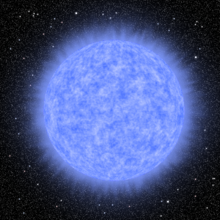
Image source [3]: Artist's rendering of Zeta Puppis, an O4 supergiant.
B-type stars are very luminous and blue. Their spectra have neutral helium, which are most prominent at the B2 subclass, and moderate hydrogen lines.

Image source [4]: Artist's impression of Aludra, a B5 supergiant seen in Canis Major.
A-type stars are among the most common naked eye stars, and are white or bluish-white. They have strong hydrogen lines, at a maximum by A0, and also lines of ionized metals (Fe II, Mg II, Si II) at a maximum at A5.
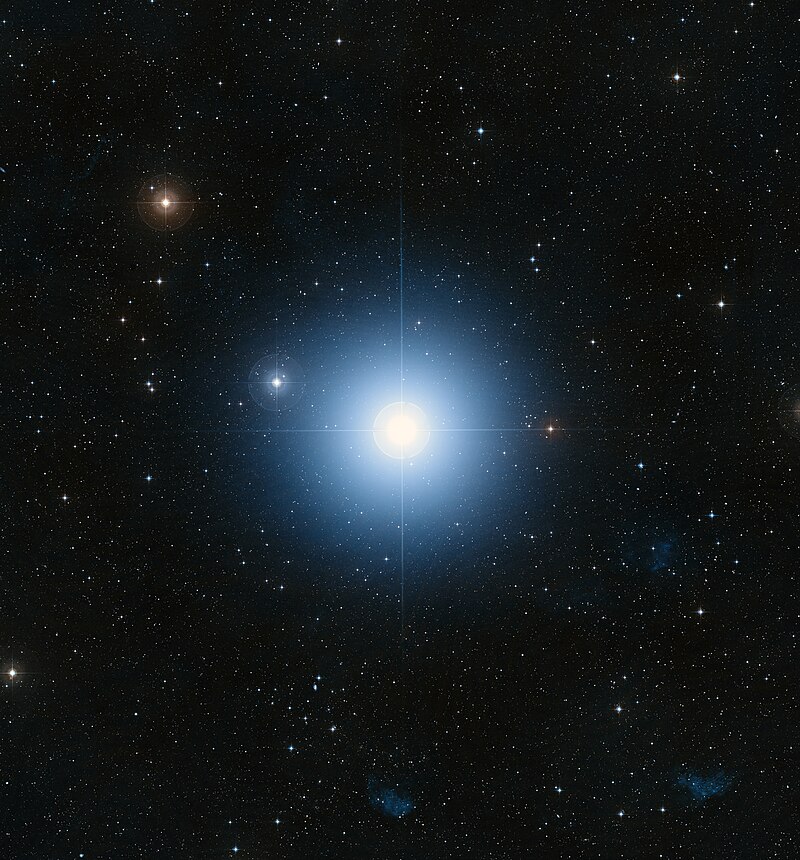
Image source [5]: Fomalhaut, an A3 main-sequence star.
F-type stars have strengthening spectral lines H and K of Ca II. Neutral metals (Fe I, Cr I) beginning to gain on ionized metal lines by late F.
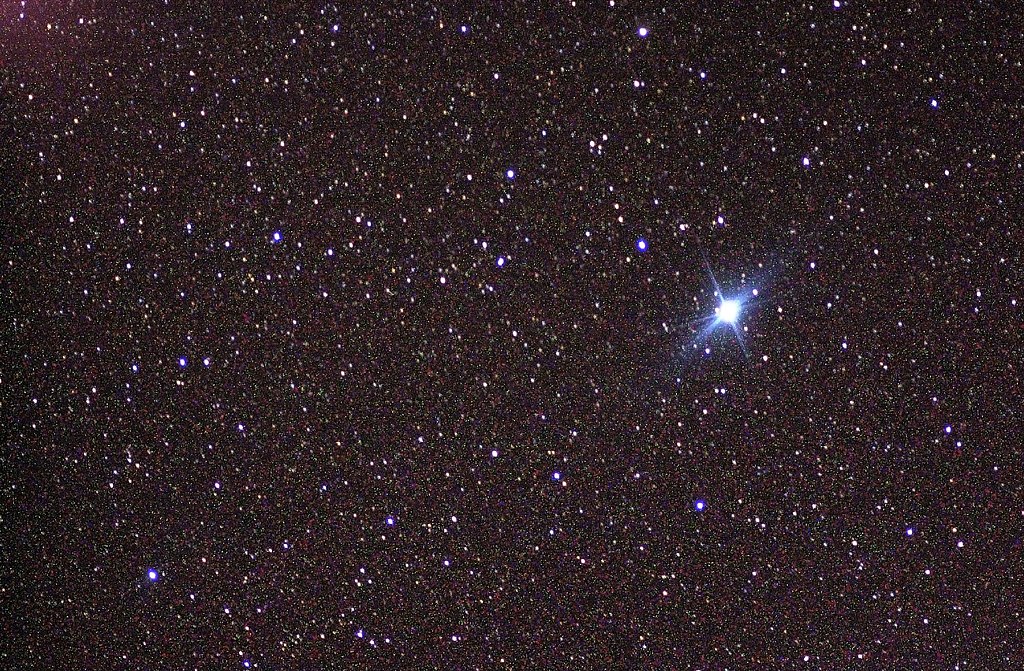
Image source [6]: Canopus, an F-type supergiant and the second brightest star in the night sky.
G-type stars, including the Sun [11] have prominent spectral lines H and K of Ca II, which are most pronounced at G2.

Image source [7]: The Sun, a G2 main-sequence star, with dark sunspots.
K-type stars are orangish stars that are slightly cooler than the Sun. They make up about 12% of the main-sequence stars in the solar neighborhood.
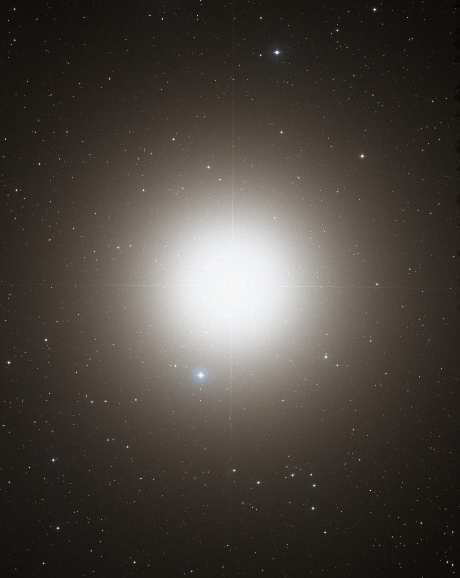
Image source [8]: Arcturus, a K1.5 giant.
Class M stars are by far the most common. About 76% of the main-sequence stars in the solar neighborhood are class M stars.

Image source [9]: UY Scuti, an M4 supergiant.
Double stars and stellar masses
Double star or visual double is a pair of stars that appear close to each other in the sky as viewed from Earth when viewed through an optical telescope. Very often, two stars form a double system, that is, they rotate one with respect to the other, due to their own gravity, and they hold together indefinitely. There are no triple systems because three bodies do not have stable orbits in general, which means that one of the three stars can be expelled from the group. Nor is there a quadruple system.

Image source [10]: Astronomers have mistakenly reported observations of a double star in place of J 900 and a faint star in the constellation of Gemini.
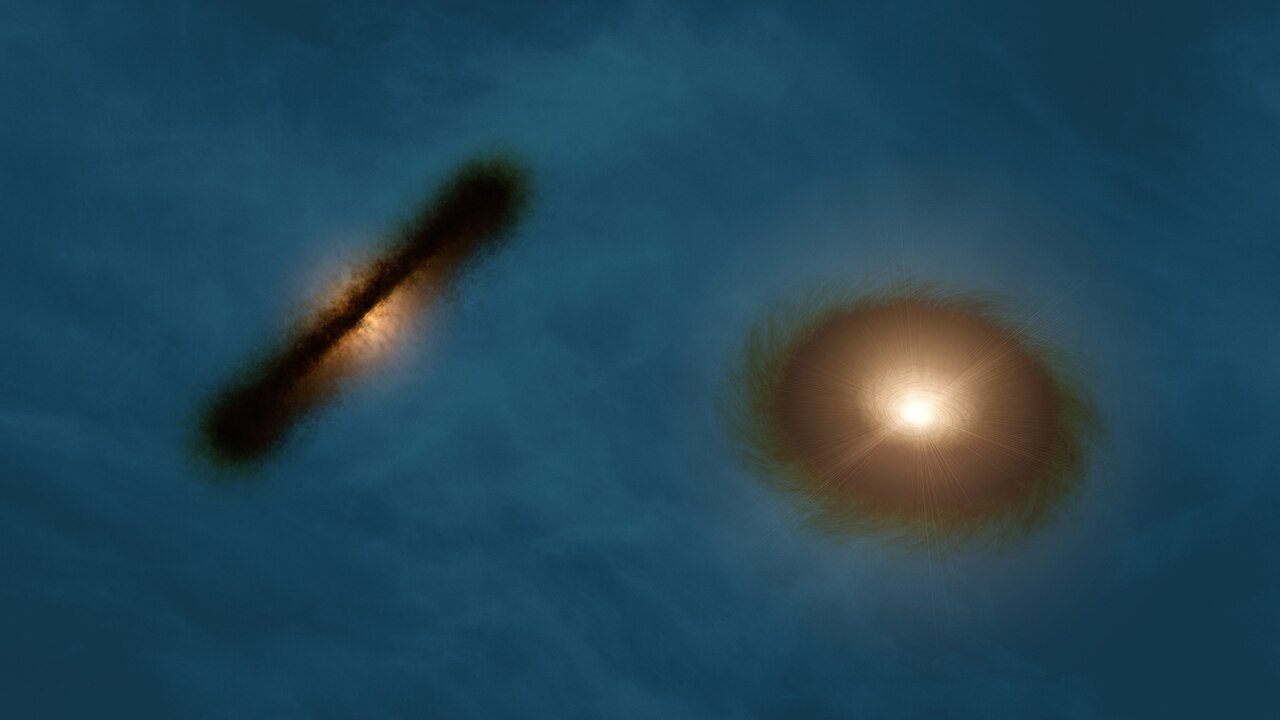
Image source [11]: Artist's impression of the discs around the young stars HK Tauri A and B.
Stellar mass is a phrase that is used by astronomers to describe the mass of a star. It is usually enumerated in terms of the Sun's mass as a proportion of a solar mass (M☉). Hence, the bright star Sirius has around 2.02 M☉.
Why a star shines
This question, surely born on the lips of a hominid millions of years ago, seemed condemned to immortality. But in physics there are no questions without answers, and today, fortunate men of this century, we already know this one. There are great achievements of humanity that we do not know how to celebrate. The stars shine due to the release of nuclear energy, a consequence of a fusion process.
The gamma rays jump around in the star, trying to get out. They're absorbed by one atom, and then emitted again. This can happen many times a second, and a single photon can take 100,000 years to get from the core of the star to its surface. When the photons have reached the surface, they have lost some of their energy, becoming visible light photons, and not the gamma rays they started out as. These photons leap off the surface of the Sun and head out into a straight line into space. They can travel forever if they do not run into anything. When you look at a star like Sirius, located about 8 light-years away, you're seeing photons that left the surface of the star 8 years ago and traveled through space, without running into anything. Your eyeballs are the first thing those photons have encountered.

Image source [12]: Hubble Space Telescope image of Sirius A and Sirius B. The white dwarf can be seen to the lower left. The diffraction spikes and concentric rings are instrumental effects.

Wow, steemit is indeed a school on its own. I never knew the sun is also a star! Amazing, and then this various classification of stars is a new dimension altogether .
that's right Steemit is a great platform to share information :)
I've been actively involved with steemit for a month now and most of what I've learnt most people won't learn in the next two to three years .
may the force be with you .. great post
:)
One can not imagine the wealth of information on steemit. This is amazing, thank you.
Thanks :D