Constellations #6

Image source [1]: NGC 6543 (Cat's Eye Nebula).
Hello friends, continuing our journey through the constellations to continue learning and observe the beauty of the universe today we are going to know the constellation Crater, Cygnus, Delphinus and Draco.
Crater is a small constellation in the Southern Celestial Hemisphere. Its name means "cup" in Latin. One of the 48 constellations listed by the 2nd-century astronomer Ptolemy, it depicts a cup that has been associated with the god Apollo and is perched on the back of Hydra the water snake.

Image source [2]: The constellation Crater as it can be seen by the naked eye.
Cygnus is a northern constellation lying on the plane of the Milky Way, deriving its name from the Latinized Greek word for swan. The swan is one of the most recognizable constellations of the northern summer and autumn, and it features a prominent asterism known as the Northern Cross (in contrast to the Southern Cross).

Image source [3]: The constellation Cygnus as it can be seen by the naked eye, with the Northern Cross in the middle.

Image source [4]: V1331 Cyg is located in the dark cloud LDN 981.
Delphinus is a constellation in the northern sky, close to the celestial equator. Its name is Latin for dolphin. Delphinus was one of the 48 constellations listed by the 2nd century astronomer Ptolemy, and it remains among the 88 modern constellations recognized by the International Astronomical Union. Delphinus does not have any bright stars; its brightest star is of magnitude 3.8. The main asterism in Delphinus is Job's Coffin, formed from the four brightest stars: Alpha, Beta, Gamma, and Delta Delphini.

Image source [5]: The constellation Delphinus as it can be seen by the naked eye.

Image source [6]: Nebulosa planetaria NGC 6891.
Draco is a constellation in the far northern sky. Its name is Latin for dragon. It was one of the 48 constellations listed by the 2nd century astronomer Ptolemy, and remains one of the 88 modern constellations today. The north pole of the ecliptic is in Draco. There are three stars under magnitude 3 in Draco. The brighter of the three, and the brightest star in Draco, is Gamma Draconis, traditionally called Etamin or Eltanin. It is an orange giant star of magnitude 2.2, 148 light-years from Earth.
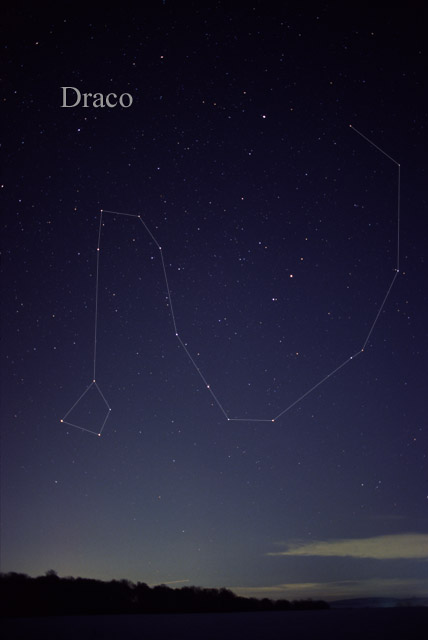
Image source [7]: The constellation Draco as it can be seen by the naked eye.

Image source [10]: PGC 39058, a dwarf galaxy found within the Draco constellation – picture taken by ESA/Hubble & NASA.

Wow.. Lovely post... So enlightening to know about these four constellations and what they are associated to... Thanks for the post... Nice post.
wow is amazing and very beautiful I was fascinated to see it, I really like this post. very-very amazing
wow ... this is so crazy, very beautiful i really like the galaxy that is so bright as if i can feel there now