Tree Deities around the World
Greek Mythology

A dryad is a tree nymph or tree spirit in Greek mythology. A particular type of dryad, which are a particular type of nymph is a Hamadryad which is also a Greek mythological being that lives in trees. Unlike Dryads who are immortals, Hamadryads are born bonded to a certain tree. If the tree died, the hamadryad associated with it died as well. For that reason, dryads and the gods punished any mortals who harmed trees.
The Deipnosophistae of Athenaeus lists eight hamadryads, the daughters of Oxylus and Hamadryas:
- Karya (walnut or hazelnut)
- Balanos (oak)
- Kraneia (dogwood)
- Morea (mulberry)
- Aigeiros (black poplar)
- Ptelea (elm)
- Ampelos (vines, especially Vitis)
- Syke (fig)
Other names of Wood Nymphs from Ancient Greek Mythology are :
- Daphnaie (laurel trees)
- Epimeliades (Apple trees)
- Kissiae (Ivy)
- Meliae (Ash trees)
- Anthousai (Flowers)
- Alseides (Groves)

The Daphnaie are the nymphs of the laurel trees. They are named after Daphne,one of the naiads who was plagued with unwanted sexual advances until she cried to Gaia for help. The Earth Mother took pity on her and turned Daphne into a laurel tree.
The Epimēliads or Epimēlides are nymphs who are protectors of apple trees. They are known to be the guards of the tree that the Golden Fleece was kept on.

Offerings were made to the Forest and Wood Nymph to appease or thank the dryads it was necessary to harvest trees or branches. The sacrifices offered to them usually consisted of lambs, milk, and oil, but never of wine.
They were generally very kind and believed to watch over the fate of mortals but conversely some were believed sometimes to appear to and frighten solitary travellers. The number of forest and wood nymphs is almost infinite.
Some Dryades were also connected with the Naiads of rivers and springs who presided over the trees sprouting on their banks.
India and South East Asia
The Yakshis or Yakshinis , mythical maiden deities of Hindu, Buddhist, and Jain mythology are closely associated with trees, especially the ashoka tree and the sal tree. Although these tree deities are usually benevolent, there are also yakshinis with malevolent characteristics in Indian folklore.
In Tamil culture, Panaiveriyamman, named after the Palmyra palm, is an ancient fertility deity linked to this palm that is so important. This deity is also known as Taalavaasini, a name that further relates her to all types of palm trees. Puliyidaivalaiyamman, the deity of the tamarind tree, and Kadambariyamman, the deity of the kadamba tree are some other Tamil tree deities. They are seen as manifestations of a goddess who offers her blessings by giving fruits in abundance.
Similarly, in Burmese Buddhist traditions, spirits called 'yokkazo' are guardians of large trees. Indiscriminate felling particularly of large trees is generally eschewed owing to the belief that they are dwellings of tree spirits and that such an act would bring the wrath of the 'yokkazo' upon the perpetrator. They act as a deterrent against environmental destruction up to a point in rural Myanmar till now. 'Yokkazo' does not died when the tree fell, instead it becomes homeless.

In Thailand the village ghosts or fairies related to trees such as Nang Takian and Nang Tani are known generically as Nang Mai, "Lady of the Tree". Nang Tani appears as a young woman that haunts wild banana trees. There are also other tree ghosts that are male.
The Penghou ,a tree spirit from Chinese mythology and folklore has a dog-shape. A Dunhuang manuscript described the Penghou as :
A creature that has evolved from the essence of wood is called Penghou. It looks like a black dog with no tail, and its meat can be prepared as food. The essence of a 1,000-year-old tree may evolve into a spirit called Jiafei. It looks like a pig. Its meat tastes like dog meat. (tr. Luo 2003: 4132)
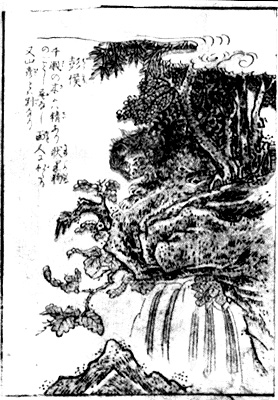
The Japanese pronunciation of Penghou is Hōkō. This tree spirit is included in the Konjaku Hyakki Shūi, one of Toriyama Sekien's collections of monster illustrations.
Such deities are present in many cultures. They are usually represented as a young woman and often connected to ancient fertility and tree worship lore. But there are other culture depicted as male and also as benevolent.
Nice post, full of interesting information. I think the mythological stories all over the world are similar. Perhaps we had a single civilization in the world in ancient time, from where people spread to other parts of the world.
Thank you. And yes, Mythology all over the world has same roots.
I like to explorer these stories, people faith and religions around the world.
I appreciate.