Jackalope
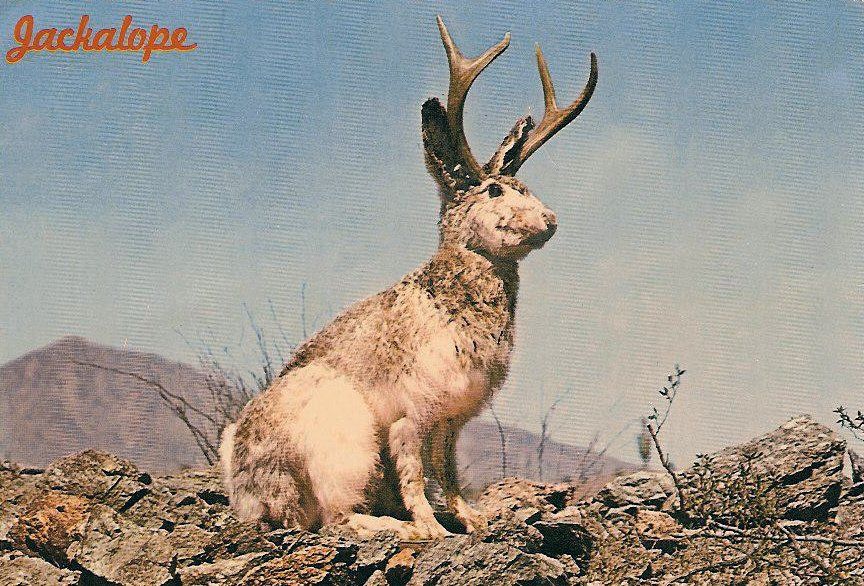
Ever heard of Jackalope! It is described as a jackrabbit with antelope horns. Here is the one Jackalope taxidermy mount in a restaurant in Kansas :
Since 1930s, hunters with taxidermy skills popularized the American jackalope by grafting deer antlers onto a jackrabbit carcass. Stuffed and mounted, jackalopes are found in many bars and other places in the United States; stores catering to tourists sell jackalope postcards and other paraphernalia, and commercial entities in America and elsewhere have used the word "jackalope" or a jackalope logo as part of their marketing strategies. The Wyoming Legislature has once considered bills to make the jackalope the state's official mythological creature. It becomes State's "Official mythical creature" in 2005. If you interest more for that particular story, read Jackalopes of Wyoming – Myth or Reality? from
Legends of America.
The underlying legend of the jackalope, upon which the Wyoming taxidermists were building, may be related to similar stories in other cultures and other historical times. Researchers suggest that at least some of the tales of horned hares were inspired by sightings of rabbits infected with the Shope papilloma virus. It causes horn- and antler-like tumors to grow in various places on a rabbit's head and body. Folklorists see the jackalope as one of a group of fabled creatures common to American culture since Colonial days.
Stories or descriptions of animal hybrids have appeared in many cultures worldwide. A 13th-century Persian work depicts a rabbit with a single horn, like a unicorn. In Europe, the horned rabbit appeared in Medieval and Renaissance folklore in Bavaria (the wolpertinger) and elsewhere. In Sweden, a related species called the skvader. Natural history texts such as Historiae Naturalis de Quadrupetibus Libri (The History Book of Natural Quadrangles) by Joannes Jonstonus (John Jonston) in the 17th century and illustrations such as Animalia Qvadrvpedia et Reptilia (Terra): Plate XLVII by Joris Hoefnagel (1522–1600) in the 16th century included the horned hare. In Central America, mythological references to a horned rabbit creature can be found in Huichol legends. The Huichol oral tradition has passed down tales of a horned rabbit and of the deer getting horns from the rabbit.

The jackalope is subject to many outlandish and largely tongue-in-cheek claims embedded in tall tales about its habits. Jackalopes are said to be so dangerous that hunters are advised to wear stovepipes on their legs to keep from being gored. They are said to be vicious when attacked and use their antlers to fight, thus they are sometimes called the “warrior rabbit.” One of the ways to catch a jackalope is to entice it with whiskey, the jackalope's beverage of choice.
The jackalope can imitate the human voice, according to legend. During the days of the Old West, when cowboys gathered by the campfires singing at night, jackalopes could be heard mimicking their voices or singing along. It is said that jackalopes only breed during lightning flashes and that their antlers make the act difficult despite the hare's reputation for fertility.
In popular culture
Jackalopes have appeared in many movies and on television. In a television series called That's Funny, Jackalope is a reoccurring character in a number of mini-episodes. A jackalope named "Jack Ching Bada Bing" was a recurring character in a series of sketches on the television show America's Funniest People. Pixar also featured a jackalope in the short animation Boundin'. The jackalope gave helpful advice to a lamb who was feeling sad after being shorn.
Many books, including a large number written for children, feature the jackalope. A search for "jackalope" in the WorldCat listings of early 2015 produced 225 hits, including 57 for books. Among them is Juan and the Jackalope: A Children's Book in Verse by Rudolfo Anaya.
Musicians have used the jackalope in various ways. R. Carlos Nakai, a Native American flute player, formerly belonged to a group called Jackalope. Jakalope is a Canadian alternative pop/rock group formed in 2003 by Dave "Rave" Ogilvie. The Swedish indie pop band Miike Snow uses the jackalope as its logo. Band member Andrew Wyatt said during an interview in 2012 that the logo was meant to signify experiment and adventure.
Jackalopes have appeared in video games. In Red Dead Redemption, the player is able to hunt and skin jackalopes. In Redneck Rampage, jackalopes, including one the size of a bus, are enemies. Jackalopes are part of the action in Guild Wars 2.