Egypt labyrinth
A few years ago, a team of researchers set out for Hawara, Egypt, to investigate a lost underground labyrinth, described by many classical authors such as Herodotus and Strabo. Data provided by the radar sweeps carried out by the "Mataha Expedition" provided conclusive evidence of the existence of this mysterious colossal underground labyrinth.

The Hawara site was explored in 2008 by a Belgian Egyptian expedition team. Although ground penetrating techniques have been used by archaeologists for years, the Mataha Expedition (Mataha = maze in Arabic) was the first to apply this technology in the sand to investigate the lost maze.
The so-called Egyptian Labyrinth, a colossal temple described by many classical authors as Herodotus and Strabo, could be the key to proving the existence of a civilization that preceded other ancient cultures of which there are still traces in the area. This monument, of colossal dimensions, is believed to contain 3,000 rooms filled with hieroglyphics and paintings, and has been lost for two millennia under the ancient sands of Egypt.
Among the authors who have mentioned the Egyptian Labyrinth, it is important to mention Herodotus, who claimed to have seen with his own eyes this underground structure and whose description is amazing. In his book of stories, Book II, Herodotus describes the labyrinth as follows:
"I'VE SEEN AN INCREDIBLE PLAY. IF SOMEONE WERE TO PUT TOGETHER THE CONSTRUCTIONS OF THE GREEKS AND SHOW ALL THEIR WORK TOGETHER, IT WOULD SEEM LESS IN EFFORT AND EXPENSE COMPARED TO THIS LABYRINTH. EVEN THE PYRAMIDS ARE SURPASSED BY THIS GREAT WORK. AND WHILE I SPEAK OF THE LOWER CHAMBERS FROM WHAT I HAVE HEARD FROM OTHERS, I MYSELF HAVE SEEN THE UPPER ONES AND THEY ALL SURPASS HUMAN ENDEAVORS."

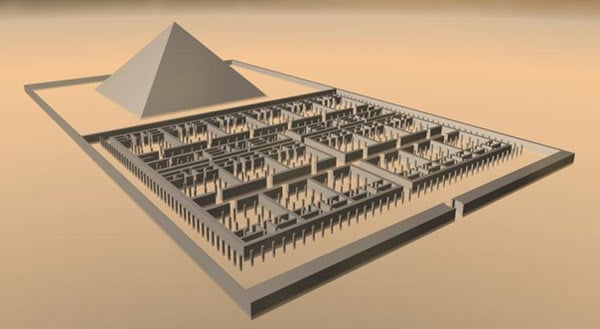
Herodotus was referring to a two-storey maze. One with gigantic stone roofs and the other with underground roofs. Attempts have even been made to represent the labyrinth as it existed in the author's time. Among them are the designs made by an Italian archaeologist and a visual reconstruction by Athanasius Kircher, a German Egyptologist and academic. During the Mataha expedition, radar results were shown which indicated the underground presence of various grid-shaped cavities under the sands of the Hawara Necropolis. In the report of the results of the expedition, the following was written:
Underneath the artificial stone surface, despite the slightly distorted effect of the presence of groundwater, at a depth of between 8 and 12 metres, there is a gigantic grid-shaped structure made of a high-strength material such as granite. We are talking about the presence of a colossal archaeological structure under the Petrie area, which is to be considered as the roof of the still existing labyrinth.
After the discovery of the labyrinth, Dr. Zahi Hawass forbade the members of the Mataha expedition from publishing any data on the discovery until he had gathered more information. However, as the investigation never went any further, the expedition decided to publish these interesting data on its website. It's been 8 years since the discovery of the underground labyrinth in Hawara. Unfortunately, access to the Hawara pyramid is currently flooded with water and mud, which means that the labyrinth is probably flooded...