Toothless Mammals
Teeth are very important for each animal, not only because of how and why they need and use it, but also in showing which kinds of mammals are related to one another. For example, in my previous post about monkeys and apes, we learned that because their teeth is similar to those of bats, that they've been classified as bats many years ago.
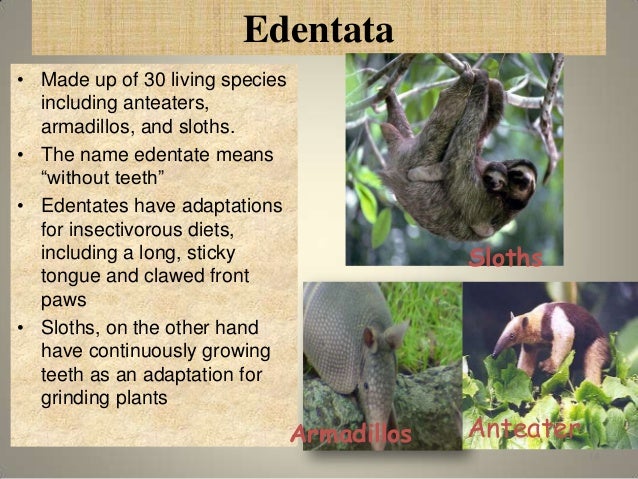
Now we come to those that have no teeth or have only small and very weak teeth. This group includes the Anteaters, Sloths and Armadillos of America. The scientific name for these three kinds of animal is Edentata. This is from a Latin word and yes, you've guessed it, it means 'without teeth' or toothless.
Exceptions to every rule
As you will have realized by now, nothing is straightforward in studying animals.
Whenever scientists think they have found a rule, important exceptions to it will soon be discovered. This is especially true for the Edentates. For instance, the Anteaters have no teeth at all. The Sloths have a few molars in the back of the mouth, and so have some of the Armadillos. Their molars are, however, small and weak and they have no enamel. In most Armadillos there are a dozen or so teeth in each jaw, but in the giant Armadillo there may be 100 in the whole mouth. There is, in fact, only one thing similar about the teeth of this group of animals: not one of them has any teeth in the front of the mouth.
Different food and different teeth
The differences in these animals' teeth are reflected in the food they eat. Anteaters eat only ants and termites, both soft-bodied insects. The Sloths, well-known for hanging upside down from branches, eat only leaves and fruit. The Armadillos also eat insects, but they will eat earthworms and small reptiles, as well as eggs, fruit and leaves, and even the flesh of small dead animals.
Are they really related?
So why are the Anteaters, Sloths and Armadillos grouped together? The Edentata are, in fact, a good example of how scientists group animals together. Animals that look alike are not always related, and animals that look very different can be related. In this group are Anteaters with hairy bodies and long tubular snouts. The Sloths have a coat of coarse hair and a very short snout. And, in even greater contrast, the Armadillos have long snouts but bodies covered with horny plates. So the three kinds of animal look very different. Yet, the similarities in their skeletons show that they are related.


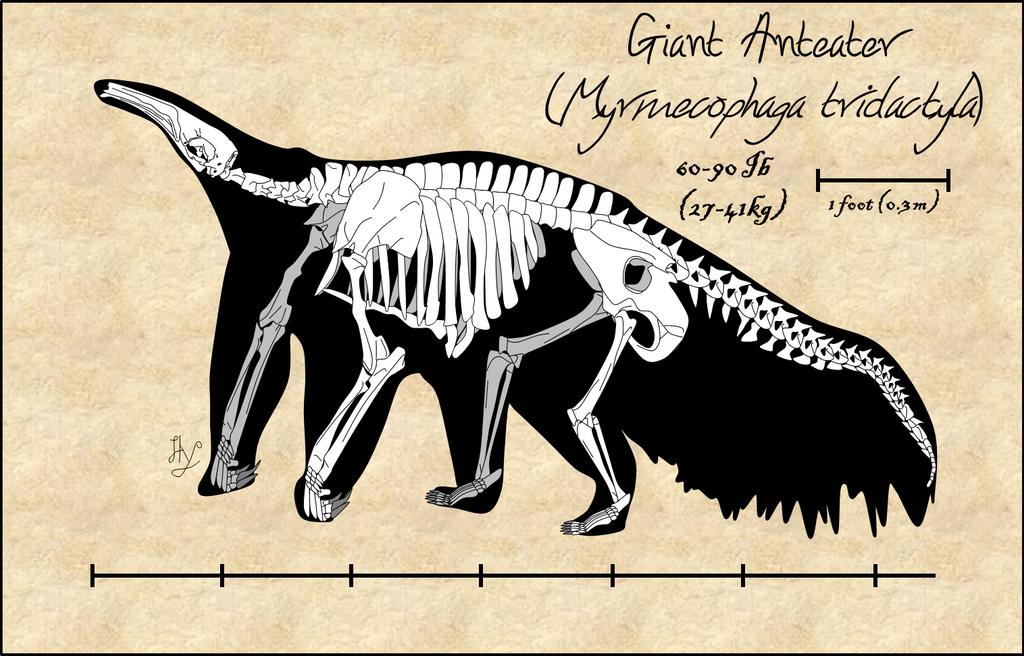
Anteaters with a difference
There are two kinds of animals that used to be classified with the Edentates. They are the Pangolins and the Aardvarks. Both eat ants or termites.

Pangolins have bodies covered in horny plates and no teeth at all. The Aardvark has no teeth in the front of its mouth. So you can understand why scientists at first thought they were related to the Edentata. However, closer study of their skeletons showed that they are not closely related to Anteaters, Sloths and Armadillos, so now they are each classified in a group of their own.

The ant-eating pig
There is only one species of Aardvark or, as it is sometimes called, the Ant-bear or Earth-pig. It is found throughout Africa south of the Sahara. Its head, which is long and narrow, ends in a pig-like snout and a small mouth. The Aardvark uses its long tongue to sweep up ants and termites, after breaking open their nests with its strong claws. There are four claws on the front feet and five on each hind foot.
Ants and termites can be troublesome when their nests have been disturbed. Those not swept up by the Aardvark's tongue swarm over its snout. They would crawl into its nostrils except that the Aardvark can open and close them at will. As a further defence to keep the insects out, the edges of the nostrils are protected by short, stiff bristles.
It is a shy animal and comes out mainly at night. Because of this little was known about it, and for a long time scientists thought it was an Edentate. Now, however, they know it is not.
Resources & Extra reading:
Edentata - Xenarthra | Sloth | Anteater | Armadillo | Aardvark | Pangolins

toofless hahaahaha
Pleasure to be here, Your post really deserve upvote
I though ant eaters were cannabil zombified ants until I saw the actual picture 😂. However, it’s amazing to know that even within the animal kingdom a lesser known species known as ant eater also has a different subsection of species in it.
However, sharks without teeth aren’t friendly at all because then they’ll bite you but it’d just be an effort trying to get out😅.