Rhinoceroses, Hippopotamuses and Pigs
The rhinoceros is another plant-feeder that has teeth similar to those of a horse. It also has an odd number of toes, each one ending in a hoof-like nail. So it, too, is classed as an odd-toed ungulate.
There are five species of rhinoceros. All of them are now rare and in danger of extinction. Although they are all bulky animals with short legs, they are able to run fairly fast. They have poor sight but a keen sense of smell. When a rhinoceros charges it can reach a speed of up to 55kog and its great weight is enough to make it dangerous. It also has on its snout one, sometimes two, dangerous-looking horns. This horn is unlike the horns of cattle and deer. It is made of horny fibres and used to be described as being made up of matted hair. This is a good way of thinking of it. Unfortunately, they are now killed for it.
Rhinoceroses are one of the largest land animals after the elephants. The largest of them, the square-lipped rhino or white rhino, of Africa, weighs 4 tonnes. The next in size is the great Indian rhino at 2,5 tonnes. Then come the black rhino of Africa and the Javan rhino, both at 1,5 tonnes and finally the Sumatran rhino at 0,5 tonne.
Really thick skins:
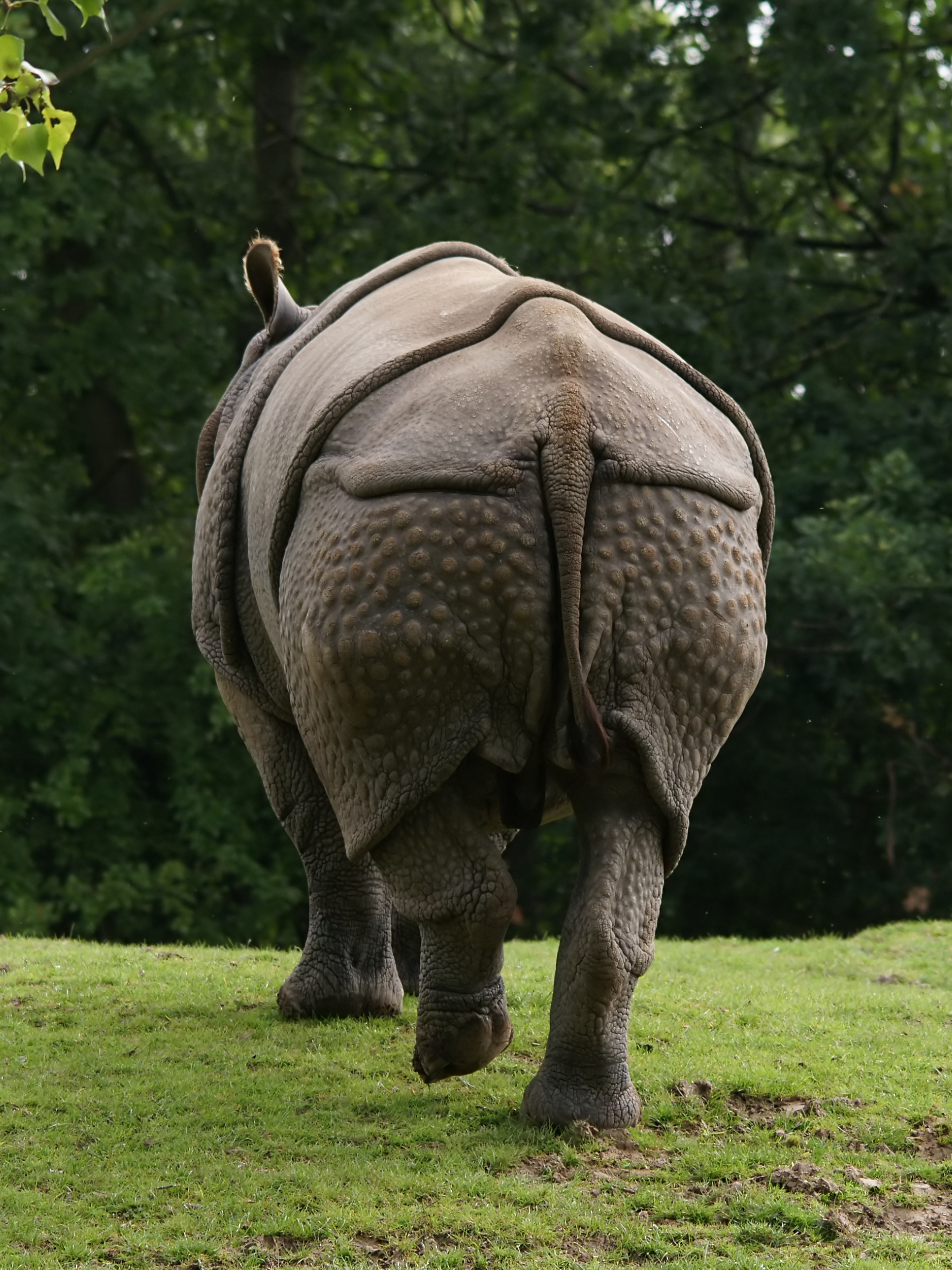
The skin of all rhinos’, except the Sumatran, is hairless apart from a brush of bristles on the tip of the tail and fringes of hair on the ears. The Sumatran rhino has long but rather scanty hair on the body. The skin of the great Indian and Javan rhinos, in particular, is very thick. It grows into folds and looks like armour-plating. But because of their thick skins, all rhinos can rush through the thorny thickets of the regions in which they live without hurting themselves.
Indian rhinos are found only in Nepal and Assam, although once they were found over a much wider area. Like the white rhino, they are peaceful plant-eating animals:

The hide of the great Indian rhino is thrown into folds, which makes the animal look as if it were armour-plated. In spite of its appearance it is inoffensive, except to tigers, its only natural enemy:
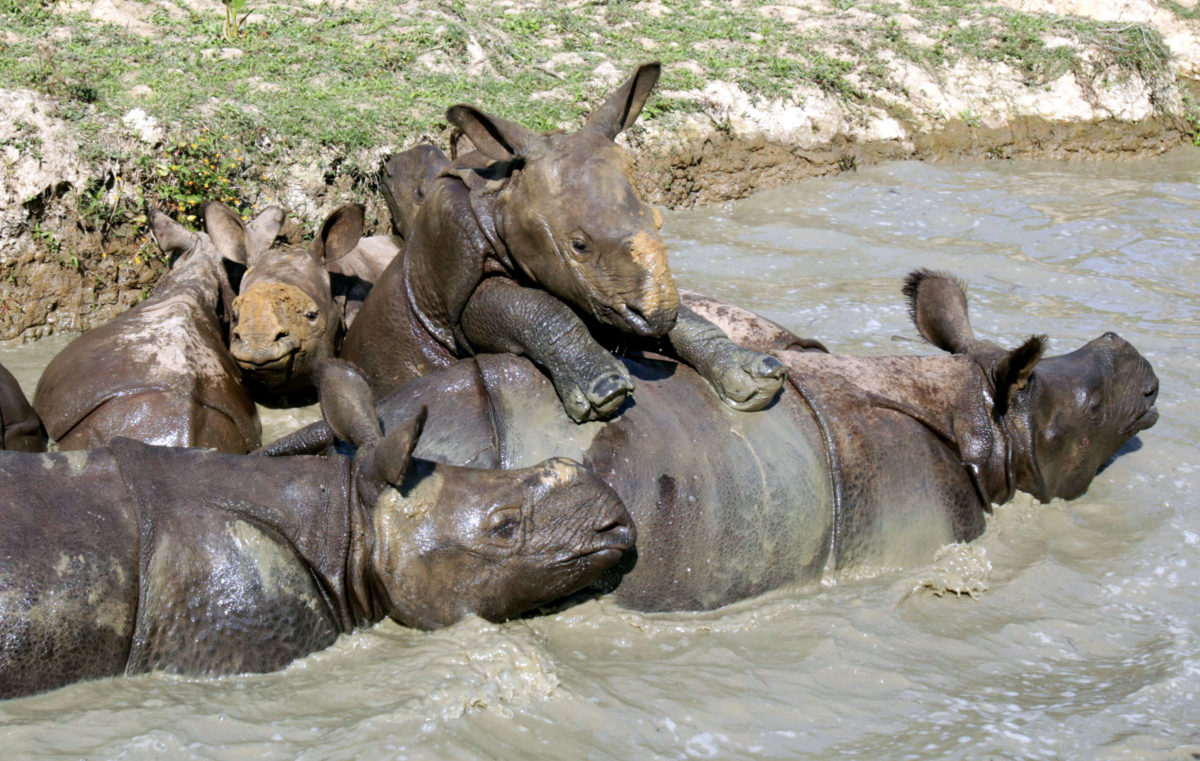
Wallowing in muddy water is something Indian rhinos seem to thoroughly enjoy. Sometimes groups of about ten will wallow together. Although protected because they are one of the world’s endangered animals, rhinos are still hunted and killed illegally and it’s not getting any better:
This brings me to Hippo’s:
The next largest ungulate, after the great Indian rhinoceros, is the common hippopotamus, which may weigh as much as 3,5 tonnes. It is one of the even-toed ungulates, and has four toes on each foot, each toe ending in a hoof-like nail.
The hippopotamus, or river horse as it is sometimes called, is found only in Africa. It has a huge barrel-like body supported by short stumpy legs and an enormous head. It spends most of the day in water, or lying asleep on a sandbank. At night it comes out on land to feed on tall grass along the river banks.
The eyes and ears of a hippo are on top of the head so the animal can keep watch for enemies, lying low in the water with only the eyes and ears showing. If anything comes near it the hippo will open its huge mouth and show its long tusks. This is not a yawn. When the hippo opens its mouth wide it is showing that it is prepared to fight. It can inflict terrible wound with its tusks. Large crocodiles are its main enemies, but hippos also fight among themselves. When they do this each tries to break the other’s foreleg. A hippo with a broken leg cannot support its great weight on land, so it cannot feed and will die.
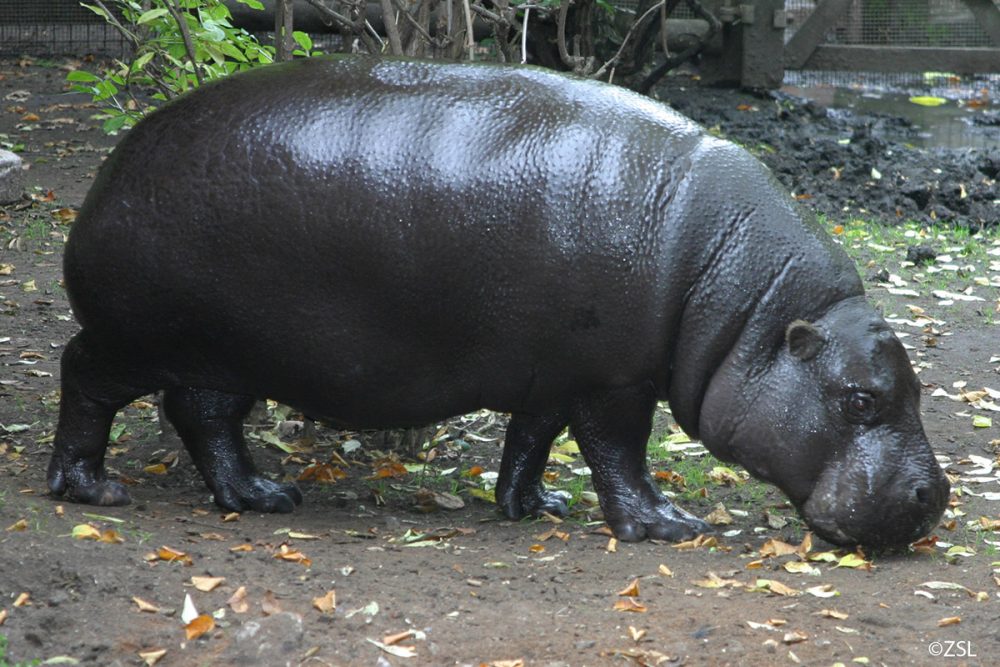
The other kind of hippo, the pygmy hippo, is very much smaller – just as its name suggests. It is only about 1,5m long, compared with the common hippo’s length of up to 4,5m.
They pygmy hippo lives either alone or in pairs in forest streams in West Africa. It is much smaller than the common hippo:
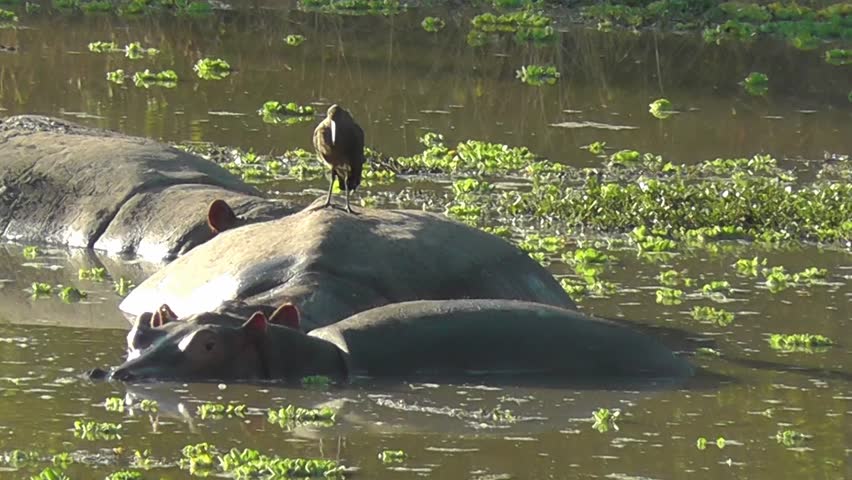
Hippopotamuses lying in the water with a hammerhead stork who finds they make a good perch. Herds of hippopotamus used to be common in rivers and lakes from the Nile delta in Egypt to the Cape in South Africa. Today, they are not found north of Khartoum in the Sudan nor south of the Zambezi River, in Zambia, except in national parks:
Members of the pig family:
Another ferocious even-toed ungulate is the peccary or wild pig of tropical America. This is a distant cousin of the hippo and of the farmyard pig or hog. Peccaries look like pigs except that they have a coat of stiffer bristles and a larger head. They live in herds, eating any plants of animal they can find. When attacked they will go into holes in the ground. If they cannot do this they turn to face the enemy, champing their tusks and charging in a group.
There are half-a-dozen species of wild pig in Europe, Asia and Africa. The European wild boar is the one that was domesticated to become the farmyard pig. It spends its time rooting in the ground eating anything, plant of animal, it can find. It will also browse on green leaves.
The Indian crested boar is like the wild boar except for a crest of black bristles from the back of its head to the shoulders. Both these wild pigs have razor-sharp tusks which they will use to defend themselves if threatened. The crested boar has been known to fight even a tiger.
The largest wild pig is that giant forest hog of Kenya. It stands about 80cm at the shoulder and can weigh up to 136kg. The smallest is they pygmy hog of Nepal. It is only about 30cm high. The babirusa, the wild pig of the island of Celebes in the south-west Pacific Ocean, is about the same height, but has long legs and looks more like a deer. It is also nearly hairless.
Two wild boar piglets in a swampy area. Their striped coats help them blend with the vegetation of their surroundings:)
The collared peccary is the wild pig of tropical America. Wild pigs are distantly related to the hippopotamuses. Peccaries live in herds among thick scrub and feed on fruits, roots and almost any plant or animal they can find:

Resources and extra reading:
Rhinos | Indian rhinoceros | White rhino | Pygmy hippo | Hippos | Peccaries | Wild boar | Giant forest hog | Pygmy hog
