Cats in the wild
The lion, king of beasts, has long appeared on the coats-of-arms of kings and noblemen. To a lesser extent, so has the leopard. At the other end of the scale for size, is the household cat, which rivals the dog for human affection and popularity.
The main differences between cats and dogs are that cats can sheathe their claws. Dogs cannot. We say that a cat’s claws are retractile. Cats also have shorter muzzles than dogs, with the exception, of course, of breeds such as the pug or the bulldog.
All cats are carnivores and the animals they hunt depend on their own size. The smaller cats, such as the European wild cat, the bush cat of Africa and the jungle cat of North Africa and southern Asia, prey on small birds, rodents, and other small animals. The big cats, such as the lion and tiger, kill hoofed animals such as buffalo and large antelopes. Middle-sized cats, such as the leopard of Africa and Asia, and the jaguar of South America, kill middle-sized prey – deer and antelopes.
The lynx is a middle-sized cat with a short tail. Different kinds live in Europe, Asia and North America. One lynx, found throughout the United States, is called a bobcat. All lynxes have tufted ears. They do not run well but have very broad feet and can walk long distances without getting tires.
The fastest runner in the cat family is the cheetah, now found only in Africa. It used also to be common in southern Asia, but has been killed off there. It has a coat covered with small spots and very long legs. Most cats stalk their prey and catch it with a last pounce. Or else they ambush it. Cheetahs, however, run down their prey, reaching speeds of about 97kph as they do so.
Dogs, too, run down their prey. A cheetah is halfway between cats and dogs in another way – its claws are only partly retractile.
The leopard is the most agile of the Big Cats. It often climbs trees, to rest stretched out along a branch. It also climbs to take the remains of its prey out of reach of hyenas and lions, usually after having eaten enough for one meal:

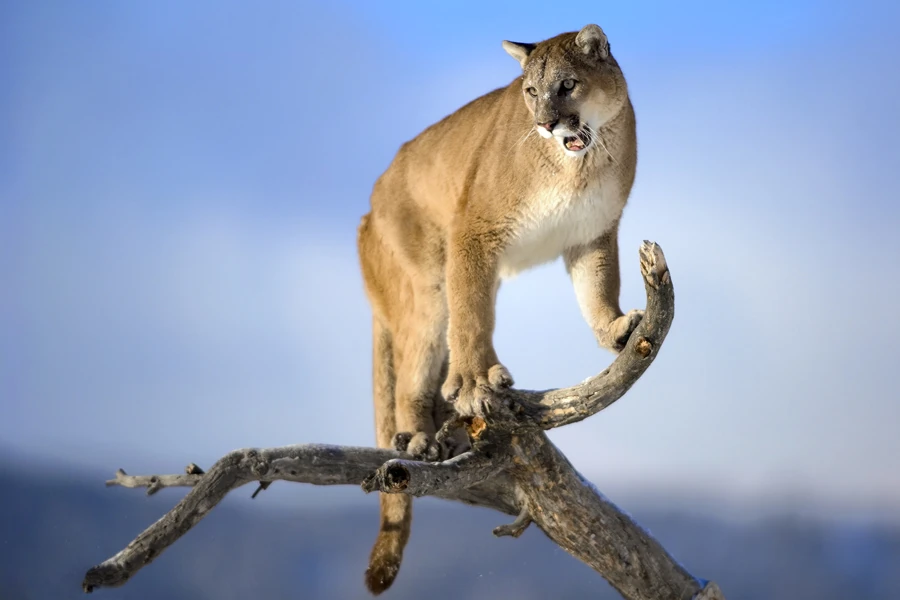
The puma, or cougar, of America, is also called the mountain lion. It looks like a lioness and is about the same size:
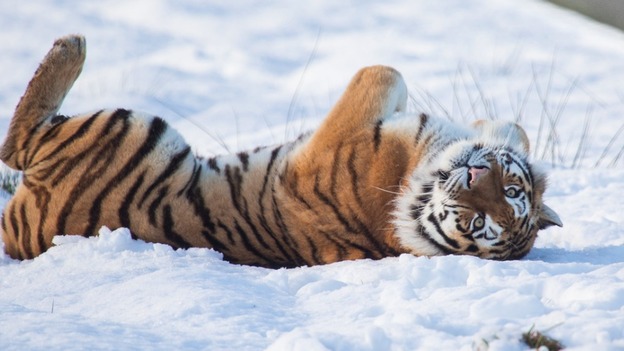
Because we think of tigers as animals living in hot countries, it is rather surprising to discover that they love lying in water, especially in the midday heat. The answer is that tigers originated in the temperate regions of Asia, where the winters are long and the ground covered in snow for much of the year. As a result they cannot stand too much heat:
The lion was once common throughout all of Africa, most of southern Asia, and even parts of southern Europe. Second only to the tiger in size, it is one of the Big Cats, the other three being the tiger, the leopard and the jaguar. Only the male lion has a mane; the lioness has short hair over the whole body:

The lynx, which is also a member of the cat family, has a stumpy tail and tufted ears. The lynx shown here on the right, is known as the bobcat. It lives in North America. All lynxes are tireless walkers as they follow their prey:

Resources and Extra reading:
Felidae | Tiger | Cheetah | Leopard | Puma | Lion | Lynx | Bobcat

Pleasant its content, I find interesting the different behaviors of the felines according to the species. excellent publication @ghostgtr.