3 Endangered animals in the world

Many animal and plant species are on the list of endangered animals, more than 15,000 in fact. Destruction of their habitat, frantic hunting, poaching, have reduced the animal cohorts drastically. And among these species, ten are particularly endangered.
The world has experienced 5 large species extinctions, all natural. Today, humanity is witnessing the beginning of the sixth massive extinction of species. But this time, it's not natural. Here is an arbitrary selection of 3 species that, if we do nothing, will probably disappear in the space of a man's life. Unless we prevent that.
It is estimated that all species have decreased by 25% in the last 500 years. In question, human activity. The numbers do not lie. The rate of extinction is 100 to 1,000 times higher than the natural evolution process according to the International Union for the Conservation of Nature. Of these endangered species, some are more so than others. You could probably witness their extinction during your lifetime. Here is the "face" of some of them.
Flying fox

The flying fox is a kind of big bats and it is not algae in fact. This bat lives in most tropical regions, except South America. It is especially in the South Pacific regions of diffuse . The length of the head with the body about 30 cm, and may reach the extension of the wing to more than 1.5 m and weighing to 11 kg, and called this name because his face looks like the face of the fox. The flying fox eats mostly fruit, and is known as the fruit patties, and also feeds with floral and nectar blossoms and pollen. He spends his day in the trees with the other fruit bats. The tree looks like it is burdened with fruit and is active in the sky and feeds at night. Flying foxes can travel long distances in search of their food, and could damage the orchards. So it is combated until it oversaw extinction.

the World's Biggest Bat
Dendrolagus (arboreal kangaroos)

Dendrolagus is a medium sized marsupial related to kangaroos. It has a short, woolly coat with pale brown to reddish brown on the upper body, beige to white on the ventral side, and yellow to light brown on the cheeks and feet. The conical tail and almost as long as the body is golden. A hairy band on the back of the neck pushes in the opposite direction. It is intended to allow better flow of rainwater when the animal is resting while the head is lower than the shoulders. The head, small and broad, is decorated with two round ears resembling those of a bear. The forelegs, shorter than the hindquarters, are equipped with specialized bent claws for gripping, while the rear legs more powerful but less developed than those of terrestrial species are provided with anti-slip pads.
Dendrolagus habitat:

Dendrolagus lives in trees in the montane rainforests of central Papua New Guinea, between 1,000 and 2,000 meters above sea level. It evolves on rugged terrain difficult to access.
Behavior of the dendrolagus:
The dendrolagus is a generally solitary arboreal animal, which can sometimes be seen in small family groups consisting of the female, the young and a male. Its activity is diurnal and it spends about 16 hours a day in the foliage to rest. He rarely goes down to the ground, where he is very clumsy. On the other hand, it is very skilful in the trees, which it climbs by wrapping the trunk of its forelegs and pushing on its hind legs, allowing the front legs to slide. The marsupial is capable of leaps up to nine meters from tree to tree, and to drop to the ground from a height of 18 meters without injury. When he moves on his hind legs, he is constantly leaning forward to compensate for the weight of his tail that serves as a balance and resting place. It emits some vocalizations and marks its territory by friction. The Goodfellow's peatworm does not have predators, with the exception of a few raptors for young people.

There is no definite breeding season in Goodfellow's grasshopper. The female is estrus every 54 or 56 days. She gives birth to a single baby at the end of a 44-day gestation. The embryo is hoisted into his mother's marsupial pocket where he clings to a nipple to begin his growth. He tips his nose out of the marsupium after four and a half months and finally leaves the pocket at the 41st week. The young person becomes totally independent around one year old, and is sexually mature after 18 or 24 months.
Goodfellow's Dendridge Diet
Goodfellow's grasshopper is folivorous. It feeds mainly on leaves, buds, flower sap and bark of a maple of the species Flindersia pimenteliana, of the family Rutaceae.
Threats on the dendrolagus:
Goodfellow's dendrolagus populations have declined by 50% over the last 30 years. The marsupial is mainly threatened by hunting, and by the disappearance of its habitats due to deforestation. Local awareness programs and hunting regulations should be put in place to prevent the species from disappearing within a short time.
Tree-kangaroo (Dendrolagus)
The Philippine Eagle(Pithecophaga jefferyi)
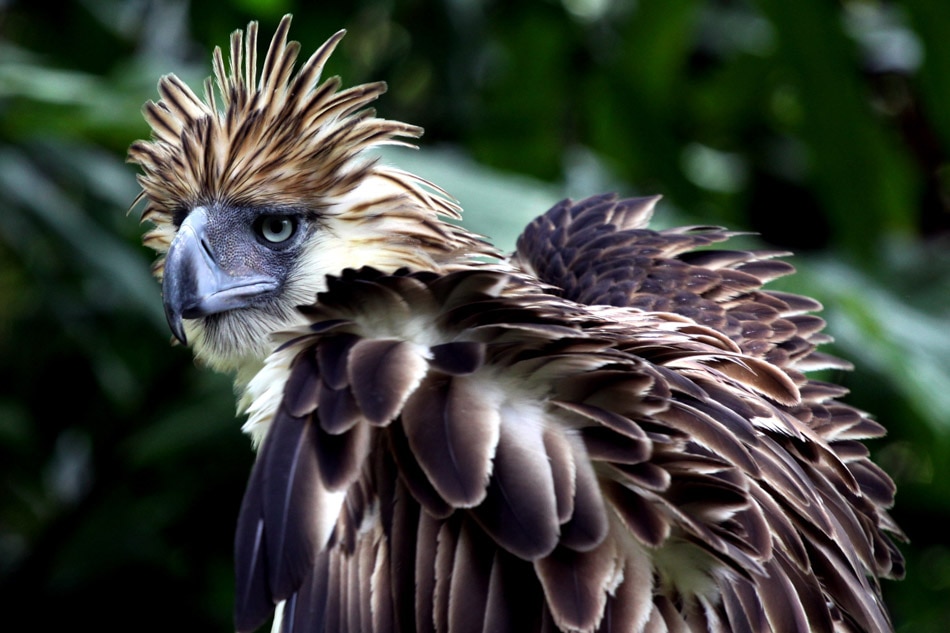
The Philippine Eagle is the second largest eagle in the world after the harpy eagle. He is also one of the most formidable and powerful. This raptor is also known as the Eagle of the Apes because of its pronounced taste for primates.
With an easily identifiable physique, it has the particularity of having around the head erectile feathers that can erect collar . Particularly impressive in flight, the Pithecophaga jefferyi, of its scientific name, has a wingspan of 2 to 2.5 meters for a weight which can vary between 6,500 and 8,000 grams, the females being larger than the males. This bird of prey, with blue-gray eyes, is brown, streaked with beige on the top of the feathers, white under the body. His particularly large tail serves as a rudder during his flights.

IUCN has classified this bird as "critically endangered" in 2012.
The eagle of the apes is exclusively visible on the Philippine archipelago, composed of more than 7000 islands, of which it is the emblem since 1995. The range of the raptor is however limited to those of Luçon, Leyte, Samar and Mindanao where the bird enjoys its favorite hunting ground: tropical forests with dense vegetation.
The island of Mindanao concentrates the largest part of the population with a number of breeding pairs ranging from 82 to 233 (data from 2003) while on the other islands there are less than 10. The population of eagles from the Philippines has much has fallen in the last 60 years, although it is difficult to give a precise figure. The specialists themselves disagree, some claiming that there are a hundred, 500 others. The truth is probably between these two figures. In any case, all come together to say that it is the most endangered species of eagle.

The disappearance of their natural habitat
The first of these is massive deforestation. Plagues well known to environmentalists, the destruction of old trees and the reduction of forest areas deprive the Philippine eagles of their natural habitat. Indeed, the trees are cut down so that their wood is sold, and the spaces once cleared are intended for agriculture and not repopulated. In addition, tropical forests are leased to logging concessions that exploit them and care little about the fate of the animals that inhabit them. This problem applies to the forests of the Philippines but also and especially to the "lung of the Earth", the Amazon.
The hunt
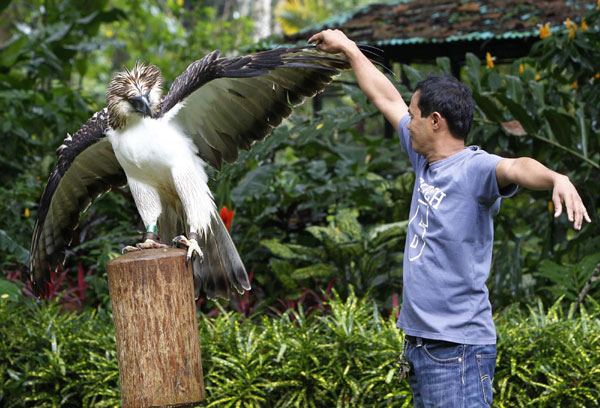
The second main threat to the monkey eagle is hunting. In the past, raptors were captured for sale or display in animal parks. Today prohibited, this practice does not prevent the eagle to be a victim of poachers who see in him a symbol of power. The raptor may also be the victim of ground traps for other animals.
According to a 2008 IUCN report, it appears that uncontrolled hunting is the most important threat to the bird in the short term.
Difficulties of reproduction
Finally, the disappearance of the species also comes from its low capacity to multiply (see reproduction section below), the number of deaths currently surpassing that of births. Young eagles, called juveniles or sub-adults, are particularly fragile.
In addition, pollution and especially pesticides used in large numbers also contribute to the depletion of the Philippine eagle.
Learn more
The Philippine eagle has a particularly effective hunting technique. He hunts as a couple. One of the members distracts by drawing the attention of the prey while the second attacks from behind.
Congratulations! This post has been upvoted from the communal account, @minnowsupport, by aekkouba from the Minnow Support Project. It's a witness project run by aggroed, ausbitbank, teamsteem, theprophet0, someguy123, neoxian, followbtcnews/crimsonclad, and netuoso. The goal is to help Steemit grow by supporting Minnows and creating a social network. Please find us in the Peace, Abundance, and Liberty Network (PALnet) Discord Channel. It's a completely public and open space to all members of the Steemit community who voluntarily choose to be there.
It's extremely scary to think how much has changed from natural evolution to unnatural all do to human activity......this was a very illuminating post....ty