RE: Andrews Airship of 1863. Did Amos Dolbear know something Alexander Graham Bell didn't? Sam Tillman, what did he know? Aero Clubs, Aero ships, what New York looked like in 1903 video! A Trump Train from the 1800's? 4500 series!
Some feel that Tesla had 2 methods in mind and they both used the same apparatus.
One was electrical current flowing through the earth, with the return path going through the upper atmosphere.
The other one was what Tesla referred to as an Earth Resonance System.
A single wire transmission line in which the earth itself would become part of the circuit and resonating like when a bell rings when you strike it with a clapper.
Was there an acoustic property or aspect to the operation of the Wardenclyff Tower.
Does it utilize both surface and underwater resonance?
Is this Why earth rang like a bell on 11.11.2018?
Is Tesla's magnifying transmitter able to direct a a standing resonate wave up to an area in the ionosphere?
Throughout this chapter, we have been studying traveling waves, or waves that transport energy from one place to another. Under certain conditions, waves can bounce back and forth through a particular region, effectively becoming stationary. These are called standing waves.
Another related effect is known as resonance. In Oscillations, we defined resonance as a phenomenon in which a small-amplitude driving force could produce large-amplitude motion. Think of a child on a swing, which can be modeled as a physical pendulum. Relatively small-amplitude pushes by a parent can produce large-amplitude swings. Sometimes this resonance is good—for example, when producing music with a stringed instrument. At other times, the effects can be devastating, such as the collapse of a building during an earthquake. In the case of standing waves, the relatively large amplitude standing waves are produced by the superposition of smaller amplitude component waves.
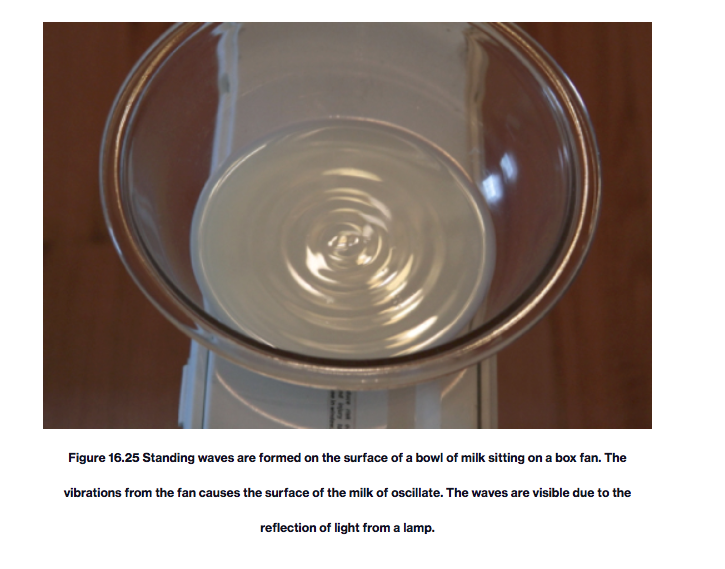
Sometimes waves do not seem to move; rather, they just vibrate in place. You can see unmoving waves on the surface of a glass of milk in a refrigerator, for example. Vibrations from the refrigerator motor create waves on the milk that oscillate up and down but do not seem to move across the surface.
Take a bowl of milk and place it on a common box fan. Vibrations from the fan will produce circular standing waves in the milk. The waves are visible in the photo due to the reflection from a lamp. These waves are formed by the superposition of two or more traveling waves, such as illustrated in (Figure) for two identical waves moving in opposite directions. The waves move through each other with their disturbances adding as they go by. If the two waves have the same amplitude and wavelength, then they alternate between constructive and destructive interference. The resultant looks like a wave standing in place and, thus, is called a standing wave.
The red wave is moving in the −x-direction and the blue wave is moving in the +x-direction. The resulting wave is shown in black. Consider the resultant wave at the points $ x=0,\text{m},3,\text{m},6,\text{m},9,\text{m},12,\text{m},15,\text{m} $ and notice that the resultant wave always equals zero at these points, no matter what the time is. These points are known as fixed points (nodes). In between each two nodes is an antinode, a place where the medium oscillates with an amplitude equal to the sum of the amplitudes of the individual waves.
Consider two identical waves that move in opposite directions. The first wave has a wave function of $$ {y}{1}(x,t)=A,\text{sin}(kx-\omega t) $$ and the second wave has a wave function $$ {y}{2}(x,t)=A,\text{sin}(kx+\omega t)$$. The waves interfere and form a resultant wave
$$\begin{array}{c}y(x,t)={y}{1}(x,t)+{y}{2}(x,t),\hfill \ y(x,t)=A,\text{sin}(kx-\omega t)+A,\text{sin}(kx+\omega t).\hfill \end{array}$$
This can be simplified using the trigonometric identity
$$\text{sin}(\alpha ±\beta )=\text{sin},\alpha ,\text{cos},\beta ±\text{cos},\alpha ,\text{sin},\beta ,$$
where $$ \alpha =kx $$ and $$ \beta =\omega t$$, giving us
$$y(x,t)=A[\text{sin}(kx)\text{cos}(\omega t)-\text{cos}(kx)\text{sin}(\omega t)+\text{sin}(kx)\text{cos}(\omega t)-\text{cos}(kx)\text{sin}(\omega t)],$$
which simplifies to
$$y(x,t)=[2A,\text{sin}(kx)]\text{cos}(\omega t).$$
Notice that the resultant wave is a sine wave that is a function only of position, multiplied by a cosine function that is a function only of time. Graphs of y(x,t) as a function of x for various times are shown in (Figure). The red wave moves in the negative x-direction, the blue wave moves in the positive x-direction, and the black wave is the sum of the two waves. As the red and blue waves move through each other, they move in and out of constructive interference and destructive interference.
https://www.coursehero.com/study-guides/suny-osuniversityphysics/16-6-standing-waves-and-resonance/
The sine wave is important in physics because it retains its wave shape when added to another sine wave of the same frequency and arbitrary phase and magnitude. It is the only periodic waveform that has this property. This property leads to its importance in Fourier analysis and makes it acoustically unique.
The subject of Fourier analysis encompasses a vast spectrum of mathematics. In the sciences and engineering, the process of decomposing a function into oscillatory components is often called Fourier analysis, while the operation of rebuilding the function from these pieces is known as Fourier synthesis. For example, determining what component frequencies are present in a musical note would involve computing the Fourier transform of a sampled musical note. One could then re-synthesize the same sound by including the frequency components as revealed in the Fourier analysis. In mathematics, the term Fourier analysis often refers to the study of both operations.
Moreover, the original concept of Fourier analysis has been extended over time to apply to more and more abstract and general situations, and the general field is often known as harmonic analysis. Each transform used for analysis (see list of Fourier-related transforms) has a corresponding inverse transform that can be used for synthesis.
The abrupt boundary between a magnetosphere and the surrounding plasma, the magnetopause, has long been known to support surface waves. It was proposed that impulses acting on the boundary might lead to a trapping of these waves on the dayside by the ionosphere, resulting in a standing wave or eigenmode of the magnetopause surface.
See more here,
https://www.nature.com/articles/s41467-018-08134-5
Atmospheric resonances and their coupling to vibrations of the ground and waves in the ocean
Observations of the ionosphere with the airglow, GPS-TEC, and HF radar techniques reveal a resonant response of the middle and upper atmosphere to broad-band excitation by earthquakes, volcano eruptions, and convective storms. The resonances occur at such frequencies that an atmospheric wave, which is radiated at the ground level and is reflected from a turning point in the middle or upper atmosphere, upon return to the ground level satisfies boundary conditions on the ground. Using asymptotic and numerical models of atmospheric waves, this paper investigates
atmospheric resonances and their excitation by seismic waves and infragravity waves in the ocean. It is found that “buoyancy” resonances with periods up to several hours arise in addition to “acoustic” resonances with periods of about 3–5 min. The acoustic and buoyancy resonances occur, respectively, on the acoustic and gravity branches of the dispersion curve of acoustic-gravity waves. Buoyancy of the atmosphere is important for the resonances of both kinds.
https://earth-planets-space.springeropen.com/articles/10.1186/s40623-020-01260-9
Excitation of the ionospheric resonance cavity by
neutral winds at middle latitudes
V. V. Surkov, O. A. Pokhotelov, Michel Parrot, E. N. Fedorov, M. Hayakawa
Received: 10 February 2004
https://hal.archives-ouvertes.fr/hal-00329368/document
HAARP, the most powerful ionosphere heater on Earth
Todd Pedersen is a scientist at the Air Force Research Laboratory’s Space Vehicles Directorate at Kirtland Air Force Base in Albuquerque, New Mexico.