Us - Movie Review
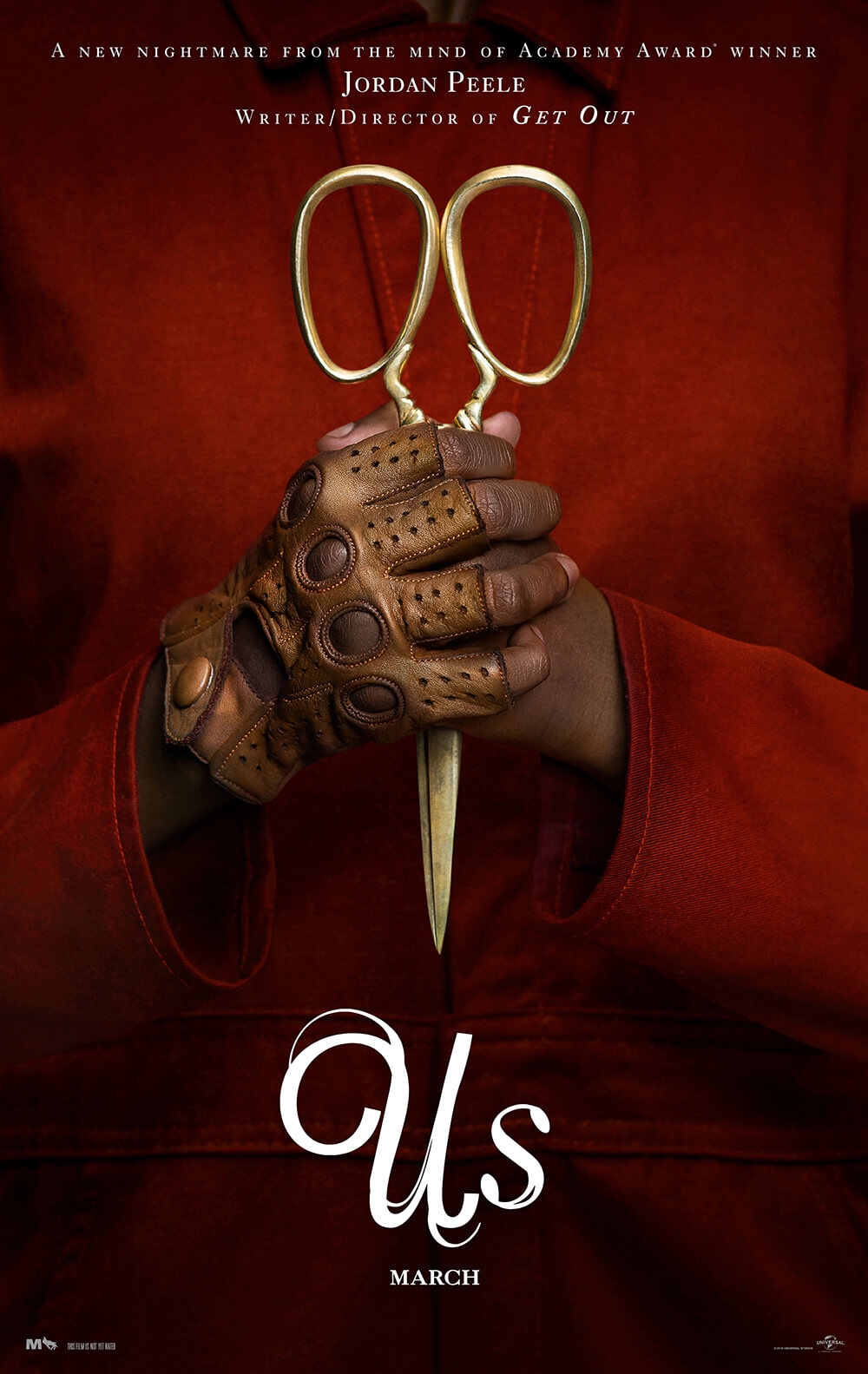
© Universal Pictures
Yesterday, I went to watch "Us" in my local movie theater (which had an OV screening, yay!). After watching "Get Out" when it was released, I didn't even check out the trailer or anything else for "Us", as I was confident it'd be at least as good.
I was not disappointed!
The movie was awesome, and I enjoyed it greatly. For everyone who prefers psychological horror over jump scares and gore, I recommend you go watch in in a movie theater and don't read my review any further, because, below this point, I will spoil basically everything.

By geralt on pixabay.com
Spoilers ahead, you have been warned.
First, a summary:
The movie begins with the main character, Adelaide, as a little girl in the 80s at an amusement park at a beach with her parents after dark. She wanders off, into a mirror labyrinth, where she encounters a girl that looks exactly like her - but it's not a mirror image.
We later see her, returned to her parents, but refusing to speak. A psychologist assumes she suffers from PTSD and suggests her parents help her express herself through drawing, dancing, or other creative methods. Thus, Adelaide starts doing ballet.
The movie jumps back to the present day, Adelaide has a husband and two kids (an older girl Zora and a younger son Jason). They arrive at what's (presumably) their summer house, close to the location of the beach. Her husband tries to convince her to go to the beach together with the children, which she first refuses to do, but then caves in, insisting that the return before dark.
Upon reaching the beach, they encounter an ambulance into which a dead man is being loaded - a dead man holding a sign with "Jeremiah 11:11" written on it, which Adelaide recognizes, as she had seen him before as a child.
At the beach, they meet a family they're friends with, which has two twins. Adelaide's son, Jason, finds a man standing at the beach, his hands dripping with blood. We don't see if the man takes any notice of the boy, as the movie cuts to his mother, frantically searching for her seemingly lost child. Once reunited with Jason, they return to the house, where Adelaide is still panicking.
She tells her husband Gabe about what happened to her as a child, and that she feels like the girl from the mirror is still coming for her. Her husband, while being somewhat supportive, obviously doesn't believe her. During their conversation, the power goes out.
In front of the house, they notice a family standing hand in hand, just watching the front door. Gabe tries to shoo them away, which prompts them to break into the house and corner the family inside the living room. There, the family realizes that the intruders look exactly like them - just in different clothes, slightly different hairstyles, and weirdly off.
Quote Zora: "They're US!"
Adelaide's double, Red, tells (with a broken voice), the story about a little girl and her shadow, about how the shadow was forced to mirror the girl's experiences, but only received twisted versions of it (didn't get to choose her husband due to love, but because he was "tethered" to the girl's "prince", gave birth to monster children, ...).
Gabe's double proceeds to drag the wounded Gabe out of the house and onto Gabe's recently purchased boat, Zora is instructed to run away, pursued by her double, the boys are sent away to play, and Adelaide remains in the living room, handcuffed to the coffee table, together with Red. Red gets scissors and tells Adelaide that she plans to do something she's calling "the untethering".
Jason manages to escape his double (Pluto), Adelaide breaks free, and together they run to the boat where Gabe has successfully killed his double Abraham. Zora joins them and the family escapes.
The movie skips to the other family that had been previously introduced as friends at the beach. Their power also cuts off for a second, but then the backup generator kicks in, making them barely notice that something happened. In contrary to Adelaide's family, they're thus not alerted to the presence of their own doubles, who swiftly kill them with their scissors.
When Adelaide's family arrives at the house of their friends, they are met by the father's double. A longer fight ensues, in which Zora, Jason, and Adelaide kill the people that have murdered their friends.
During a brief moment of peace, they call the police, just to be met with an automated voice stating that currently there are too many people calling. In the news, it's shown that the doubles are killing people all over the USA, and are then forming a long chain, holding each other by the hands.
The family decides to drive to Mexico.
On the way, they run over Zora's double, and then encounter Jason's double near the beach where everything started. Jason realizes that Pluto mimics his own actions, which he uses to walk the child into a fire and kill him, but he's then snatched by Red and dragged underground. Adelaide pursues them.
Going through the mirror labyrinth she had her traumatic experience in as a child, she finds a door and an escalator that only leads down, and brings her into an underground tunnel system with rooms left and right, filled with white rabbits hopping around. In one of the rooms, she finds Red.
Red proceeds to explain what is happening. She tells Adelaide that the doubles had been created as a way to control the people "above", but while it had been possible to clone the body, "the soul" could not be replicated, leaving the doubles mimicking their counterparts above ground. According to Red, the research had been discontinued due to this failure, and the doubles left underground to themselves. Without a purpose, they just kept wandering the halls, dragged along through the lives of their counterparts above.
The scene then changes, as Red tells the story from her view, how she met Adelaide on that day. The scenes switch between "above" and "below", illustrating how the life below ground was just a perverted imitation of the life above (for example, while a couple from "above" would feed each other snacks, the couple from "below" was ripping apart a rabbit and feeding each other the raw bites).
While young Adelaide makes her way to the mirror labyrinth, young Red climbs the escalator, and they both meet face to face.
Back in the present, Red tells Adelaide that she also learned ballet, only thanks to Adelaide. And that was when the other doubles noticed something was special about Red. Over the years, Red made a plan to move all the doubles above ground at once, to show the world they exist and that things have to change.
Adelaide and Red proceed to have a final fight, which Adelaide wins, killing Red. She then finds Jason who's hiding inside a closet, brings him back above ground, rejoins the other half of their family, and then they get in a car together and drive away.
While they are driving away, the viewer is shown scenes from Adelaide's memories, showing what happened between her meeting the mirror girl and returning to her parents. It is then revealed that the girl from "below" dragged the girl from "above" to the tunnels, handcuffed her to a bed, took her clothes and returned to the surface, taking over her life - which means that Red has been the "true" version all along, and Adelaide was the product of the experiment.
My review:
I liked the movie, a lot. And because I liked it, and I want to end this review on a positive note, I will talk about what I didn't like first.
To quote one of my other favorite psychological horror movies Secret Window:
Only thing that matters is the ending. It's the most important part of the story.
And yes, the only part that I did absolutely not like was the ending - or rather the final plot twist showing that Red and Adelaide had switched places as children. It just does not make sense to me, in any way. Adelaide's character just doesn't work for me like that, and honestly? Neither does Red (I will keep referring to them by their names given during the movie, not the ones they would have originally had before they switched).
Sure, you can explain it by saying they were very young when they switched, giving them both enough time to evolve in the way their counterpart would have. Adelaide could have been scared of Red coming back to the surface to take back her life. Red could have remembered the life above and could have wanted to take it back. The idea was nice, and differently executed it could have given the movie an extra twist of "oh shit, who are actually the bad guys here???", but for me, it didn't. It felt forced, illogical (yes, even horror movies have an internal logic that should not be violated), and absolutely useless. I could have done without it, and it cheapens the ending a bit.
But okay, that happened. So, what did I like about the movie?
1. Suspense from the first few minutes to the last
I hate it when horror movies are 30 minutes of boring introduction. It's even worse if they don't have any suspense at all, or if they try to shock you with blood every few minutes. "Us" just kept me on the edge, the only thing that varied was the intensity. But there was not a single moment where I was able to relax, to feel like the characters were safe. Everything seemed to be foreshadowing. And, as I will explain later, everything was foreshadowing.
2. No jump scares
Jump scares are just a cheap trick to make weak movies scary. You're often not actually scared, you're just startled. To me, that's annoying and lazy. But there was not a single moment in this movie that I'd consider a jump scare.
You knew what's coming. The camera moved slowly. The "scary thing" moved into the frame slowly. It's a constant "oh shit, oh shit, oh shit, oh shit", which somehow is a lot worse than a jump scare. 10/10 would want this in every horror movie.
3. The soundtrack
Generally, the soundtrack was great. In one specific scene, it was absolutely magnificent. I'm referring to the final fight scene between Red and Adelaide, during which this song was playing:
Be sure to listen until at least 1:43 (and a bit beyond), because that was the part where I was literally clinging to my seat, eyes white open. It is also one of the reasons why I want you to watch it in the movie theater; it's just not the same at home.
The fight scene is interrupted by scenes of young Red and Adelaide at their big ballet show. Which is very fitting, as the song's name "Pas de Deux" refers to a duet of two ballet dancers. To directly quote Wikipedia:
It is often considered to be the pièce de résistance and bravura highlight of a ballet and is usually performed by a leading pair of principal dancers.
Who doesn't love details like that. Gosh I would watch the movie a second time just for that scene ...
4. The Evil explained
You know what I hate? The evil that comes out of nowhere, wreaks havoc, and is never really explained (looking at you, "The Others").
But "Us" gives an explanation that (in-universe) makes sense. Sure, it doesn't really make sense, but we're given an explanation that can be believed, with a certain suspension of disbelief. And I'm 100% fine with that.
5. Foreshadowing/Chekov's gun
Chekov's gun is often referenced in fiction. Quote Wikipedia:
Chekhov's gun is a dramatic principle that states that every element in a story must be necessary, and irrelevant elements should be removed. [...] "Remove everything that has no relevance to the story. If you say in the first chapter that there is a rifle hanging on the wall, in the second or third chapter it absolutely must go off. If it's not going to be fired, it shouldn't be hanging there."
And on Chekov's gun vs. Foreshadowing (also Wikipedia):
Note the difference between Chekhov's gun and foreshadowing. Chekhov was commenting on narrative detail and what details the writer should include. Foreshadowing only vaguely implies that an event will take place in the future, while the Chekhov's gun principle guarantees that an event will happen further along in the story.
As far as I am aware, the concept of Chekov's gun was only intended for the stage, to not overload it. Still, it gives the viewer a certain satisfaction when all the pieces fall into place, and "Us" has a great mix of Chekov's gun and foreshadowing. Some examples that I remember from the top of my head:
At the beginning of the movie, there's writing that tells the viewer that there are empty, unused tunnels all over the USA. As we learn later that they're inhabited, this fact suggests that the doubles are really everywhere, following their above counterparts around constantly.
The entrance of the mirror labyrinth says "Find yourself", which honestly, made me laugh
Jeremiah 11:11
Therefore, thus says the LORD, Behold, I am bringing disaster upon them that they cannot escape. Though they cry to me, I will not listen to them.
(Ok, I had to look that up)
Jason keeps the door of a small closet he's hiding in open with a toy car. In exactly that closet, he later locks his double, kicking away the toy.
Gabe is told by the father of the befriended family to go get a flare gun for the boat. Gabe later proceeds to shoot the flare gun at the father's double
At the beginning of the movie, "Hands Across America" is referenced, and young Red is wearing a shirt with the logo, which presumably sparks the plan for the "undergrounders" version of the event
A lot of bunnies in cages during the intro credits, the same bunnies later shown in the tunnels
Zora saying she doesn't want to do track and field anymore, her dad saying that it would be useful, and Zora later being chased down by her double, proving that her experience running saved her life
The first double spotted (without the viewer really being aware) is the double of the guy holding the "Jeremiah 11:11" sign. Jason finds him by the beach, his hands on his sides as if he was waiting for someone to grab them. He started the chain of humans.
Jason noticing early that his double Pluto mimics his movements, and has an affinity for fire. He later used that to kill the double.
Red chaining Adelaide with what appear to be the same handcuffs Adelaide used to trap Red underground as a child.
There was probably more, but I would have to watch the movie again to spot everything.
6. Comedy that keeps the suspense
There were funny moments all the time, usually slightly macabre, sometimes light-hearted. And it didn't ruin the mood a single time. I laughed, and the stress and suspense were right back. If anything, it helped keep me engaged, because there's only so long you can stay focused, before the fear starts subsiding.
The jokes made it possible for the movie to keep you on the edge.
7. Mostly sensible characters
Not going to lie, there were some dumb moves (especially by Gabe in the beginning). But overall, the characters act like humans, not like dumb puppets that stumble into traps the script set for them.
I can see myself making the same decisions, even the same mistakes. Which, again, increases the horror factor.
Shesh, almost three thousand words. That's why I usually don't write movie reviews, but I was really excited about finally having a movie that's at least as good as "The Cabin in the Woods". And while "The Cabin in the Woods" had more humor and more gore, "Us" stressed me out in a good way.
I've you've read this and haven't watched it, I really recommend you still do. Except, of course, you can't stand horror movies.
If you've watched it, I'd love to hear your own take on the movie (and maybe even that one part I did not like).
Thanks for reading!
~Suesa
!sneeze !sneeze !sneeze
How smart I am.
Well, the virus will get stuck on this account
You have been infected by the King of Disease!
Will you quarantine yourself?
Or will you spread the plague?
To listen to the audio version of this article click on the play image.

Brought to you by @tts. If you find it useful please consider upvoting this reply.