Interesting facts about Lake Baikal.
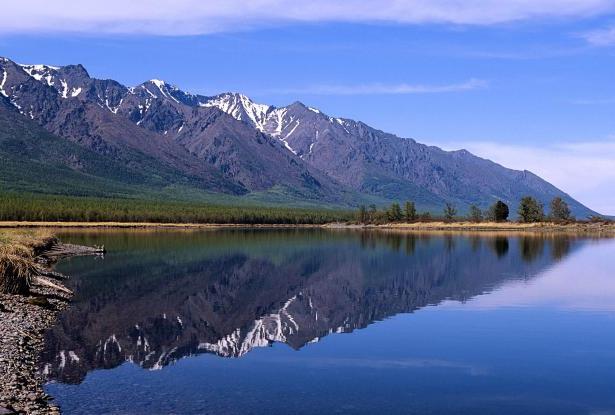
For the title of the eighth wonder of the world, several places on the planet could claim at once. We have this, undoubtedly, Baikal. He outstripped other lakes on the records entered in the Guinness Book, and related interesting facts every year attract many tourists to Russia. In ancient times, this lake was called Bay-Hai (the northern sea) and was mentioned in Chinese literary monuments. Mongolian Baikal was called Baigaal-Dalai, which translates as "rich fire", and in Turkic languages - Bai-Kul, which means "rich lake". The Baikal is the world's largest freshwater reservoir. 1/5 of all natural fresh water is located there. If you pour this water on the tanks and divide between all the Russians, each will get almost 3000 tank cars! Even the five Great American Lakes together can not compete with the amount of water with Lake Baikal. The water in the lake is so clean that you can drink it right away, without pre-treatment. This also can not boast of any other lake of the planet.
If water suddenly disappeared in Lake Baikal, all the world's rivers would need a year of "work" to refill the lake. The water in Baikal tastes very much like distilled water. There are very few dissolved and suspended mineral substances, negligible organic impurities, and a lot of oxygen. By the end of winter, ice thickness on Baikal reaches 1 m, and in bays - 1,5-2 m. In severe frost, cracks, which have a local name "stony cracks", rupture ice into separate fields. The length of such cracks is 10-30 km, and the width is 2-3 m. Discontinuities take place annually in approximately the same areas of the lake. They are accompanied by a loud crash, reminiscent of peals of thunder or shots from guns. Thanks to cracks in the ice, the fish on the lake do not die from lack of oxygen. Baikal is the oldest lake in the world. According to the calculations of scientists, it can be up to 35 million years. Despite such venerable age, the lake is very young: its banks are still actively moving, shifting to 2 cm per year. Baikal is also a lake with the deepest depth. The maximum removal of the bottom from the surface is 1642 meters. But, perhaps, the lake is deeper, just a deeper point has not yet been discovered. On Baikal go not only for natural beauty, but also for the sun: in some places of the lakeside 300 days a year there is clear weather.
The Baikal rift zone refers to areas with high seismicity: earthquakes occur regularly here, the strength of most of which is one or two points. However, there are also strong ones; Thus, in 1862, during the ten-point Kudara earthquake in the northern part of the Selenga delta, a land plot of 200 km² landed with 6 ulus, inhabited by 1,300 people, and the Gulf of Proval was formed. The last strong earthquakes in Lake Baikal occurred in August 2008 (9 points) and in February 2010 (6.1 points). By the number of unique animals, Baikal resembles the Australian continent. In the lake and on the banks there are more than 3600 representatives of flora and fauna, about 70% of which are not found anywhere else. In Lake Baikal are found some of the most ancient animals of the planet - sponges. And also in its waters lives the famous Baikal sturgeon: a one and a half meter handsome man weighing more than 100 kg. On the shores of Lake Baikal grow a cedar that celebrated the 550th anniversary, and a real old timer among larch trees - a tree that is already over 700 years old! In 1996 Baikal was inscribed on the UNESCO World Heritage List.
Source: http://i-fakt.ru
Hello @magnata this post has won a spot on the STEVE'S TOP5 POST for today.
Congratulations to you, your reward would be posted as a comment on this post.
Thank you