Gharials: A Glimpse to Wildlife

Gharials, sometimes called gavials, is one of the largest crocodilians in Asia (the group that includes crocodiles, alligators, caimans, and more), but it has the narrowest snout of any crocodilian species. Historically found in India, Pakistan, Nepal, Bangladesh, Bhutan, and Myanmar but is now extinct in most of these countries and the remaining populations are restricted to India and Nepal and are highly fragmented.
When a male of this species gets to be around 10 years old, a bulbous knob which scientists refer to as either the ghara or gharal, descended from the Hindi word ghara, which is a round earthenware pot, will start to emerge just behind his nose and may serve to attract females. Males use their gharas to vocalize and blow bubbles during mating displays. The animals gather to mate and make nests during the dry season and then females lay eggs in sandbanks along slow-moving sections of water. Eggs incubate for 70 days, and hatchlings will stay with their mothers for several weeks or even months. The gharial has quite weak legs, and fully grown adults are incapable to raise their bodies off the ground when on land.
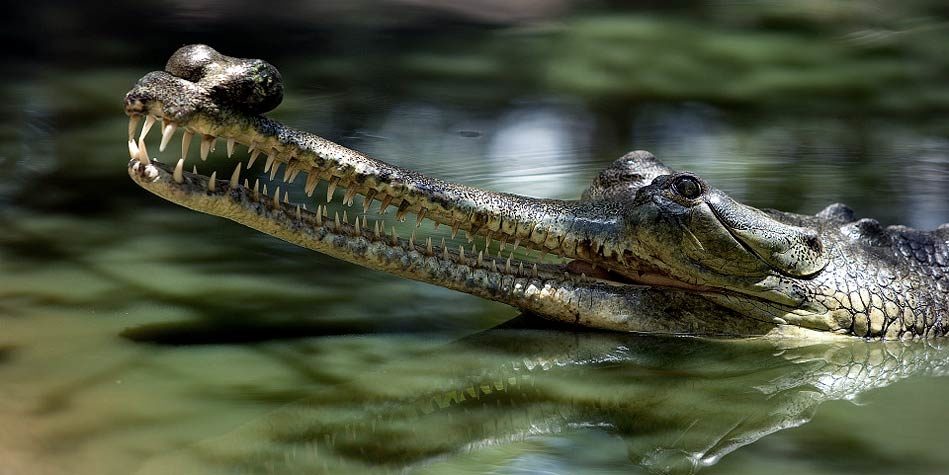
A typical gharial will reach 12 to 15 feet in length and weigh up to 2,000 pounds. Gharials do not stalk and attack at prey like other crocodilians—their snouts contain sensory cells that can detect vibrations in the water. Whereas most crocodilians have rather broad snouts, a gharial’s is so long and thin that it looks like a toothy broomstick regulating their body temperature by basking in the sun to warm up or resting in shade or water to cool down.
Comical as these jaws may seem, the slender shape is perfectly designed for snapping up the animal’s favorite food: fish. Their snout can rapidly slice through the water with minimal resistance, and its jaws are equipped with 106 to 110 needle-like teeth, which interlock when the crocodilian snaps its mouth shut—impaling any fish that happen to be between its jaws.
As it grows, their snout changes shape, and its diet evolves accordingly.

The youngsters mainly eat insects, crustaceans, and frogs since they have broader jaws than adults do. Over time, their snouts get thinner and longer and become ill-suited for snapping up the large land animals that other crocodilians tend to pursue. Although big individuals sometimes gulp down the occasional bird, reptile, or small mammal, full-grown gharials almost exclusively dine on fish.
With their specialized jaws, gharials just aren’t built to take down big land animals—including us. Attacks on people are exceptionally rare—only a handful have ever been reported, and most cases implicate either a mother gharial who was protecting her nest or an irate specimen that had gotten tangled up in somebody’s fishing net. Not one of these interactions resulted in the loss of human life.
Still, while the beasts don’t kill people, they do scavenge our cadavers. Homo sapiens remains have been found inside gharial stomachs, along with bracelets and jewelry. Corpses are regularly sent down the Ganges River as part of a Hindu funerary custom, and to the gharials that stalk these waters, lifeless bodies make for easy targets. There's another benefit to eating humans, too. Like all reptiles, they can’t chew their foods that goes into their mouth and must swallow down their meals in large chunks. In order to better process its meals, a gharial will swallow hard objects like rocks, which, within the stomach, jostle around and mash up undigested chow and might be deliberately swallowing human jewelry theoretically, for it helps them to digest real food. Technically, gharials don’t hunt humans but corpses are on the menu.

From the time the mid-1900s, the gharial's numbers have declined as much as 98% due to hunting for traditional medicine and drastic changes to their freshwater habitats. For instance, being the most aquatic of the crocodilians, gharials are found in the calmer, deep areas of fast-flowing rivers but people have manipulated the flow of rivers, causing certain areas to dry out and making it more difficult for water-reliant gharials to survive and has been classified as critically endangered.
World of Photography Beta V1.0
>Learn more here<
Thank you for participating in #animalphotography, the weekly selection will be released on Tuesday.
You have earned 5.05 XP for sharing your photo!
Daily photos: 1/2
Daily comments: 0/5
Multiplier: 1.01
Server time: 10:00:31
Total XP: 5.05/100.00
Total Photos: 1
Total comments: 0
Total contest wins: 0
Follow: @photocontests
Join the Discord channel: click!
Play and win SBD: @fairlotto
Developed and sponsored by: @juliank
thanks for the info :)