Daily Field Notes #17
Welcome to the seventeenth Daily Field Note! Here you find the top post of the day, one covering each scientific field that is included by Geopolis. Since these authors put a lot of effort in writing a good post they surely deserve the extra exposure.
Geopolis is a project to promote and connect authors who write in the fields of global sciences. Upvotes are currently worth more than $1,50 so don't hesitate to get involved or become a member for higher rewards! You can read more about the project and how to join here:
https://steemit.com/geopolis/@geopolis/geopolis-the-community-for-global-sciences-update-3
Subjects curated by Geopolis are Geography, Anthropology, Ecology, Geology, Archeology and certain branches of History.


History: 5 MILLION YEARS AGO...SHIVA'S BEAST AND OTHER SOUTH AFRICAN FOSSILS.
Let's go fossil hunting in South Africa! @highonthehog shares with us the history of the area where this excavation took place and the many peculiar ancient animals that roamed the land then. Very interesting story with great illustrations.
West Coast Fossil Park in Langebaanweg is a world-renowned fossil site dating to circa 5.2 million years ago, which is the terminal Miocene/early Pliocene period.
It is located approximately 150 km north of Cape Town and known for its exceptionally well-preserved fossil faunal remains. It is a 14-hectare area declared the National Heritage Site.
The highlight of the Park is the ‘in situ’ exhibit of an ongoing excavation, undertaken by a team of national and international researchers, in attempt to recreate unique history of fossils and the environment and climate of the west coast. 5 million years ago it had a subtropical climate, open grasslands, riverine and lush forests. Animals such African bears Sivathere (Shiva’s beast) – short necked giraffes, sabre-toothed cats, hyenas that are now extinct, were roaming freely in this area.
Geology: The Cataclysmic Floods of the Last Ice Age: Pacific Northwest
Can you imagine that not so long ago North America was partially covered in ice? Well, it happened and many remnants of that are still visible in the current landscape. You can find all the details in @keephy's well written post on the subject.
In todays world, it’s hard to imagine the far reaches of the United States being covered in ice. It was only 12,000 years ago that massive sheets of ice, known as the Last Glacial Maximum, scoured the lands of America, which spread from Washington state to New York and as far south as Illinois. The glacial landscapes left behind from these slow moving behemoths (e.g. cirque, trough valley, esker, kame, kettle lakes, etc.) are proof of their existence. However, in Washington state of the Pacific Northwest, there is a peculiar topography that left many geologists puzzled for the better part of the 20th century. This landscape is known as the Channeled Scablands.
Geography: Google Earth pearls #14: Upland farming in Ethiopia
This image might look like an innocent mountainous landscape, but it hides a much more complicated story of over exploitation and unsustainable land use. Very interesting story brought to you by @ignacepelckmans
Today's image is coming from the Ethiopian highlands. In the valleys you can see thousands of small farms in a so called 'upland permanent farming' system. It is the final stage in the expanding usage of fallows, starting with the infamous slash & burn system. The natural fallow becomes scarcer when farmers are expanding the cultivated area and in the end, they end up in a system with a lot of small farms with almost no natural vegetation left. At the top of the hills, there is no cropland. These lands are the communal grazing grounds where herdsmen guide flocks of cattle and bring them back to their farms in the evening.
Anthropology: Culture, Social life, and Sociocultural systems - Part 5: Culture includes everything - Final
It has been a while since @zest was last featured, but today he concluded his series on cultures, social life, and sociocultural systems. His last post give a more general conclusion and view on cultures an nicely ends his series.
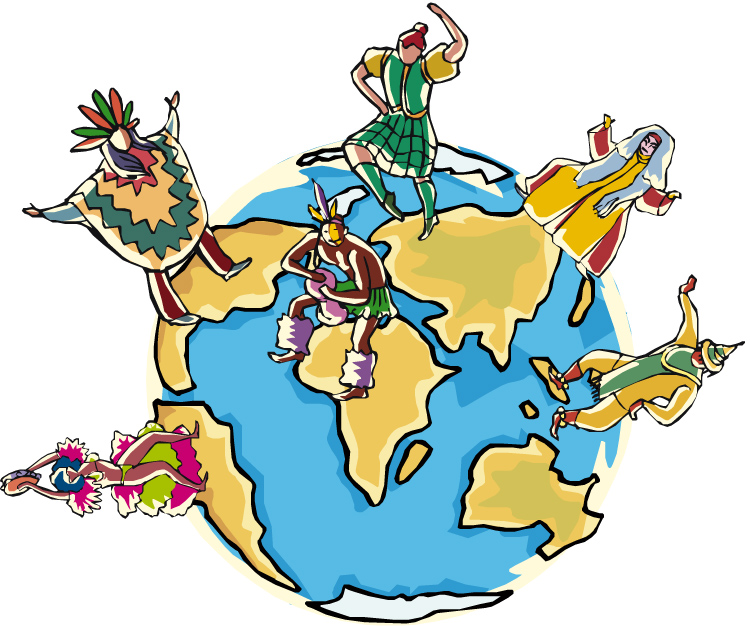
We have already understood that culture includes all aspects of human activity. The concept of culture encompasses thus so-called refined culture, "popular" culture, conventional behaviour and seemingly trivial behaviour, all human activities and endeavours.
The most important symbolic feature of culture is language. Human beings use words, to represent ideas, concepts and objects to convey meaning. Language, as symbols, makes learning and sharing experience possible and it also enables humans to transmit or convey information - sociocultural system - from generation to generation.
Ecology: Let's try to save our planet.
I've heard a lot of people talking about climate change, whether well informed or not, but only a few take actual actions. @callmekevinos takes the matter into his own hands and decided to start the reforestation of a mountain in his area. As I really appreciate that attitude I am of the opinion he really deserves a big thumbs up!
Hey my fellow steemians i hope youˋre doing very well! Today i bring you my second post, guessing that i'm starting to feel more motivated to share with this huge and nice community my experience planting some trees in a mountain near my home and bring you some info about climatic change.
I've been reading news about climatic change (surely isnˋt a myth anymore) and how does it affects humans and all of the living creatures in the planet, the continuous emissions of toxic gases into the atmosphere are increasing the global temperature called "Global Warming" it is the current increase in temperature of the Earth's surface (both land and water) as well as it's atmosphere; Average temperatures around the world have risen by 0.75°C (1.4°F) over the last 100 years about two thirds of this increase has occurred since 1975.
This was todays selection of post. Make sure to check out other authors and upvote this post to support the project!
Get involved with Geopolis on the Discord chat