Ocean worlds mission proposal
The New Frontiers - one of three mission classes, conducted by NASA, with the purpose or researching Solar System bodies from Venus to Pluto. Other classes are Discovery (simple and relative inexpensive missions) and Flagship - advanced missions with more than $1 Bn tags. New Frontiers is a middle class missions - its cost, excluding launch, must not exceed $850 Million cap. Three New Frontiers missions are active now: New Horizons (Pluto and Kuiper Belt), Juno (Jupiter poles), and OSIRIS-REx (asteroid sample delivery).
Formally, there are six candidates for launch in 2024 (New Frontiers 4):
1. Venus in-situ Explorer: lander with drill and balloon in amosphere
2. Lunar South Pole- Aitken Basin Sample Return
3. Jupiter Trojan Tour and Rendevous
4. Comet Surface Sample Return
5. Saturn Atmospheric Entry Probe
6. Titan/Enceladus Mission
Until the end of 2017, NASA will shortlist the best concepts, and final winner will be chosen in 2019. For now, we can exclude Nr 3, because it is already approved as part of the cheaper Discovey class mission - Lucy.
For me, the most interesting seems Nr. 6 - Ocean Worlds: Saturn mission with deep researces of its satellites with rich and active hydrosphere.

Image: NASA Cassini
Enceladus - icy ball, only 505 kilometers in diameter.

Image: NASA
It spills plumes of water, rich with minerals, up to several hundreds kilometers high. To explore this soup, there is no need to land - enough is to pass through the plumes and collect samples.
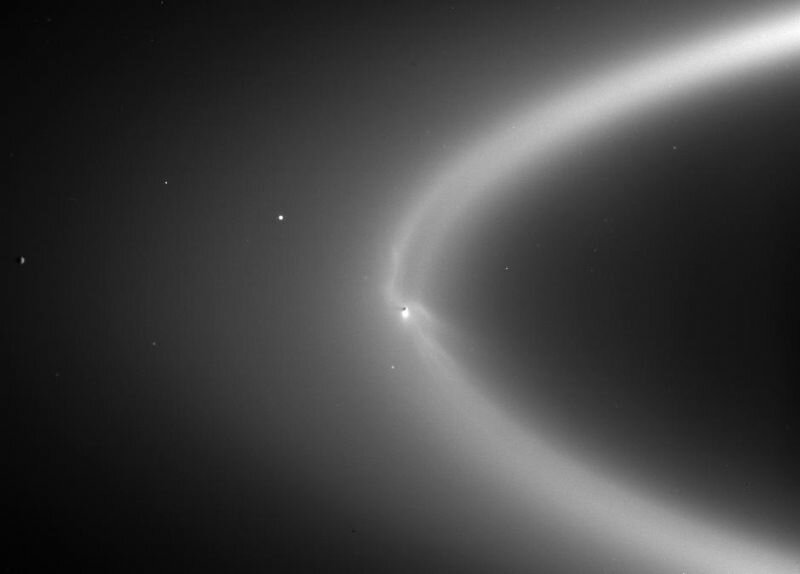
Image NASA Cassini
Unlike Enceladus, Titan has thick amosphere, and its hydrosphere, while live and active, consists not from water, but from liquid hydrocarbons. 12 years ago Huygens landed in the wet riverbed. All seas and lakes located near poles, equatorial regions occupy Great Sand Seas - vast flowing sand dunes. Titan sands consists of water ice particles.
Here is radar images of Shangri-La region: ice sand dunes flowing around rocks

Image: NASA Cassini
Northern hydrocarbon sea Ligeia Mare, second largest Titan sea has area 130 000 square kilometers. This is radar image in false colors to emphasize its features. Note river system and multople islands

Mission proposal for New Frontiers program named JET. It is orbital spacecraft with onboard laboratory for Enceladus water analysis, radar and infrared cameras for Titan detailed mapping. In 2 years mission, it will four times pass through Enceladus plumes and perform 12 Titan close flybys.

Image: JPL
Here is map of track over Titan ground during flybys with image resolutions, and scheme of Enceladus plume passages with heights.

If approved, launch is planned on 2025 with arrival at Saturn in 2030.
It is a pity there is no room for several candidates ... :(
In fact, there is! ))
N 3 - is now in another mission class and it is approved https://steemit.com/science/@busser/asteroid-robotic-missions-new-trend-in-space-exploration
Lunar South Pole - Chinese have such mission on the list
Ah I see, you have different categories. I guess this may be connected to the budget associated with each mission?
Yes! New Frontiers is middle class. There is also mission sample return from the Moon's pole in Russia, but it's very doubtful ((