JENNIFER BYRNE: Error sleuth
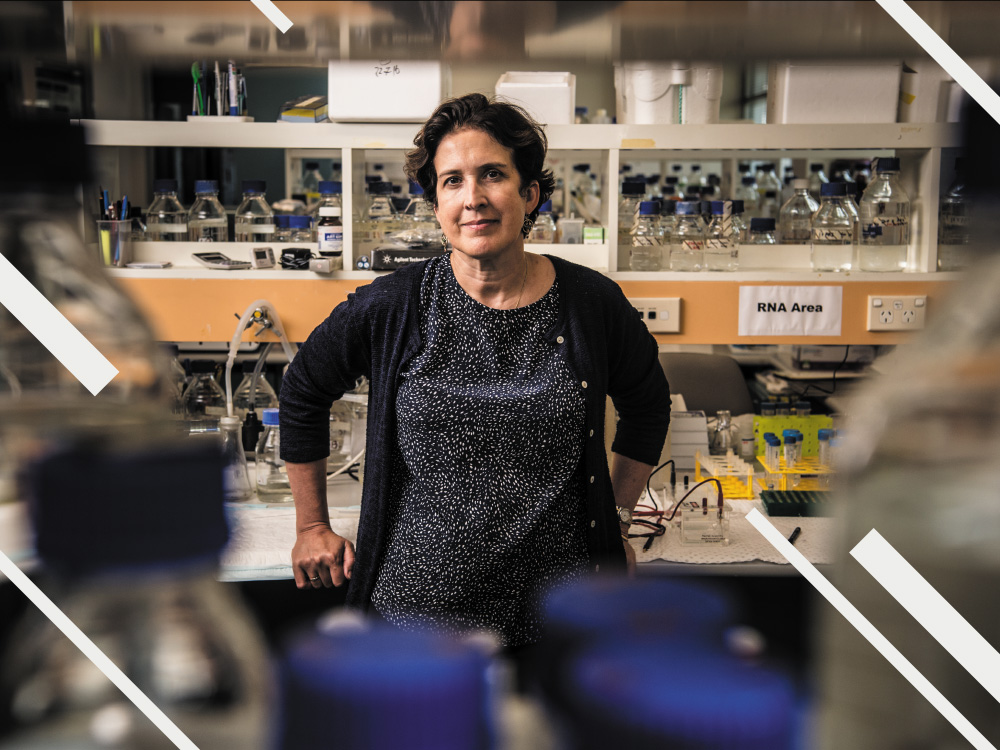
By day, Jennifer Byrne studies the genetics of cancer. But by night, she hunts for errors in genetics research papers. As her children and husband watch action movies, Byrne has spent countless evenings over the past two years on her laptop trawling the literature for flawed — and potentially fraudulent — articles. “I was doing PubMed searches hoping nobody was noticing that I wasn’t on the couch,” she says.
Byrne, who works at the Children’s Hospital at Westmead in Sydney, Australia, has so far spotted dozens of papers with DNA-sequence errors. Most of them have other suspicious features, such as poor-quality graphics and chunks of text that overlap with other manuscripts. Byrne suspects misconduct is involved in some cases, although that hasn’t been proven.
Her tenacious work is now making waves. Journals have retracted nine papers as a result of Byrne’s work — seven this year. And in October, she and French computer scientist Cyril Labbé released an online program called Seek & Blastn to help automatically detect similar problems. “When I’m on my deathbed, I’ll look back and be really proud of this work,” she says.
Byrne first discovered the patterns of errors in five papers that all mentioned a rare gene that she had studied. They all claimed to observe the effects of inactivating the gene in cancer cells, but Byrne saw that they reported the wrong DNA sequences for the experiments they claimed to conduct. Four of the papers have been retracted; neither Byrne nor Nature has heard from the editor or authors of the fifth.
Realizing that more faulty papers were out there, Byrne teamed up in 2016 with Labbé, a researcher at the University of Grenoble Alpes, France, who has experience developing software to identify junk manuscripts. The two hope that journal editors and publishers could use a refined version of the program they released this year to check manuscripts in advance of publication.
A lot of scientists despair over sloppy or fraudulent manuscripts polluting the literature, says Nick Enfield, a linguist at the University of Sydney. “But few people go to the lengths that Jenny has gone to expose them,” he says. Enfield has given Byrne research funding to hire a research assistant to help check errors in some papers. “She’s motivated by her belief that truthful publication of data is paramount,” adds gene therapist Belinda Kramer, Byrne’s colleague at the Westmead hospital’s Kids Research Institute.
Byrne says her detective work has made her realize the extent to which research is built on trust. “I used to think that science ran on brains and money. Trust is the component that’s easy to forget and take for granted,” she says.