Fukushima Japan
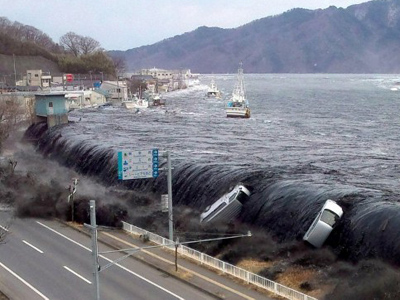
Credit:Photo from google image
a.Following a major earthquake, a 15-metre tsunami disabled the power supply and cooling of three Fukushima Daiichi reactors, causing a nuclear accident on 11 March 2011. All three cores largely melted in the first three days.
b.The accident was rated 7 on the INES scale, due to high radioactive releases over days 4 to 6, eventually a total of some 940 PBq (I-131 eq).
c.Four reactors were written off due to damage in the accident – 2719 MWe net.
d.After two weeks, the three reactors (units 1-3) were stable with water addition and by July they were being cooled with recycled water from the new treatment plant. Official 'cold shutdown condition' was announced in mid-December.
e.Apart from cooling, the basic ongoing task was to prevent release of radioactive materials, particularly in contaminated water leaked from the three units. This task became newsworthy in August 2013.
f.There have been no deaths or cases of radiation sickness from the nuclear accident, but over 100,000 people were evacuated from their homes to ensure this. Government nervousness delays the return of many.
g.Official figures show that there have been well over 1000 deaths from maintaining the evacuation, in contrast to little risk from radiation if early return had been allowed.
The Great East Japan Earthquake of magnitude 9.0 at 2.46 pm on Friday 11 March 2011 did considerable damage in the region, and the large tsunami it created caused very much more. The earthquake was centred 130 km offshore the city of Sendai in Miyagi prefecture on the eastern cost of Honshu Island (the main part of Japan), and was a rare and complex double quake giving a severe duration of about 3 minutes. An area of the seafloor extending 650 km north-south moved typically 10-20 metres horizontally. Japan moved a few metres east and the local coastline subsided half a metre. The tsunami inundated about 560 sq km and resulted in a human death toll of about 19,000 and much damage to coastal ports and towns, with over a million buildings destroyed or partly collapsed.
Eleven reactors at four nuclear power plants in the region were operating at the time and all shut down automatically when the quake hit. Subsequent inspection showed no significant damage to any from the earthquake. The operating units which shut down were Tokyo Electric Power Company's (Tepco) Fukushima Daiichi 1, 2, 3, and Fukushima Daini 1, 2, 3, 4, Tohoku's Onagawa 1, 2, 3, and Japco's Tokai, total 9377 MWe net. Fukushima Daiichi units 4, 5 & 6 were not operating at the time, but were affected. The main problem initially centred on Fukushima Daiichi units 1-3. Unit 4 became a problem on day five.
The reactors proved robust seismically, but vulnerable to the tsunami. Power, from grid or backup generators, was available to run the Residual Heat Removal (RHR) system cooling pumps at eight of the eleven units, and despite some problems they achieved 'cold shutdown' within about four days. The other three, at Fukushima Daiichi, lost power at 3.42 pm, almost an hour after the quake, when the entire site was flooded by the 15-metre tsunami. This disabled 12 of 13 back-up generators on site and also the heat exchangers for dumping reactor waste heat and decay heat to the sea. The three units lost the ability to maintain proper reactor cooling and water circulation functions. Electrical switchgear was also disabled. Thereafter, many weeks of focused work centred on restoring heat removal from the reactors and coping with overheated spent fuel ponds. This was undertaken by hundreds of Tepco employees as well as some contractors, supported by firefighting and military personnel. Some of the Tepco staff had lost homes, and even families, in the tsunami, and were initially living in temporary accommodation under great difficulties and privation, with some personal risk. A hardened emergency response centre on site was unable to be used in grappling with the situation, due to radioactive contamination.
Three Tepco employees at the Daiichi and Daini plants were killed directly by the earthquake and tsunami, but there have been no fatalities from the nuclear accident.
Among hundreds of aftershocks, an earthquake with magnitude 7.1, closer to Fukushima than the 11 March one, was experienced on 7 April, but without further damage to the plant. On 11 April a magnitude 7.1 earthquake and on 12 April a magnitude 6.3 earthquake, both with epicenter at Fukushima-Hamadori, caused no further problems.