Bitcoin News
Tax Loophole Closing For South Korean Cryptocurrency Exchanges

The South Korean government is working on taxing cryptocurrency transactions. While the media reports that up to 24.2 percent taxes will be collected this year from crypto exchanges, the regulators say that the tax rates have not been decided.
Also read: South Korean Officials Caught Trading On Insider Knowledge of Crypto Regulations
What Tax Rates Apply To Crypto Exchanges?
 The South Korean government is working on how to tax cryptocurrency exchanges. The Korea Times quoted an official of the Ministry of Strategy and Finance revealing on Monday, “Virtual money exchanges will have to pay taxes. But we have yet to decide the exact tax rates as we are in talks with the National Tax Agency.”
Yonhap, however, reported that “The government said Monday it will collect up to 24.2 percent of corporate and local income taxes from South Korea’s cryptocurrency exchanges this year.” The news outlet also quoted an official saying:
Virtual currency exchanges should pay the corporate tax on income earned last year by the end of March and the local income tax by the end of April.
Following media reports, the government posted a notice on its website quoting the Ministry of Strategy and Finance, stating, “In relation to virtual currency taxation, we are currently considering the method to secure taxation data…it has not been decided yet.”
Imposing Corporate and Income Taxes
The Korea Times explained that in South Korea:
All companies reporting more than 20 billion won have to pay 22 percent and 2.2 percent of corporate and local income taxes out of their revenues under the relevant laws. But the rules were not applied to exchanges.
However, recently the regulators emphasized that some taxes are possible under the current law, as news.Bitcoin.com previously reported.
 The crypto exchanges that will pay the most taxes are the country’s two largest exchanges, Bithumb and Kakao-backed Upbit. At the time of writing, Bithumb’s 24-hour trading volume is $3.14 billion whereas Upbit’s is $2.97 billion, according to Coinmarketcap.
In the first 7 months of last year, Bithumb reported 49.23 billion won (~USD$46.3 million) in earnings on 49.27 billion won sales. According to Yujin Investment & Securities, the exchange’s 2017 estimated earning is 317.6 billion won (~$298.5 million). Based on this estimate, Bithumb could be paying about 60 billion won in corporate and local income taxes, according to Yonhap.
Earlier this month, the Korean National Tax Service launched a tax investigation into Bithumb and Coinone. The Hankook-Ilbo described, “The government is considering ways to impose a capital gains tax on virtual currency investment returns.”
What do you think of the Korean government taxing cryptocurrency exchanges? Let us know in the comments section below.
Images courtesy of Shutterstock, the Korean government, and Bithumb.
Need to calculate your bitcoin holdings? Check our tools section.
The post Tax Loophole Closing For South Korean Cryptocurrency Exchanges appeared first on Bitcoin News.
Tezos Swiss Foundation Concept is “Old, Inflexible and Stupid”

The drama from Tezos just keeps coming. A top attorney in the cryptocurrency space, once involved with setting up the Tezos Foundation, has issued sharp cautionary notes for those who wish to dabble within the burgeoning initial coin offering (ICO) market.
Also read: Samourai Wallet Introduces Bitcoin via SMS Text Message for Censorship Resistance
Swiss foundation Old, Inflexible, Stupid
Dr. Luka Müller, partner at Switzerland and Crypto Valley based law firm MME, can be said to be that rare bird: an expert on initial coin offerings (ICOs). The firm counts among its clients Ethereum, Bancor, and the ill-fated Tezos Foundation. When he speaks, it’s probably a good idea for future ICO participants to listen.
“The Swiss foundation actually is a very old, inflexible, stupid model,” Dr. Müller told Reuters. “The foundation is not designed for operations. You as a user must be absolutely clear — and if you don’t understand it, keep your fingers away — that if you have an ether or a bitcoin, and it does not work, you have nobody to claim against,” he insisted.
 Dr. Luka Müller
If Dr. Müller appears salty, that’s to be expected in the light of Tezos’ ongoing drama, of which the Swiss foundation concept is front and center. News.Bitcoin.com reported recently of how the Tezos meltdown now includes an entire community in revolt. About two weeks before Christmas, its top board member abdicated. Weeks prior to that, The Foundation was to be tapped to pay for legal expenses stemming from its ICO lawsuits. Clearly, its strategy needs serious reevaluation.
The foundation idea is for a kind of non-profit status, and as such list investments as contributions, especially for rigorously tech-involved projects that might need incubation. Dr. Müller suggests building a corporate structure instead of a foundation umbrella for most ICOs:
“If you structure your token sale in a way that it would look like an initial public offering, then even if you launch a (blockchain) protocol, the foundation is maybe not suitable. If…the background is more an investor environment rather than a technical environment, yes, do all the registrations. If you want to sell it, if you want to be active and actively promoting it in the US, apply U.S. law.”
Foundations for Tech, Companies for Most ICOs
Tezos was able to snag a quarter billion USD during its ICO in a year that saw over 5 billion USD in ICOs overall. Switzerland alone hosted over 600 million USD in ICO projects, and so its professional financial sector is among the most experienced the world and highly sought in consultation as a result.
“Under MME’s guidelines, tokens become property with an enforceable right once the blockchain launches and the token receives a spot on the first block. Before the launch contributors have no such rights,” Reuters notes.
Dr. Müller’s foundation concept was to earmark funds expressly, protecting developers ultimately in terms of liability. “It’s a concept of a donation, from which it is clear you donate. You donate into a structure and you donate to a team and to their idea,” he explained. Without liability it’s potentially much harder to find a counterparty to hold responsible, especially in terms of lawsuit. Instead, going forward ICOs should involve themselves in Gesellschaft mit beschränkter Haftung (Gmbh), a Northern European variant on limited liability corporations, LLCs in the United States, or even an Aktiengesellschaft (AG), he recommends. An AG arrangement is basically a corporation that divvies up shares.
Experts also warn of the near impossibility of Swiss foundation models to cough up refunds should the project turn sour, an issue now being hammered out in US courts.
What do you think of ICOs? Let us know in the comments section below.
Images courtesy of Pixabay, MME, Tezos.
Not up to date on the news? Listen to This Week in Bitcoin, a podcast updated each Friday.
The post Tezos Swiss Foundation Concept is “Old, Inflexible and Stupid” appeared first on Bitcoin News.
As Blockchains Grow Bigger, Full Node Counts Increase

Back in 2016, the number of full nodes within the Bitcoin core network was dropping. At the time, Bitcoin enthusiasts thought the amount of nodes would continue to decline and the metric was used heavily in the scaling debate. However, in contrast to many people’s predictions, the count of full node BTC implementations has been rising, and over the past year, its node count is up over 106 percent.
Also read: Cryptocurrency Activities Will Be Legal and Tax Free in Belarus Starting in March
What Is a Full Node?
A full node is basically a computer that connects to a cryptocurrency’s network and downloads every single block and transaction on the blockchain. Because full nodes record the entire blockchain’s network activity in real time, they rely on both storage and bandwidth requirements. A wide variety of digital assets that utilize blockchains have participants running full nodes on networks like dash, litecoin, bitcoin cash, ethereum, and bitcoin core. There are also a lot of ‘lightweight nodes’ which do not download entire blockchains but rather verify transactions by downloading the associated block headers. One of the cheapest methods of building a full node is using a Raspberry Pi computer, and a one terabyte external drive for roughly $100 USD. There are also many businesses that sell pre-manufactured full nodes but these are usually far more expensive.
 Examples of pre-manufactured full nodes. Nodes can run on any computer that has the storage and bandwidth capacity.
 BTC Node Count Jumps to Over 11,000 Reachable Nodes In 2018
Currently, BTC has 11,703 detectable nodes that interact within that specific network. The number of nodes is never static and continually changes when participants either drop off the network or join. This metric has increased significantly over the past year, and the 12-month average has been roughly 8,643 nodes according to Bitnodes statistics.
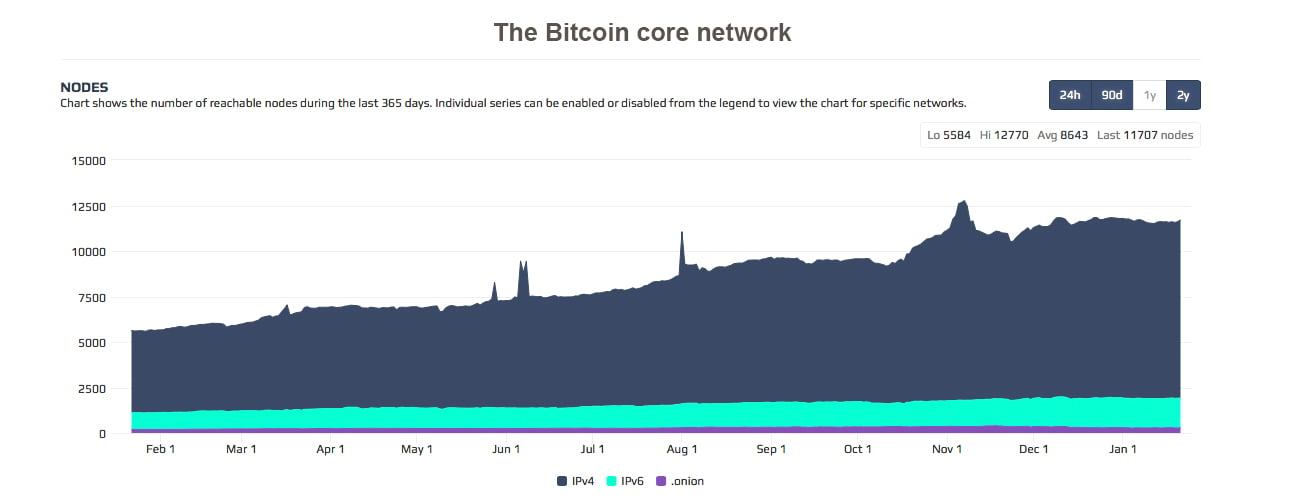 BTC node count 1 year.
 The leading countries with the most full nodes at the moment include the U.S., Germany, China, France, Netherlands, Canada, the UK, and Russia. Nodes are also operated in countries suffering from poor internet service and economic hardship such as Venezuela, Algeria, Mexico City, South Africa, Namibia, Pakistan, and Nigeria.
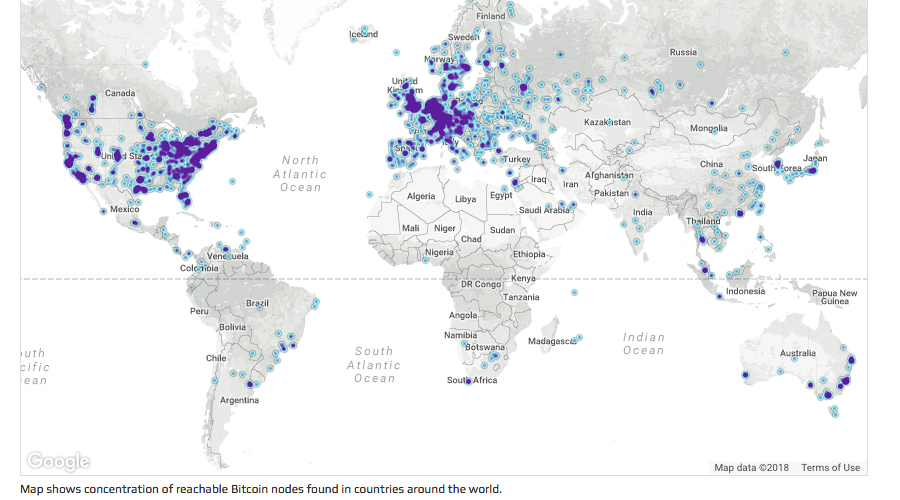 BTC node count displayed across a map of the globe showing specific concentrations of full nodes.
 Core Software and Alternative Clients
There are multiple types of different forms of the BTC software within the network. According to the data website Coin Dance, there are 9,002 nodes running the Core software, 542 Bitcoin Unlimited nodes, 294 Bitcore nodes, and nine more implementations. Even after the intense scaling debate throughout the summer and into the fall, nodes signaling for the user-activated-soft-fork (UASF), and Segwit2x (BTC1) continues to this day. A large number of bitcoin core supporters are against alternate implementations and don’t recommend using them for “serious use because it is currently difficult to determine whether they implement the consensus rules with 100 percent accuracy.”
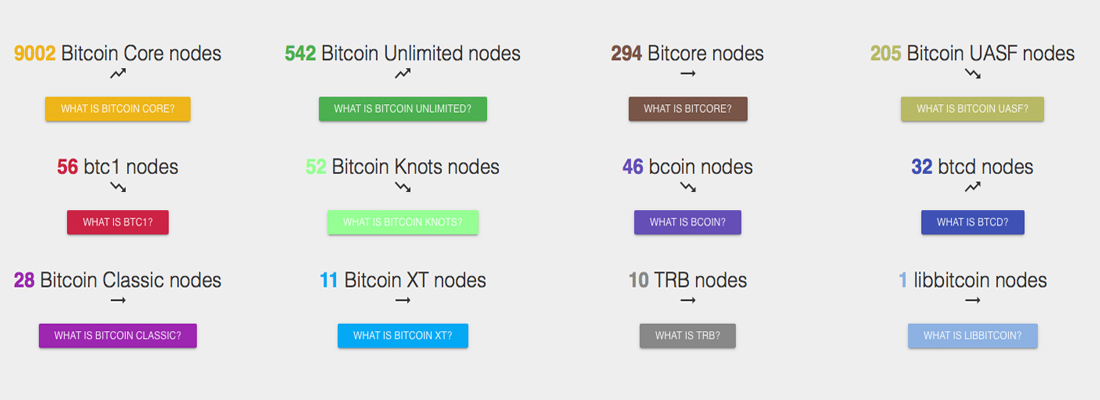 Current detectable BTC clients.
 Alternative Clients Move Towards Supporting the Bitcoin Cash Network
Another interesting trend that has taken place over the last year was the August 1 hard fork and the bitcoin cash (BCH) blockchain split. Since the inception of BCH nodes, alternative nodes on the BTC network have dropped in numbers sharply. Implementations such as Bitcoin Unlimited, XT, and others started to assist the BCH network and contribute to its node count. Currently, BCH has 1,231 nodes between four types of clients. Bitcoin ABC is the dominant client with 1,024 nodes which is followed by Unlimited, XT, and some unrecognized implementations as well. BCH supporting nodes have also increased significantly over time, and their numbers saw all-time highs throughout November and December of 2017.
 Current detectable BCH clients.
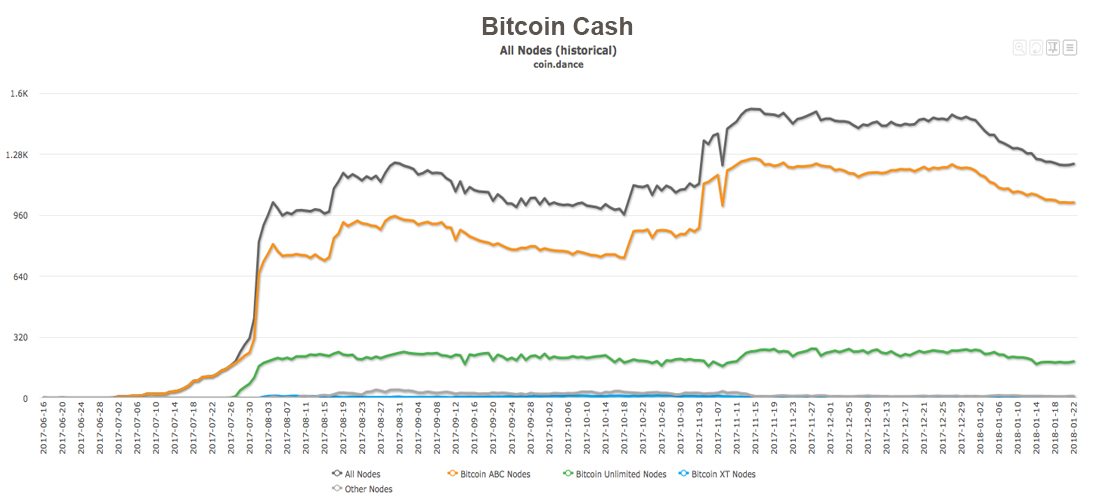 BCH node count less than 1 year.
Even Though BCH Utilizes Bigger Blocks, the BTC Chain Is Still 20 GB Larger
Overall both the BTC and BCH blockchains have grown in size as far as storage capacity is concerned. Presently the bitcoin core network adds roughly 50 GB a year to the blockchain’s size, and the BCH chain is already 8,517 blocks ahead of the core chain. Most people would think that because BCH miners process much larger blocks, a full client’s storage size would be more substantial. However, as of today, the BTC chain has grown 20.66 GB more than the BCH chain, even with BCH blocks processed at anywhere between 2-8 MB in size. A majority of network nodes within both networks are lightweight clients due to the popularity of Simplified Payment Verification (SPV) wallets. Even though SPV clients still eclipse full nodes, both BTC and BCH full network node counts continue to rise.
What do you think about the rise of full nodes? Do you think full nodes are essential for the network? And what do you think about bitcoiners who are against alternative clients? Let us know in the comments below.
Images via Shutterstock, Pixabay, Bitnodes, and Coin Dance.
Want to etch a document into the bitcoin cash blockchain? Check out our bitcoin cash powered notary service here.
The post As Blockchains Grow Bigger, Full Node Counts Increase appeared first on Bitcoin News.
Trend Analysis Reveals the Most Loved and Hated Cryptocurrencies

For investors trying to predict market movements, the more data that can be analyzed the better. Trend analysis and fundamental analysis are a starting point, but there are other clues scattered across the web which lie outwith conventional search parameters. One of these, social analysis, involves discerning the general sentiment towards cryptocurrencies on public networks such as Twitter. One bot does just that on an hourly basis, revealing which coins are feeling the love and which are receiving hate.
Also read: More than Half of Russians Know About Bitcoin Now
Social Analysis Reveals Market Sentiment
 The Watson’s Reports bot
Twitter is full of bots. While some of of them are malevolent, spamming users and spreading fake news, others are extremely nifty. Watson’s Reports is a bot that provides hourly updates on what people are saying about cryptocurrencies on Twitter. The trend analysis bot, developed by data analyst Crypto Watson, highlights the most talked about cryptocurrencies. It also analyzes the prevailing sentiment to reveal which coins have the most positive and negative mentions.
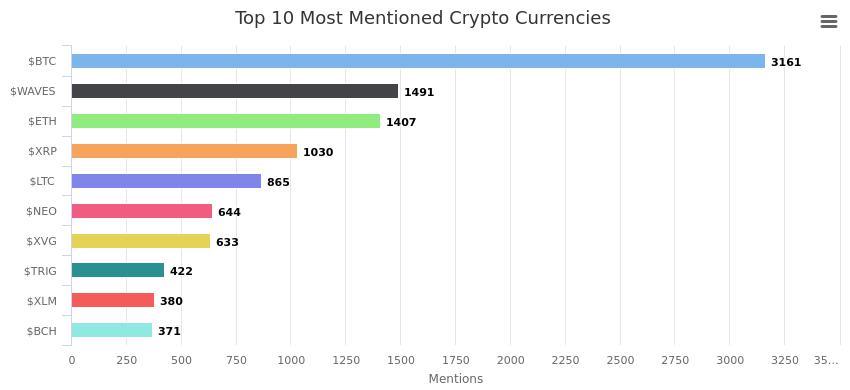
The most recent hourly at the time of publication shows bitcoin predictably out in front with over 3,000 mentions. Waves (1,491), ethereum (1,407), and ripple (1,030) follow. Below that come the likes of litecoin, neo, verge, tron, stellar, and bitcoin cash. While bitcoin invariably leads, other cryptos enter and exit the top 10 depending on whether they’re in the news. But just because someone’s talking about a cryptocurrency doesn’t mean they’re holding it or planning to invest. In fact, several of the most popular coins are also the most hated.
A research paper published in December called “Market Sentiment Helps Explain the Price of Bitcoin” examines this trend in more detail. Its author concludes:
By combining the concept of Metcalfe’s law the variation of the BTC price can be accurately explained by using a market sentiment volume about BTC that is positively scored on social networks. The assumption is that the price of BTC is predominantly a result of the demand-supply balance of buyers and sellers, which is greatly influenced by market sentiment. It is likely that market sentiment is also highly affected by the price itself, forming a circular and bidirectional reflexivity.
It’s Better to Be Hated Than Ignored
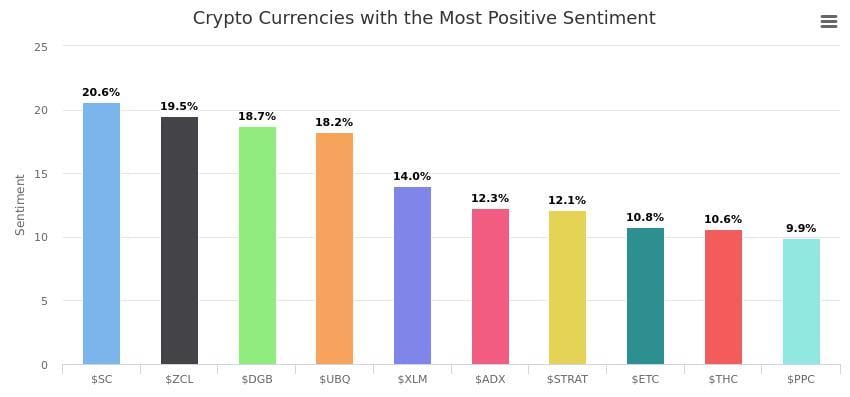
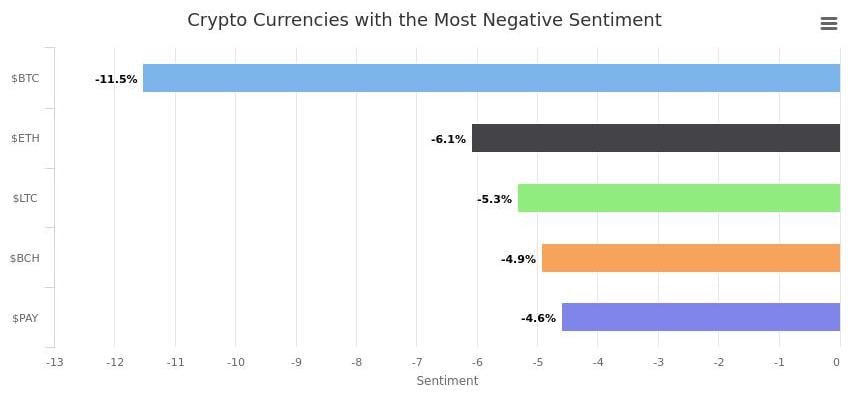
According to the Watson’s Reports bot, bitcoin has the highest amount of negative hourly sentiment (11.5%). That’s to be expected given bitcoin’s dominance; haters gonna hate after all. A look at the runners-up in the positive and negative categories reveals some interesting entrants. The most positively mentioned coins are sia (20.6%), zclassic (19.5%), and digibyte (18.7%). Ubiq and stellar complete the top five.
In terms of negativity, after bitcoin it’s ethereum (6.1%), litecoin (5.3%), bitcoin cash (4.9%), and tenx (4.6%). Because the bot updates its analysis each hour, these trends are quite dynamic, with many cryptocurrencies, save for bitcoin, regularly trading places. Whether social analysis is an arbiter of market trends is a matter for investors to agonize over.
A Whole Lotta Bots
Public databases such as Twitter, which provide gigabytes of scrapable data in real-time, are ideal for bots to trawl. Coders have developed bots to analyze an investor’s returns if they were to automatically buy and sell on the advice of Twitter traders, for example. Other bots will tweet when the buy volume for a coin suddenly increases, or in the case of Telegram bot Crypler when a coin is added to an exchange. As AI and the use of bots increases, traders will increasingly take their signals from computers. For the time being, at least, the best traders still rely on a good dose of intuition and gut instinct, attributes which no bot can detect.
Do you think social media analysis can indicate imminent price movements? Let us know in the comments section below.
Images courtesy of Shutterstock, and Watson’s Reports.
Need to calculate your bitcoin holdings? Check our tools section.
The post Trend Analysis Reveals the Most Loved and Hated Cryptocurrencies appeared first on Bitcoin News.
Your Taxes Paid for a Lot of Blockchain Surveillance Last Year

Governments worldwide have been ramping up regulations for cryptocurrencies and hiring research and blockchain surveillance teams. One firm that tracks transactions on the Bitcoin Core blockchain is called Chainalysis, and this year the company has gathered over a half a million USD on record from various government and law enforcement entities.
Also read: South Korean Exchange Korbit Stops Serving International Citizens
Public Records Show Chainalysis Is Garnering Quite a Bit of Funds from Government Agencies
 Over the course of the past year, one company has received a lot of money from government and law enforcement groups. That firm is Chainalysis, a blockchain surveillance team created in October 2014 by Jan Moller, Jonathan Levin, and Michael Gronager. Currently there’s a whole slew of teams that monitor blockchain activity, but Chainalysis has worked with nearly every U.S. government agency and is also employed by European organizations as well such as Europol. On record, the company has garnered $500,000 USD from the Department of Homeland Security (DHS), the Internal Revenue Service (IRS), Immigration and Customs Enforcement (ICE), and many more entities. The company is likely the most hired firm dedicated to following bitcoin transactions as multiple reports have disclosed many contracts and partnerships with Chainalysis over the past twelve months.
The IRS, DEA, ICE, FBI, Ficen, and Many More Government Entities Continue to Hire Chainalysis
For instance, the U.S. law enforcement agency the Federal Bureau of Investigation (FBI) have poured a lot of money into Chainalysis’s coffers. The company was hired by the IRS earlier this year, and the Drug Enforcement Agency (DEA) has paid Chainalysis this past fall. All three of these agencies have paid Chainalysis multiple times in the past as the firm has helped with investigations like the Silk Road trial and the Mt. Gox bankruptcy as well. Last year the company also disclosed in a U.S. congressional hearing that it knew the location of the missing 650,000 BTC lost during the Mt Gox demise. At the congressional hearing, the Chainalysis co-founder Jonathan Levin told a U.S. senator the firm had found the Mt Gox coins. Levin states this past June:
Chainalysis was the official investigator in the Mt. Gox bankruptcy case and the destination of those coins is definitely known.
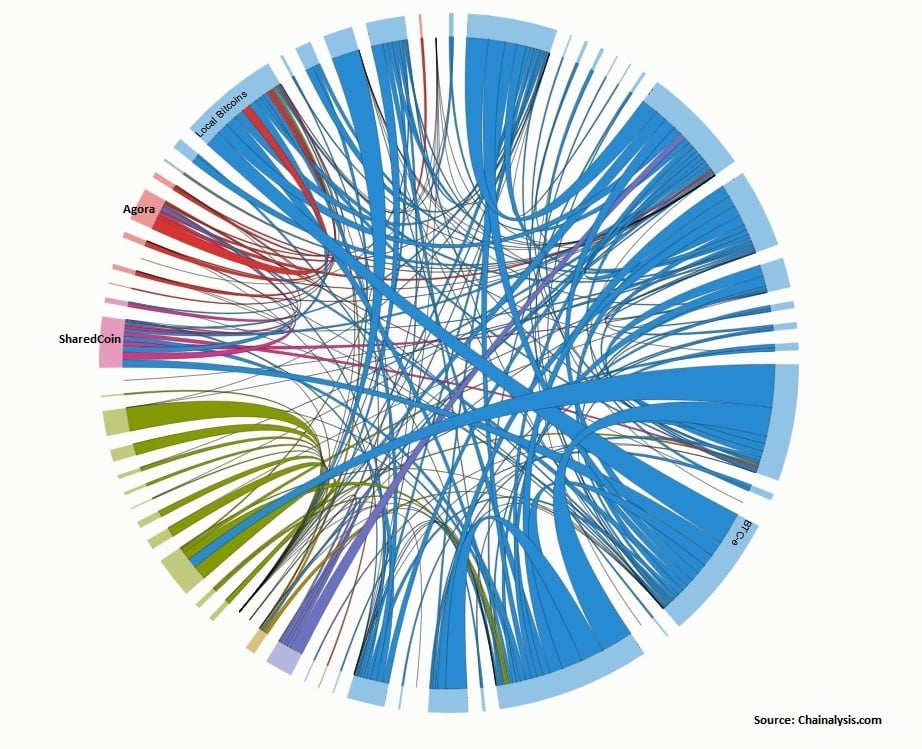 Chainalysis’ clustering algorithm for this data was intended to isolate sub-economies, and not see each individual trades (“hops”), so the number of hops between exchanges are removed, and you end up with the start and finish of a transaction, and a smooth chord that shows you where the transaction began and ended. Source: David Shares.
The Company Aims to Respect Privacy While at the Same Time Preventing Financial Abuse
Chainalysis’ website states that the company believes in cryptocurrencies and blockchain technology. However, the company was built to spot connections between digital identities and identify malicious actors. The firm’s mission statement is to create tools that respect user privacy but also prevent abuse within the financial system at the same time.
Companies that hire Chainalysis receive reports on blockchain activity that include alerts and quarterly reviews. The company helps organizations with onboarding customers and assists them by showing exactly where funds are coming from by verifying blockchain sources. Chainalysis also says they have very efficient “cyber threat intel” that can teach employees how to deal with blockchain related threats.
“Train your analysts to be able to spot emerging threats from the deep web and investigate ransomware or extortion notes in-house,” emphasizes the New York-based blockchain surveillance firm.
 This chart shows tracked bitcoins that were used in a ransomware exploit.
 Speculators Believe Chainalysis Has Gathered Millions from Government Entities Worldwide
The fact that Chainalysis is gathering a lot of clients stemming from governments and law enforcement entities is becoming more alarming to privacy advocates who believe in the future of cryptocurrencies. The public records concerning funding Chainalysis for investigation is $500,000, but that’s just in the U.S. It is estimated that this one blockchain surveillance company has received millions from governments all around the world.
What do you think about governments hiring Chainalysis to monitor the bitcoin core network and other blockchains? Let us know what you think in the comments below.
Images via Shutterstock, and Chainalysis.
Need to calculate your bitcoin holdings? Check our tools section.
The post Your Taxes Paid for a Lot of Blockchain Surveillance Last Year appeared first on Bitcoin News.
There Are At Least Twice as Many Bitcoin Traders in Brazil as Stock Investors

Bitcoin critics try to attack the cryptocurrency from all angles, but one thing no one can deny is that BTC has now completely captured the attention of the masses. According to figures in local reports, there are already more than twice as many people invested in bitcoin as those who trade stocks in Latin America’s largest economy, Brazil.
Also Read: U.S. Rating Agency to Issue Bitcoin and Cryptocurrency Grades Wednesday
Bitcoin > Stocks
 The number of bitcoin investors in Brazil has already surpassed the total number of individuals registered on the São Paulo Stock Exchange (Brasil Bolsa Balcão S.A. or B3). The country’s three biggest bitcoin exchanges – which process about 95% of all cryptocurrency transactions in Brazil – had 1.4 million registered clients in December 2017. This number is more than twice the 619,000 registered individuals in B3 at the end of last year, reports Brazil’s largest media conglomerate Globo. There may also be more Brazilian bitcoin traders who use foreign exchanges or only trade offline.
The cause of this popularity, according to the owners of these exchanges, is the massive price rally last year. “The variable that explains this is the price of bitcoin,” said Rodrigo Batista, CEO of Mercado Bitcoin (Bitcoin Market), which reached 750,000 customers in 2017, a jump of 275% in comparison to the previous year. For André Horta of Bitcoin to You, which serves 300,000 people, the fall in the profitability of other investments was another factor that attracted investors to bitcoin.
Exchanges Can’t Keep Up with Demand
 The flood of investors attracted by bitcoin brought significant growth to Brazilian exchanges, which similarly to venues all over the world greatly hampered their ability to cope with normal client service. At Mercado Bitcoin, for example, there are now 5,000 new registrations per day. A year ago, it was a maximum of 500. The result of this was an explosion in the number of complaints against the companies, according to the report.
To handle the number of investors, who are growing at almost 3.5 times from year to year, exchanges have had to strengthen their IT systems and hire more staff. Bitcoin to You has quadrupled its staff to 40 people.
With 350,000 registrations, São Paulo-based Foxbit had to suspend service to new investors in mid-December. “From one day to the next, the daily volume has gone up five times and we have not been able to meet this demand,” said Guto Schiavon, founding partner of Foxbit. From 40 people in November, the company’s staff rose to 60, and another 15 people were hired in January when the company reopened to the public.
What other factors can explain the popularity of bitcoin in Brazil? Tell us what you think in the comments section below.
Images courtesy of Shutterstock.
Do you like to research and read about Bitcoin technology? Check out Bitcoin.com’s Wiki page for an in-depth look at Bitcoin’s innovative technology and interesting history.
The post There Are At Least Twice as Many Bitcoin Traders in Brazil as Stock Investors appeared first on Bitcoin News.
Source: https://news.bitcoin.com/
This post has received a 6.63 % upvote from @moneymatchgaming thanks to: @cryptoseeds. Upvote this Post to Support the MMG Community on Steemit! :)
Sneaky Ninja Attack! You have been defended with a 1.66% vote... I was summoned by @cryptoseeds! I have done their bidding and now I will vanish...Whoosh
2.16% @pushup from @cryptoseeds