Gadgets – TechCrunch
Watch SpaceX launch NASA’s new planet-hunting satellite here
It’s almost time for SpaceX to launch NASA’s TESS, a space telescope that will search for exoplants across nearly the entire night sky. The launch has been delayed more than once already: originally scheduled for March 20, it slipped to April 16 (Monday), then some minor issues pushed it to today — at 3:51 PM Pacific time, to be precise. You can watch the launch live below.
TESS, which stands for Transiting Exoplanet Survey Satellite, is basically a giant wide-angle camera (four of them, actually) that will snap pictures of the night sky from a wide, eccentric and never before tried orbit.
The technique it will use is fundamentally the same as that employed by NASA’s long-running and highly successful Kepler mission. When distant plants pass between us and their star, it causes a momentary decrease in that star’s brightness. TESS will monitor thousands of stars simultaneously for such “transits,” watching a single section of sky for a month straight before moving on to another.
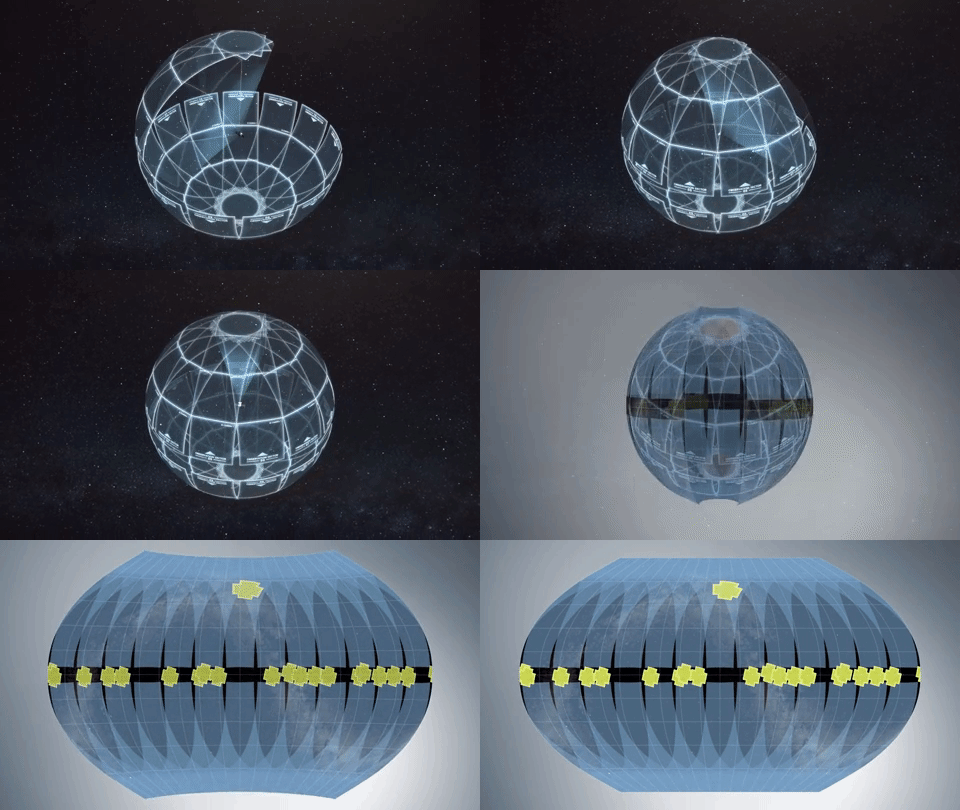 By two years, it will have imaged 85 percent of the sky — hundreds of times the area Kepler observed, and on completely different stars: brighter ones that should yield more data.
TESS, which is about the size of a small car, will launch on top of a SpaceX Falcon 9 rocket. SpaceX will attempt to recover the first stage of the rocket by having it land on a drone ship, and the nose cone will, hopefully, get a gentle parachute-assisted splashdown in the Atlantic, where it too can be retrieved.
The feed below should go live 15 minutes before launch, or at about 3:35.
EarthNow promises real-time views of the whole planet from a new satellite constellation
A new space imaging startup called EarthNow aims to provide not just pictures of the planet on demand, but real-time video anywhere a client desires. Its ambition is matched only by its pedigree: Bill Gates, Intellectual Ventures, Airbus, SoftBank and OneWeb founder Greg Wyler are all backing the play.
Its promise is a constellation of satellites that will provide video of anywhere on Earth with latency of about a second. You won’t have to wait for a satellite to come into range, or worry about leaving range; at least one will be able to view any area at any given time, so they can pass off the monitoring task to the next satellite over if necessary.
Initially aimed at “high value enterprise and government customers,” EarthNow lists things like storm monitoring, illegal fishing vessels (or even pirates), forest fires, whale tracking, watching conflicts in real time and more. Space imaging is turning into quite a crowded field — if all these constellations actually launch, anyway.
The company is in the earliest stages right now, having just been spun out from years of work by founder and CEO Russell Hannigan at Intellectual Ventures under the Invention Science Fund. Early enough, in fact, that there’s no real timeline for prototyping or testing. But it’s not just pie in the sky.
Wyler’s OneWeb connection means EarthNow will be built on a massively upgraded version of that company’s satellite platform. Details are few and far between, but the press release promises that “Each satellite is equipped with an unprecedented amount of onboard processing power, including more CPU cores than all other commercial satellites combined.”
 Presumably a large portion of that will be video processing and compression hardware, since they’ll want to minimize bandwidth and latency but don’t want to skimp on quality. Efficiency is important, too; satellites have extremely limited power, so running multiple off-the-shelf GPUs with standard compression methods probably isn’t a good idea. Real-time, continuous video from orbit (as opposed to near-real-time stills or clips) is as much a software problem as it is hardware.
Machine learning also figures in, of course: the company plans to do onboard analysis of the imagery, though to what extent isn’t clear. It really makes more sense to me to do this on the ground, but perhaps a first pass by the satellite’s hardware will help move things along.
Airbus will do its part by actually producing the satellites, in Toulouse and Florida. The release doesn’t say how many will be built, but full (and presumably redundant) Earth coverage means dozens at the least. But if they’re mass-manufactured standard goods, that should keep the price down, relatively speaking anyway.
No word on the actual amount raised by the company in January, but with the stature of the investors and the high costs involved in the industry, I can’t imagine it’s less than a few tens of millions.
Hannigan himself calls EarthNow “ambitious and unprecedented,” which could be taken as an admission of great risk, but it’s clear that the company has powerful partners and plenty of expertise; Intellectual Ventures doesn’t tend to spin something off unless it’s got something special going. Expect more specifics as the company grows, but I doubt we’ll see anything more than renders for a year or so.
GoPro launches TradeUp program to swap old cameras for discounts
GoPro is willing to take that old digital camera stuffed in your junk drawer even if it’s not a GoPro. Through a program called TradeUp, the camera company will discount the GoPro H6 Black $50 and Fusion $100 when buyers trade-in any digital camera. The company tried this last year for 60 days, but as of right now, GoPro is saying this offer does not expire.
This offer works with any digital camera, including old GoPros. It clearly addresses something we noticed years ago — there’s often little reason to buy a new GoPro because their past products were so good.
GoPro tried this in 2017 for 60 days and says 12,000 customers took advantage of the program.
The service is reminiscent of what wireless carries do to encourage smartphone owners to buy new phones. It’s a clever solution, though other options could net more money. Users could sell their camera on eBay or use other trade-in programs. Best Buy lets buyers trade-in old cameras, too, and currently gives $60 for a GoPro Hero3+ Black and $55 for a HD Hero 960.
GoPro is in a tough position, and this is clearly a plan to spur sales. The company’s stock is trading around an all-time low after a brief upswing following a report that Chinese electronic maker Xiaomi was considering buying the company. The company also recently started licensing its camera technology and trimmed its product line, while introducing a new, $200 camera.
StudioBricks is a Barcelona-based startup that sends you a studio in a box
My friend Rick is a voice-over artist and works in Ohio — right along the flight path for jets taking off and landing at the Columbus airport. As a result, he said, he had to record late at night when the airport closed, a limitation that he found exasperating.
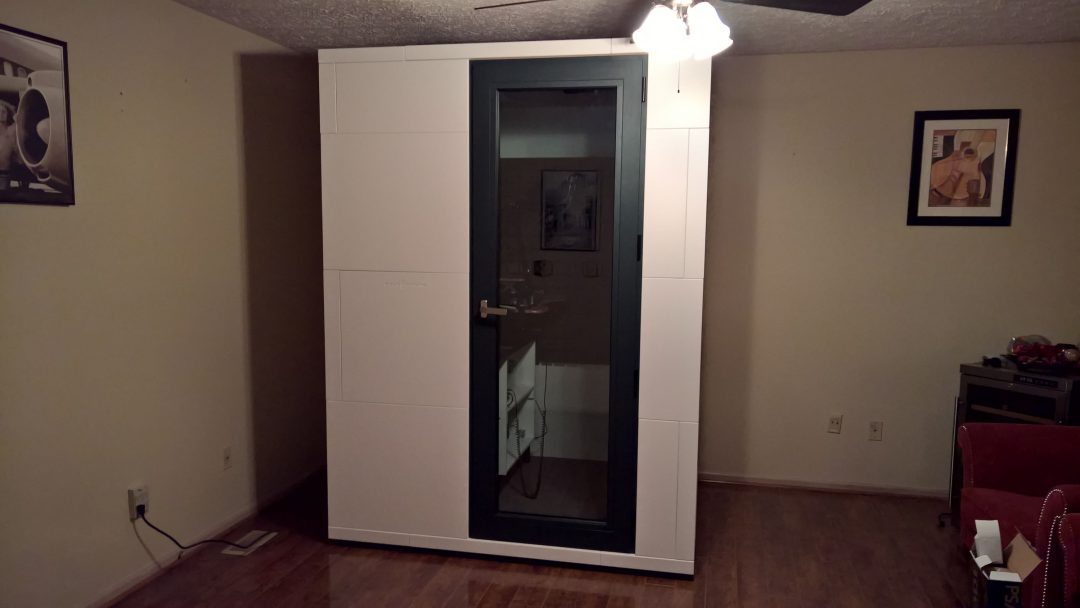
Enter StudioBricks, a cool startup from Barcelona. Founded by Guillermo Jungbauer, the small company makes and sells soundproof studios that click together like LEGO. The company started in 2008 and created a USA subsidy in 2014.
StudioBricks aren’t cheap. Rick paid $9,940 for his, including almost $2,000 in shipping. However, he said, it’s been a life-saver.
“The StudioBricks sound isolation booths are designed to be incredibly fast and easy to install without compromising the booth’s excellent sound isolating properties,” said Jungbauer. “This is achieved thanks to its modular panels, which are built of high-performance sound-isolating materials and can simply be slotted together.”
The company sold 1,053 cabins in 207 and they’re on track to keep growing.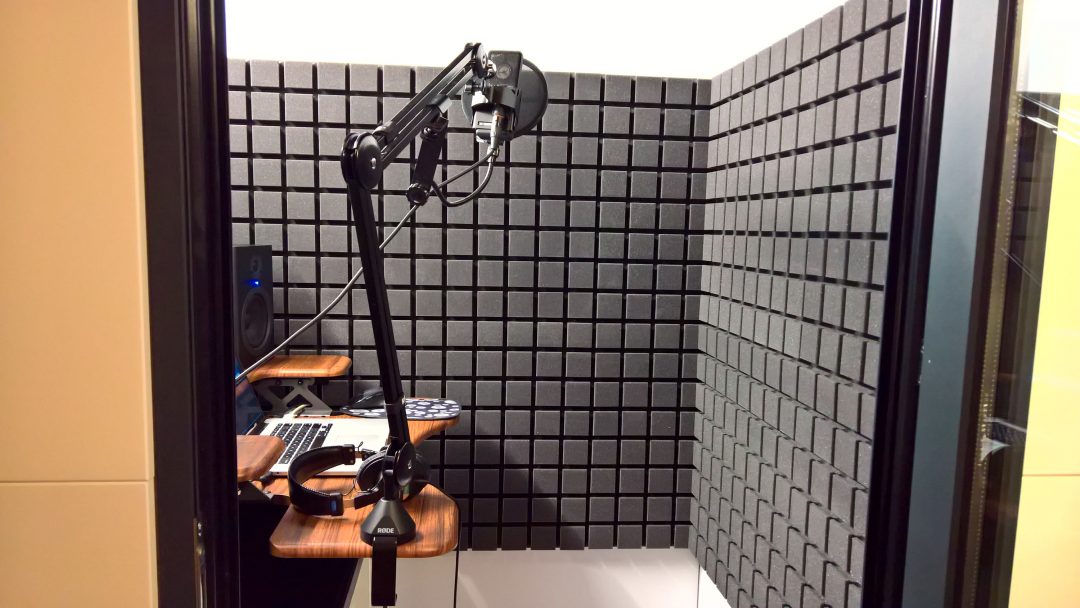
“About 10 years ago I created the first booth as rehearsal space out of my own need as a saxophonist,” said Jungbauer. “I developed the first bricks with acoustic engineers already having in mind the market possibilities.”
The system includes a ventilation system, a heavy, sound-proof door, and solid, sound-proofed wall panels. Rick, in his long build post, found it easy to build and quite effective at keeping the plane noise at bay.
“From the beginning on, StudioBricks aims to be eco-friendly. We are in a continuous process of improvement and have a strong commitment with the environment,” said Jungbauer. “That means that both on an organisational level and product level we are improving continuously our processes and product, considering the best options regarding the environment. For example, years ago we changed our lacquer to a water-based one. Our plant is the first and right now only in Spain using a biomass-based central heating boiler.”
It’s cool to see a small European company selling a niche product gain such success. Because the company solves a notoriously difficult and wildly frustrating problem they are getting all the organic traction they need to keep going. Given the rise of corporate podcasting and other recording needs, a system like StudioBricks makes perfect sense. Considering it can be put together by two people in a few hours, it is almost like the IKEA of vocal studios — compact, easy to build and incredibly useful.
And now Rick doesn’t have to worry about the Delta flight from JFK intruding on his audio book reading session. Ganar-ganar, as they say in Barcelona.
Building the Moon without leaving the London area
Hardware isn’t easy — especially if you decline to take advantage of the global manufacturing infrastructure, build everything in a flat in London and use only local labor and materials. But that’s what the creators of successful Kickstarter project Moon did, and they have no regrets.
Back in 2016, I got a pitch for the Moon, an accurate replica of our satellite around which a set of LEDs rotated, illuminating the face in perfect time with the actual phase. A cool idea, though for some reason or another I didn’t cover it, instead asking Alex du Preez, one of the creators, to hit me back later to talk about the challenges of crowdfunded, home-brewed hardware.
The project was a success, raising £145,393 — well over the £25,000 goal — and Alex and I chatted late last year while the team was wrapping up production and starting on a second run, which in fact they just recently wrapped up, as well.
It’s an interesting case study of a crowdfunded hardware project, not least because the Moon team made the unusual choice to keep everything local: from the resin casting of the moon itself to the chassis and electronics.
[gallery ids="1622869,1622870,1622871,1622872"]“At the time we wanted to make sure that we made them correctly, and that we didn’t spend a lot of our energy and money prototyping with a factory,” du Preez said. “We’ve seen a lot of Kickstarter campaigns go straight to China, to some manufacturing facility, and we were afraid we’d lose a lot of the quality of the product if we did that.”
The chief benefit, in addition to the good feeling they got by sourcing everything from no farther than the next town over, was the ability to talk directly to these people and explain or work through problems in person.
“We can just get on a train and go visit them,” du Preez said. “For instance, there’s a bent pipe which is the arm of the device — even that part alone, we worked with a pipe-bending company and went out there like three times to have conversations with the guy.”
Of course, they weren’t helpless themselves; the three people behind the project are designers and engineers who have helped launch crowdfunding campaigns before, though this one was the first they had done on their own.
“I think Oscar [Lhermitte, who led the project] probably worked two and a half or three years on this, from ideation all the way to manufacturing,” said du Preez. “He had this idea and he contacted NASA and asked for this topographical data to make the map. He came to us because he wanted some technical and engineering input.”
The decision to do it all in the U.K. wasn’t made any easier by the fact that it was a demanding piece of hardware, the team’s standards were high and. despite being a great success, $200,000 or so still isn’t a lot with which to build a unique, high-precision electronic device from scratch.
The whole operation was run out of a small apartment in London, and the team had to improvise quite a bit.
[gallery ids="1622874,1622867,1622865,1622873,1622877"]“We had this tiny little room the size of a kitchen we were producing these things out of,” du Preez recalled. “It wasn’t like a warehouse. And we were on the second floor — we’d get a delivery of like, a ton of metal, and we’d have to spend half a day hauling it up, then boxes would arrive and it would fill up the whole studio.”
They resisted the urge to get something off the shelf or ready-made from Shenzhen, choosing instead to rely on their own ingenuity (and that of nearby, puzzlingly specific artisans) to solve problems.
“One of the trickiest parts was that every single part is made with a different process,” he said. “If you want to make a piece of electronics in a plastic case,” for example a security camera or cheap Android phone, “it’s a lot quicker to develop and execute.”
Obviously the most important part to get right is the globe of the moon itself — and no one had ever made something quite like this before, so they had to figure out how to do it themselves.
“It’s quite large, so we can’t cast it in one solid piece,” du Preez explained. “It would be too heavy to ship. And it sinks — the material moves too much. So what you do is you make a mold, like a negative of the moon, and you pour the liquid inside it. And while the liquid is setting, you rotate it around, to make sure the inner surface is being coated by resin while it’s drying.”
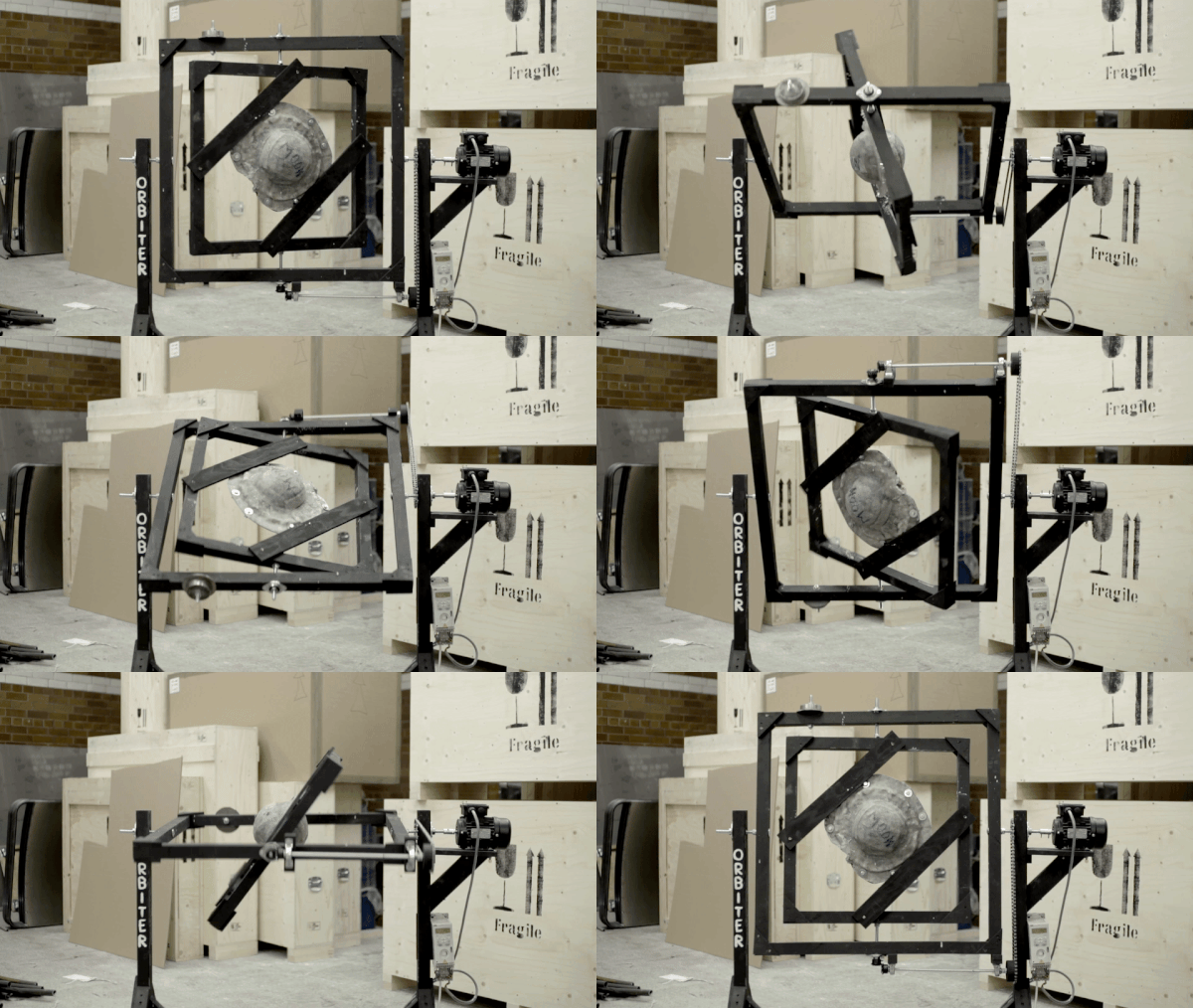 In order to do this for their prototyping stage, they jury-rigged a solution from “wood, bicycle parts, and I think a sewing machine engine,” he said. “We had to put that together on the spot to keep costs down. We kind of replicated what we knew was already out there to test our materials and concepts. We knew if we could make this work, we just had to build or find a better one.”
As luck would have it, they did find someone — right up the tracks.
“We found this guy in Birmingham who basically has an industrial version of this; he makes molds and he has this big metal cage rotating around all day,” du Preez said. “The quality of his work is amazing.” And, of course, it’s just a short train trip away — relative to a trip to Guangzhuo, anyway.
Attention to detail, especially regarding the globe, led to delays in shipping the Moon; they ended up about four months late.
Late arrivals are of course to be expected when it comes to Kickstarter projects, but du Preez said that the response of backers, both friendly and unfriendly, surprised him.
[gallery ids="1622896,1622892,1622895,1622893,1622894"]“It seemed quite binary. We had 541 backers, and I’d say only two were really pissed off about not having their moon, and they were irate. I mean they were fuming,” he said.
“But no one really got publicly angry with us. They’d just check in. Once they email you and you give them a response, they seem to be very understanding. As long as we kept the momentum going, people were okay with it.”
That said, four months late isn’t really that late. There are projects that have raised far more than Moon and were years late or never even shipped (full disclosure, I’ve backed a couple!). Du Preez offered some advice to would-be crowdfunders who want to keep the goodwill of their backers.
“It’s really important to understand your pricing, who’s going to manufacture it, all the way down to shipping. If you have no game plan for after Kickstarter you’re going to be in a tricky situation,” he said. “We had a bill of materials and priced everything out before we went to Kickstarter. And you need some kind of proof of concept to show that the product works. There are so many great hardware development platforms out there that I think that’s quite easy to do now.”
Their attention to detail and obvious pride in their work has resulted in a lasting business, du Preez told me; the company has attracted attention from Adam Savage, Mark Hamill and MOMA, while a second run of 250 has just completed and the team is looking into other projects along these lines.
You can track the team’s projects or order your own unit (though you may wish you’d gotten the early bird discount) over at the dedicated Moon website.
Watch SpaceX launch NASA’s latest exoplanet-hunting satellite
Update: SpaceX has delayed the launch to address a last-minute issue with the guidance, navigation and control (GNC) systems:
Standing down today to conduct additional GNC analysis, and teams are now working towards a targeted launch of @NASA_TESS on Wednesday, April 18.
— SpaceX (@SpaceX) April 16, 2018
SpaceX is set to launch a Falcon 9 rocket today during a 30-second window at 6:32pm EDT. On board is NASA’s Transiting Exoplanet Survey Satellite (TESS), designed to find exoplanets. SpaceX said this morning there’s an 80 percent chance of launching today. Following the launch, SpaceX will attempt to recover the Falcon 9 rocket and nose cone by landing the rocket on a drone ship and using parachutes to slow down fairings before they hit the Atlantic. SpaceX’s high-speed net boat Mr. Stevens is still in the Pacific.
The live stream is set to begin at 6:00pm EDT.
The satellite on board uses four cameras to hunt for exoplanets around stars. They measure tiny dips in a star’s brightness that could indicate a planetary body passing in front of the camera’s line of sight. This is called a transit. Mission officials have said that this satellite will likely find thousands of worlds during its two-year mission.
The Falcon 9 used in today’s mission has never been launched before, though, if it lands successfully, it reportedly will be used in a future mission. This rocket is also the final block 4 version before SpaceX starts using block 5 versions with upgraded engines and improvements to increase the reusability of the rocket.
Source: https://techcrunch.com/
This user is on the @buildawhale blacklist for one or more of the following reasons:
You got a 9.56% upvote from @redlambo courtesy of @tokenguy! Make sure to use tag #redlambo to be considered for the curation post!
This post has received a 5.17% upvote from @msp-bidbot thanks to: @tokenguy. Delegate SP to this public bot and get paid daily: 50SP, 100SP, 250SP, 500SP, 1000SP, 5000SP Don't delegate so much that you have less than 50SP left on your account.