Gadgets – TechCrunch
Waymo reportedly applies to put autonomous cars on California roads with no safety drivers
Waymo has become the second company to apply for the newly-available permit to deploy autonomous vehicles without safety drivers on some California roads, the San Francisco Chronicle reports. It would be putting its cars — well, minivans — on streets around Mountain View, where it already has an abundance of data.
The company already has driverless driverless cars in play over in Phoenix, as it showed in a few promotional videos last month. So this isn’t the first public demonstration of its confidence.
California only just made it possible to grant permits allowing autonomous vehicles without safety drivers on April 2; one other company has applied for it in addition to Waymo, but it’s unclear which. The new permit type also allows for vehicles lacking any kind of traditional manual controls, but for now the company is sticking with its modified Chrysler Pacificas. Hey, they’re practical.
The recent fatal collision of an Uber self-driving car with a pedestrian, plus another fatality in a Tesla operating in semi-autonomous mode, make this something of an awkward time to introduce vehicles to the road minus safety drivers. Of course, it must be said that both of those cars had people behind the wheel at the time of their crashes.
Assuming the permit is granted, Waymo’s vehicles will be limited to the Mountain View area, which makes sense — the company has been operating there essentially since its genesis as a research project within Google. So there should be no shortage of detail in the data, and the local authorities will be familiar with the people necessary for handling any issues like accidents, permit problems, and so on.
No details yet on what exactly the cars will be doing, or whether you’ll be able to ride in one. Be patient.
The Roadie 2 tuner ups your guitar game
The first Roadie tuner was a modern marvel. An automatic guitar tuning system, the little device connected to your phone to listen to your guitar strings and then set them to the proper tuning using an internal motor. The new model, the $129 Roadie 2, is even cooler.
I’ve been using the Roadie 2 for a few months now and I’m hooked. I was never a good player or tuner – my ear wasn’t quite right and even with tools I couldn’t get my guitars exactly in tune. Now, however, with the Roadie 2 I just place the winding end on the pegs and press a button. A quick pluck of the string and you’re tuned in seconds.
The Roadie 2 is completely self-contained and charges via USB-C. It has a built-in vibration sensor that can also asses the current string and change the tuning accordingly. The system also allows you to add multiple stringed instruments – you can set up profiles for your electrics and acoustics and even your banjo . You can also tune them to standard or even open tunings. The high-torque motor spins the pegs quickly and effortlessly and you can wind and unwind your instruments as well.
Winding and unwinding with the Roadie Tuner 2! pic.twitter.com/TfIqMb6DXx
— John Biggs (@johnbiggs) April 13, 2018
The team kickstarted the Roadie 2 last March and began shipping this year. I’ve been using it to tune my guitars since I got it and it’s worked quite well except for one unfortunate incident while winding – and overwinding – a kid’s guitar. An app included with the package lets you control the instruments and the tunings.
I know some guitarists can tune to the sound of overhead fluorescent lights and still others are OK with a quick listen to a digital tuner. I’m neither of those. The Roadie 2, then, is a godsend for those of us cursed to the never-ending torment of being really bad at guitar. At least now I can be really good at tuning.
[gallery ids="1621701,1621702,1621703,1621704"]Arcade fame turns to infamy as Billy Mitchell’s record-setting Donkey Kong score is invalidated
The record-setting score that settled the Donkey Kong arcade rivalry made famous by the documentary The King of Kong has been invalidated by Twin Galaxies, the de facto arbiter of arcade world records. What’s more, Billy Mitchell, the occasionally controversial player who set it and other record breaking scores, has been permanently banned from consideration for future records.
It’s a huge upset that calls into question decades of history. Will other similarly disputed scores get the ax? Are any old-school arcade legends safe?
Before anything, it should be noted that although this sounds like kind of a random niche issue, the classic gaming scene is huge: millions follow it closely and take it very seriously. Breaking a high score on a 30-year-old game or shaving a quarter of a second off a hotly contested time can and will be celebrated as if the player has won an Olympic medal. One can never underestimate the size or sincerity of online communities. Cheating is, of course, not tolerated.
With that said, it’s worth considering that Billy Mitchell’s case is unique. He is undoubtedly a highly skilled player and has been setting records since the ’80s. But, as anyone who watched The King of Kong will have learned, he’s also a bit shady and his Donkey Kong acumen is far from established.
The issue is simply that despite his having provided tapes of games setting certain records — including, most famously, being the first to break a million in Donkey Kong — no one has seen him play like that in person.
That may sound like a red flag, but in the speedrunning and record-setting community, a great deal of practice happens alone, in an empty arcade, or otherwise with no credible witnesses (though Twitch has changed that). You could set a world record while in the zone after getting home from work, but it doesn’t count unless it’s seen live, or a recording reviewed and verified by a neutral party. Twin Galaxies is the largest organization performing that duty, and they take it very seriously indeed.

The final score on Mitchell’s disputed tape showing in The King of Kong (the leading 1 is omitted because the digits roll over when you reach a million).
You may remember that at the end of The King of Kong, Mitchell reestablishes his supremacy over plucky local kid Steve Wiebe with a “direct capture” tape of a run scoring 1,047,200 points. There are no witnesses to this game. Shortly after this, he recorded a 1,050,200 score, also not witnessed. And just a week before being inducted into the International Video Game Hall of Fame in Iowa, he set records in both Donkey Kong (1,062,800) and Donkey Kong 2.
Now here’s where things get dicey (and nerdy).
If anyone thinks something is fishy, they can officially dispute a score and the Twin Galaxies team may choose to look into it. Jeremy Young, aka Xelnia, put together a two-part complaint on the forum back in February. In one part of it, he mentioned the suspicions some already had regarding the evidence set forth of the last and highest score Mitchell set, in a place called Boomers.
As others had already pointed out, not only are the run itself and resulting score not shown in the video, but the referee is one considered notoriously unreliable, and the timeline is unclear, among other things. Most damning, however, it is clear that when Mitchell’s confederate ostentatiously “swaps out” the Donkey Kong board (so it can be verified elsewhere) for a Donkey Kong Jr. one (which Mitchell supposedly then set a record on), both PCBs were in fact the latter.
 Twin Galaxies user Robert.F explained the differences in charming internet forum argot:
to a UN-trained train eye Dk and DKjr look the same and in fact they are vary similar, except for a few noticeable differences…the DK pcb has white text on the pcb and the Dk jr has banana yellow text printed on the board ,, the DK pcb is 1/2 digital and 1/2 Analog sound and there is a adjustment pot on the dk pcb for the Analog sound`s, The Dk Jr board is fully digital and has no Analog sound adjustment pot in the exact same position on the dkjr board, and the 3rd noticeable differences and you will see; it if you review the video carefully Dk has the same ROM socket lay out and the same number of sockets as a Dkjr pcb ,, But DKjr has one of them ROM socket empty ,,,,,,
Why perform this clumsy sleight of hand? Was it just a mistake? Why are people who point out the issue having their comments deleted from YouTube? Although suspicious, these circumstantial issues could be explained as a bit of confusion in the moment, a misspoken word in the excitement of setting a record, and so on. Fortunately, that wasn’t the extent of the evidence.
As you may know, emulators are a type of application made to run old software (like arcade games) as closely as possible to how it ran on the original hardware. MAME is by far the most complex and perhaps the best-known emulator; this amazing app can emulate everything from Donkey Kong to much more recent games with complex 3D graphics. Of course, MAME runs aren’t accepted for world records — you could easily manipulate the software or even the game data itself. Real arcade hardware is required.
But MAME isn’t perfect; there are tiny differences in how it displays graphics — things you wouldn’t notice unless you were watching a game frame by frame looking for them in particular.
Which is exactly what people started doing with Mitchell’s no-witnesses, only-on-video scores.
It turns out that the original Donkey Kong PCBs had a specific method of rendering a scene during graphics transitions called a “sliding door effect,” distinctive in the pattern of how pixels are updated. Careful inspection of Mitchell’s tapes showed not a sliding door, but instead a distinctive artifact of MAME emulation whereby the frame is rendered in chunks according to how the data is loaded from memory.
You can see the similarity in the GIFs below, provided as evidence by Young.
First is footage of an actual machine taken at 60FPS. Note the diagonal “sliding door” that reveals the scene from the top left downwards:
 Next, Mitchell’s 1,050,200 run:
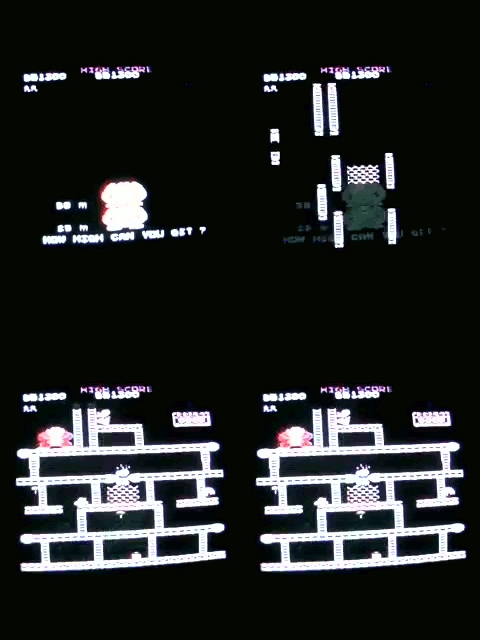 Last, how MAME renders a similar scene:
 See how the ladders come in all at once in that pattern, and there’s no sliding door? As you can tell, it’s something of a smoking gun. Certainly Twin Galaxies investigators thought so. In their conclusions, issued today on the forums, they wrote (emphasis theirs):
The taped Donkey Kong score performances of 1,047,200 (the King of Kong “tape”), 1,050,200 (the Mortgage Brokers score) that were historically used by Twin Galaxies to substantiate those scores and place them in the database were not produced by the direct feed output of an original unmodified Donkey Kong Arcade PCB.
They decline to go so far as saying they know it was MAME, but that’s a mere scruple — everyone understands it’s the most likely situation. Regardless, the very fact that Mitchell passed off non-authentic footage as real is more than enough to strike his scores and, as they also announce, ban him from further placement anywhere in the system.
Perhaps more importantly, Steve Wiebe, the underdog challenger in The King of Kong, has been elevated to become the first player to actually hit a million points in the game. Better late than never! Belated congratulations to Wiebe. (Wikipedia has already been updated.)
Update: Wiebe tells Variety: “I’m not the champ any more, but getting recognition for being the first to a million is a great consolation. That’s what I was really bummed out about 11 years ago.”
Mitchell, on the other hand, has remained out of sight during the investigation that has gone on these last few months, and has essentially been ruined for good in the arcade world. Even if he were to set a world record today (and existing record holders doubt he has the skill to do so based on reviewing his play), it would be tainted by years of proven deception. The community won’t forgive him.
And that’s the worry others are voicing: Will the investigators come for other scores that for years have been venerated but have not been verified as strictly as modern records are? Will, for example, any score without an accredited witness or reliable recording be removed from the lists?
In their decision, Twin Galaxies’ authorities write:
Twin Galaxies is dedicated to absolutely rooting out invalid scores from our historic database wherever we find them.
Our methodic approach has allowed many things to surface, not only related to this specific score, but other scores as well as some previously never-before-discussed video game related history.
We must repeat, the truth is the priority. That is the concern. Whatever it takes.
This dispute is closed, and a controversial but nevertheless legendary gaming figure covered in shame (or he should be if he has any). Who will be next? Regardless of who falls, the community will no doubt continue to thrive; the passion for these old games is undying and, as new generations have shown, is not limited to an aging cohort of Gen-Xers striving to extend a bygone era of glory (though admittedly they are a big part of it).
If this strange saga interested you anywhere near as much as it interested me, go ahead and dive in. You might find you have a new hobby. Just don’t try to fake it. And by the way, the current top score in Donkey Kong is 1,247,700, set just two months ago by Robbie Lakeman. Good luck.
Covering “Virtual Insanity” in virtual reality
A musician from Raleigh, North Carolina named Chase Holfelder, recorded a cover of Jamiroquai’s “Virtual Insanity,” a stonerific acid jazz anthem that should be familiar to ’90s kids. This version, however, is recorded entirely inside a virtual reality rig with the help of the HTC Vive and VRScout.
Holfelder used the SoundScape VR project to play and sequence the music, allowing him to snap drums with virtual drumsticks and play the piano using the Vive paddles. In all it’s a pretty exciting of Vive’s interactive elements.
There is very little real commercial utility in VR… yet. However, when artists like Holfelder fire up their rigs and make artistic stuff like this they show us the possibilities of the medium and how we might be interacting with complex systems in the future. Sadly, he did not slide across a virtual floor or wear a furry hat in this video, an oversight that sets VR research back by at least a few years.
Luminar puts its lidar tech into production through acquisitions and smart engineering
When Luminar came out of stealth last year with its built-from-scratch lidar system, it seemed to beat established players like Velodyne at their own game — but at great expense and with no capability to build at scale. After the tech proved itself on the road, however, Luminar got to work making its device better, cheaper, and able to be assembled in minutes rather than hours.
“This year for us is all about scale. Last year it took a whole day to build each unit — they were being hand assembled by optics PhDs,” said Luminar’s wunderkind founder Austin Russell. “Now we’ve got a 136,000 square foot manufacturing center and we’re down to 8 minutes a unit.”
Lest you think the company has sacrificed quality for quantity, be it known that the production unit is about 30 percent lighter and more power efficient, can see a bit further (250 meters vs 200), and detect objects with lower reflectivity (think people wearing black clothes in the dark).
The secret — to just about the whole operation, really — is the sensor. Luminar’s lidar systems, like all others, fire out a beam of light and essentially time its return. That means you need a photosensitive surface that can discern just a handful of photons.
Most photosensors, like those found in digital cameras and in other lidar systems, use a silicon-based photodetector. Silicon is well-understood, cheap, and the fabrication processes are mature.
 Luminar, however, decided to start from the ground up with its system, using an alloy called indium gallium arsenide, or InGaAs. An InGaAs-based photodetector works at a different frequency of light (1,550nm rather than ~900) and is far more efficient at capturing it. (Some physics here.)
The more light you’ve got, the better your sensor — that’s usually the rule. And so it is here; Luminar’s InGaAs sensor and a single laser emitter produced images tangibly superior to devices of a similar size and power draw, but with fewer moving parts.
The problem is that indium gallium arsenide is like the Dom Perignon of sensor substrates. It’s expensive as hell and designing for it is a highly specialized field. Luminar only got away with it by minimizing the amount of InGaAs used: only a tiny sliver of it is used where it’s needed, and they engineered around that rather than use the arrays of photodetectors found in many other lidar products. (This restriction goes hand in glove with the “fewer moving parts” and single laser method.)
Last year Luminar was working with a company called Black Forest Engineering to design these chips, and finding their paths inextricably linked (unless someone in the office wanted to volunteer to build InGaAs ASICs), Luminar bought them. The 30 employees at Black Forest, combined with the 200 hired since coming out of stealth, brings the company to 350 total.
 By bringing the designers in house and building their own custom versions of not just the photodetector but also the various chips needed to parse and pass on the signals, they brought the cost of the receiver down from tens of thousands of dollars to… three dollars.
“We’ve been able to get rid of these expensive processing chips for timing and stuff,” said Russell. “We build our own ASIC. We only take like a speck of InGaAs and put it onto the chip. And we custom fab the chips.”
“This is something people have assumed there was no way you could ever scale it for production fleets,” he continued. “Well, it turns out it doesn’t actually have to be expensive!”
Sure — all it took was a bunch of geniuses, five years, and a seven-figure budget (and I’d be surprised if the $36M in seed funding was all they had to work with). But let’s not quibble.

Quality inspection time in the clean room.
It’s all being done with a view to the long road ahead, though. Last year the company demonstrated that its systems not only worked, but worked well, even if there were only a few dozen of them at first. And they could get away with it, since as Russell put it, “What everyone has been building out so far has been essentially an autonomous test fleet. But now everyone is looking into building an actual, solidified hardware platform that can scale to real world deployment.”
Some companies took a leap of faith, like Toyota and a couple other unnamed companies, even though it might have meant temporary setbacks.
“It’s a very high barrier to entry, but also a very high barrier to exit,” Russell pointed out. “Some of our partners, they’ve had to throw out tens of thousands of miles of data and redo a huge portion of their software stack to move over to our sensor. But they knew they had to do it eventually. It’s like ripping off the band-aid.”
We’ll soon see how the industry progresses — with steady improvement but also intense anxiety and scrutiny following the fatal crash of an Uber autonomous car, it’s difficult to speculate on the near future. But Luminar seems to be looking further down the road.
DroneShield is keeping hostile UAVs away from NASCAR events
If you were hoping to get some sweet drone footage of a NASCAR race in progress, you may find your quadcopter grounded unceremoniously by a mysterious force: DroneShield is bringing its anti-drone tech to NASCAR events at the Texas Motor Speedway.
The company makes a handful of products, all aimed at detecting and safely intercepting drones that are flying where they shouldn’t. That’s a growing problem, of course, and not just at airports or Area 51. A stray drone at a major sporting event could fall and interrupt the game, or strike someone, or at a race it may even cause a major accident.
Most recently it introduced a new version of its handheld “DroneGun,” which scrambles the UAV’s signal so that it has no choice but to safely put itself down, as these devices are generally programmed to do. You can’t buy one — technically, they’re illegal — but the police sure can.
Recently DroneShield’s tech was deployed at the Commonwealth Games in Brisbane and at the Olympics in PyeongChang, and now the company has announced that it was tapped by a number of Texas authorities for the protection of stock car races.
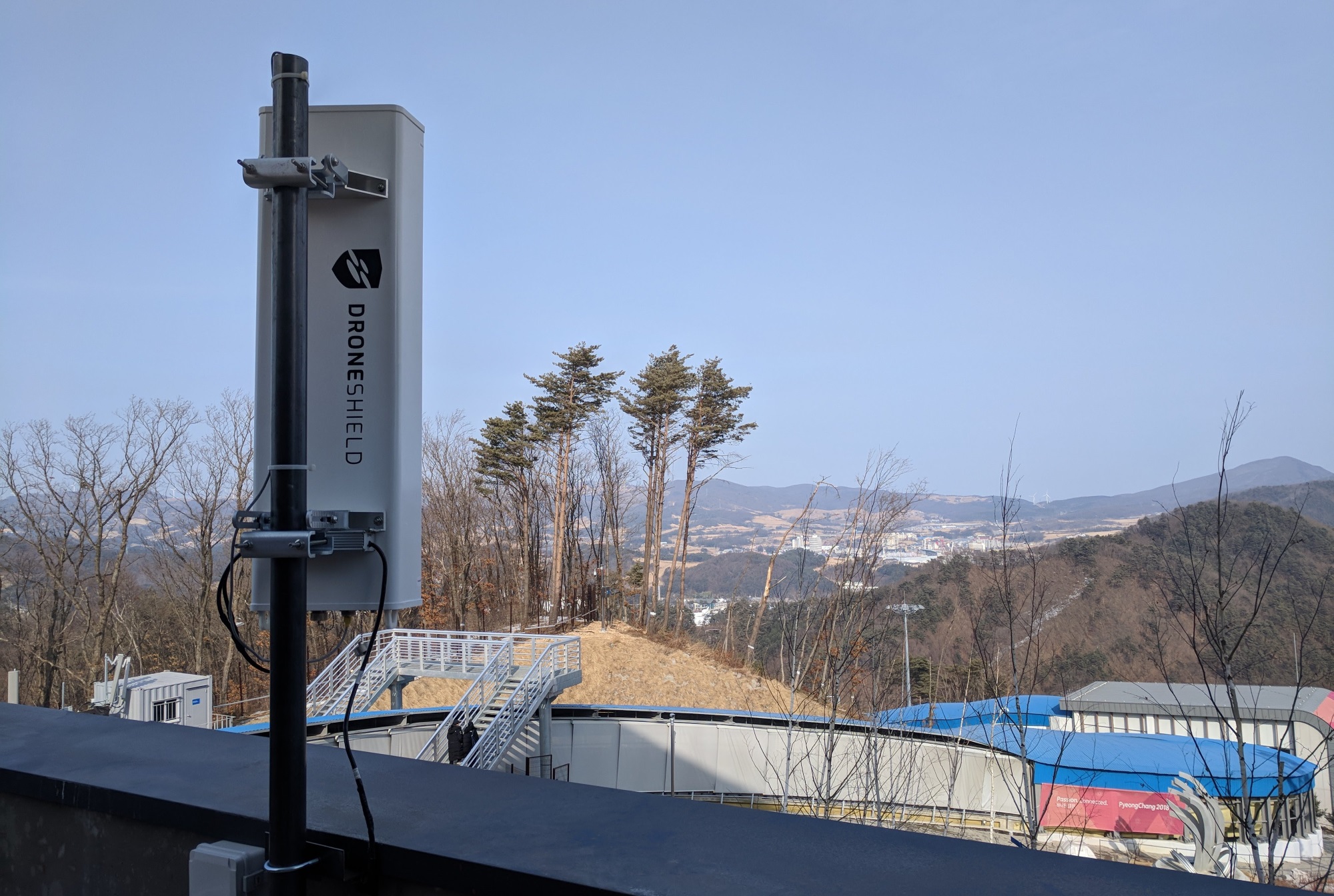
DroneShield’s systems in place in PyeongChang
“We are proud to be able to assist a high-profile event like this,” said Oleg Vornik, DroneShield’s CEO, in an email announcing the news. “We also believe that this is significant for DroneShield in that this is the first known live operational use of all three of our key products – DroneSentinel, DroneSentry and DroneGun – by U.S. law enforcement.”
It’s a big get for a company that clearly saw an opportunity in the growing drone market (in combating it, really) and executed well on it.
Source: https://techcrunch.com/
This user is on the @buildawhale blacklist for one or more of the following reasons:
You got a 100.00% upvote from @sunrawhale courtesy of @tokenguy!
This service has been created with the help of @yabapmatt so please show your support by voting for him for witness!